While water may be a right for all (Article 21 of the Constitution guarantees the right to life and also includes the right to water), not all receive water as equals.
Nall Bazar, a locality in south Mumbai’s Masjid-Dongri areas, is home to several buildings built in the early 1900s. The bazar, which opened in 1867, received its name from the fact that the main drain — or nallah — of the city flowed past this place on its way to the sluices of Varli (now called Worli).
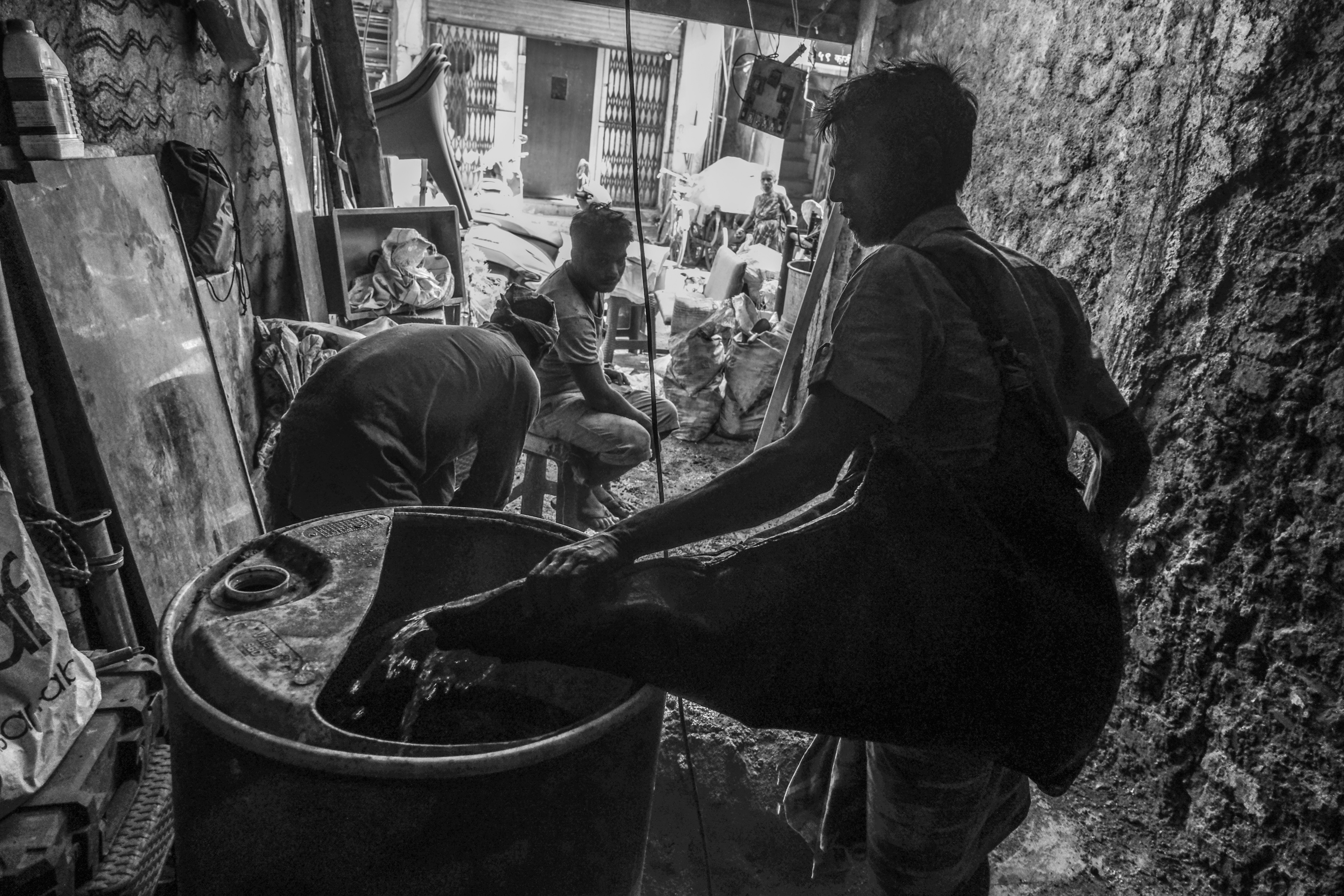
An image from Aslam Saiyad's photo exhibition, The last Bhistees, shows Manzur Alam with his mashaq (leather bag). (Aslam Saiyad)
A hundred years later, the narrow passages between these buildings still remain — these gullies, less than a foot in width, were once meant for the city sweepers to access the wastebaskets that hung down residents’ windows, and had open drains that carried away the sullage from the ground floor flats. A profusion of water pipes and water meters (hidden from view with a metal cover) can be seen outside many of these buildings, but whether or not a resident receives water throughout the day is altogether a different matter. In fact, many don’t — because the sloping, shingled roofs of their buildings aren’t designed to hold large syntax water tanks.
However, in the bustling marketplace, where one can find anything from brass betelnut crackers to packaged bottle gourd oil, water is an hourly need that must be met.
Enter the bhistis, or the water carriers who transport water from the area’s many community wells and tanks in large leather bags called mashaq.
***
Aslam Saiyad, a 45-year-old media professor and photographer (teaching mass media at Nirmala College, Kandivli), runs Go Hallu Hallu, a walking tour group, with photographer and flaneur MS Gopal.
Saiyad recalls seeing the bhistis in Ajmer, when he would visit as a child, and later in Nagpada where he studied engineering in the late 1990s-early 2000s. “The bhistis were a human pipeline, supplying water to the residents who didn’t have access to the formal pipeline network set in place,” he said. “Their presence in the city meant that the city had water, which could be transported.”
Today most of them get their water from the civic body’s water supply line, as most wells (or bunds) in the city have dried up. The biggest challenge to their livelihood is the plastic 50-litre water jar.
Saiyad started visiting Nall Bazar in December 2020, shortly after the peak of the first wave of the Covid pandemic, to take photographs that would be displayed at Confluence: Water Stories of Mumbai, a virtual exhibition by the Living Waters Museum which opened in March 2021. The museum, formed in 2017 is a digital repository of our water heritage and is now part of the Centre for Water Research at the Indian Institute of Science Education and Research, Pune.
Saiyad followed two men, Manzur Alam and Babu Nayyar, as they went about their day supplying water in mashaqs to shopkeepers and residents in the area. A few months later, Saiyad was introduced to Yunus, a mashaq repairman. Saiyad continued to photograph the bhistis even after the exhibition went up.
Saiyad, who recently showcased some of his photographs at the Rizvi College of Architecture in Bandra — this time, he also added a bioscope that viewers could peer through — took this writer on a walk through the bylanes of Nall Bazar, between the Goldeval temple and the Masjid municipal market: the bhistis' water route.
We emerged onto a main road where an anjuman (group of social activists) runs a water stall that remains open throughout the year. A silver engraved mashaq hangs over the stall, and thirsty passers-by are served water stored in large plastic vats filled from a civic pipeline. A few metres away, another mashaq, this one made of granite, occupies the footpath near the Baab-e-shohada-e-karbala, a darwaza (gateway) dedicated to the martyrs at Karbala.
The mashaq holds an important place in Shiite history: In 680 CE, the caravan of Hussain, the Prophet’s grandson, and his family and army was besieged next to the banks of river Euphrates by Caliph Yazid for eight days; they were starved and kept thirsty for the last three days of the siege, before they were massacred. In contemporary times, to ensure that no one goes thirsty, the faithful provide water to those who take part in the procession of Muharram (the mourning that marks this massacre).
While the mashaq may be well represented in stone and metal, the actual leather bag that the bhistis carry is a fast-disappearing sight in these lanes. The bhistis now tote 50-litre buckets which they empty out, bit by bit, pouring water into smaller buckets of stall owners. Yunus, the man who repaired mashaqs, no longer visits, Saiyad said. His craft just isn’t financially viable anymore.
“When I started out in December 2020, there may have been around 10 people carrying this mashaq. The rest were using handas or buckets. Now, however, there is no one left carrying this mashaq,” Saiyad said, when we visited Nall Bazar in February.
***
While water may be a right for all, not all receive water as equals.
In his 2017 book, Hydraulic City, anthropologist Nikhil Anand writes about how access to water in this city was itself a sign of what Anand called “hydraulic citizenship”.
There are different kinds of such “citizenships,” Anand writes: Residents of buildings who have access to storage tanks, slums dwellers who are guaranteed water supply by the civic body but receive it only for a few hours a day, occupants of office complexes or malls who receive water for longer hours, to name just a few.
“Like those who live in buildings, settlers share water connections with their neighbours and collectively pay the city their water dues. However, because settlers are connected to the city by a different and differentiating regime of pipes and policies, they often cannot draw on the same techno-political arrangements as those living in buildings. They are not permitted (neither legally nor logistically) the construction of large underground sumps or overhead storage tanks. Their shared connections are often much smaller, making the volume of water that arrives every day significantly more contested. Settlers are formally not allowed to extend water connections from the shared line into their homes. (…) When the water “comes,” members of each household collect and store their daily supplies separately in a dense agglomeration of water containers—drums, tubs, buckets, and vessels.”
Anand’s book is eye-opening in its depiction of how a municipal corporation allocates water to the city’s residents, including those deemed “illegal” by the authorities.
In Mumbai, thanks to a 2014 Bombay High Court judgment, water is a right for even those who live in illegal colonies or slums. The court, which was hearing a 2012 public interest litigation (PIL) filed by Pani Haq Samiti, a collective of civil society organisations and people’s movements, held that Article 21 of the Constitution, which guarantees the right to life, also included the right to water. The PIL was filed on behalf of settlers living in unauthorised slums (those constructed in Mumbai after January 1, 2000).
“As the right to life guaranteed under Article 21 of the Constitution of India includes right to food and water, the State cannot deny the water supply to a citizen on the ground that he is residing in a structure which has been illegally erected,” the court held.
Ironically, the bhistis themselves have no pipeline to call their own – many spend the nights on the footpath and use public sanitation utilities. They must rely on the old tanks of the city, at least those still in use, which hark back to an era when water was not a commodity or under the control of the civic body, but a shared resource.
Dhamini Ratnam is a senior editor in HT based in Mumbai. Her fortnightly column will focus on what Mumbai’s survival and spirit mean. You can also listen to her podcast, Gender Question, on HT Smartcast among other platforms.

 E-Paper