The southern masala recipe for the national imagination
Going by the success of the film at the box office and the feeling of pride it has invoked both regionally and nationwide, it appears that Raja Raja Chozhan now has an Indian passport.
Within a week of its opening, filmmaker Mani Ratnam’s Ponniyin Selvan-1 has become a pan-Indian blockbuster. It is also the latest film from south India to capture the national imagination. Earlier this year, SS Rajamouli repeated his success with the Bahubali franchise by mixing history and mythology in the blockbuster RRR, a Telugu epic on the lives of Alluri Sitarama Raju and Komaram Bheem, and their struggle against colonial rule and the feudal Nizams, respectively. Mani Ratnam’s film adapts Kalki Krishnamurthy’s novel that fictionalises the early years of Raja Raja Chozhan, the Chozha emperor who ruled from 985 CE to 1014 CE. Kalki was a prolific Tamil writer, journalist and freedom fighter. His novel Ponniyin Selvan was first serialised in the weekly editions of an eponymous magazine founded by him — Kalki — between 1950 and 1954. The following of the series was so huge that the magazine’s circulation crossed 70,000 copies at its peak, an unthinkable number at the time. In some ways, therefore, the success of the film in Tamil Nadu was a given. But its national appeal deserves some attention.
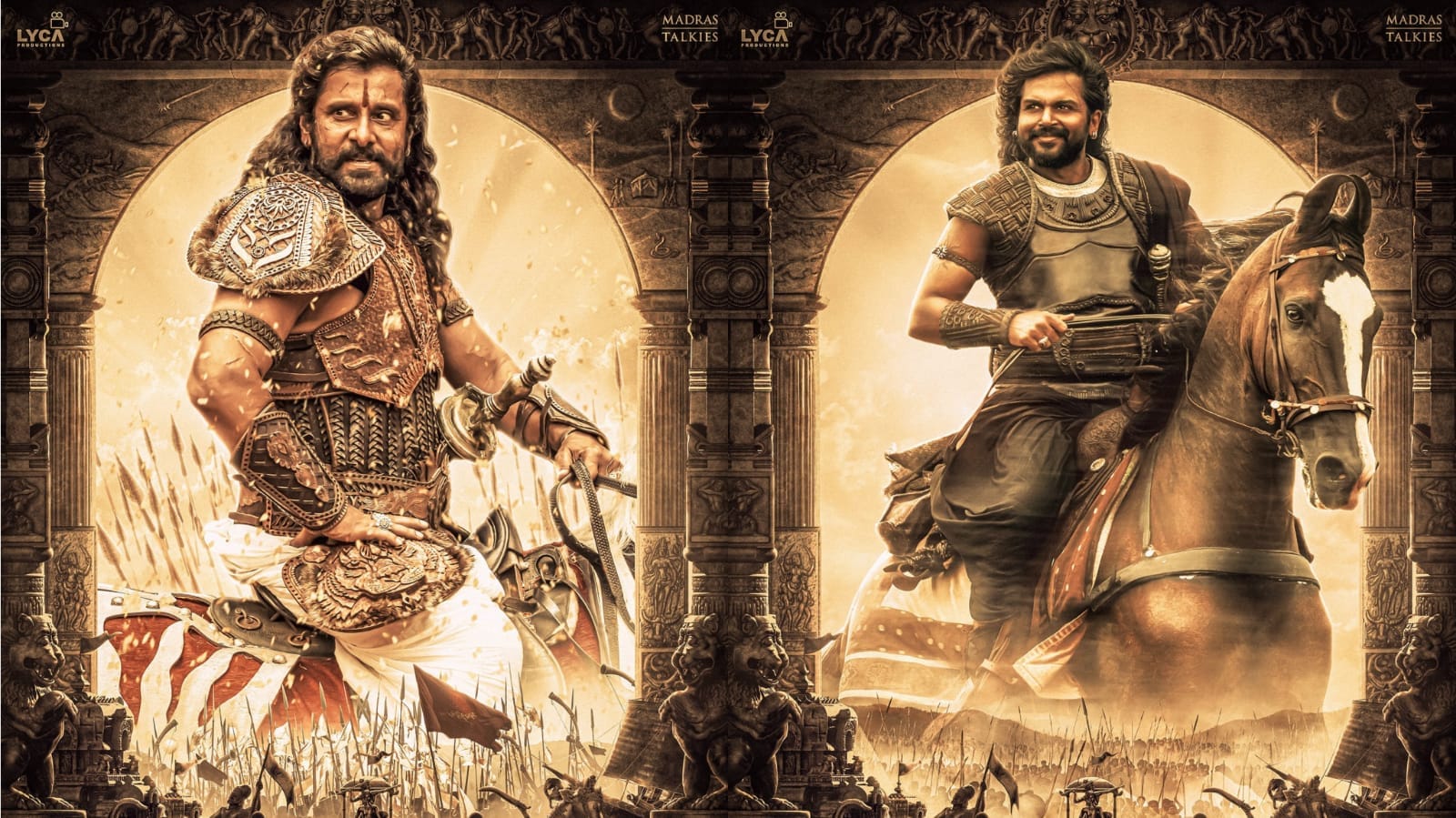
Vikram and Karthi in Mani Ratnam's Ponniyin Selvan-1.
Shortly after the film was released, a controversy broke out over whether the dynasty depicted in the film was Hindu. Speaking at an event, filmmaker Vetrimaaran cautioned against continued attempts to appropriate Tamil identities such as Raja Raja Chozhan, who belonged to the Saiva sect. However, leaders of the Bharatiya Janata Party (BJP) refuted this claim and argued that the king was indeed Hindu, while praising the film for its portrayal. In recent years, the Right-wing has tried to appropriate Tamil icons such as poet Thiruvalluvar and Raja Raja Chozhan, hoping to capture both the regional and national imagination. This is important because at least in popular culture, only two emperors have captured pan-Indian imagination in recent decades — Ashoka and Akbar — and neither were Hindus. This churn has been closely reflected in the kind of cinema Bollywood has produced.
Sanjay Leela Bhansali narrated the story of Brahmin ruler Baji Rao I in Bajirao Mastani (2015) and the Rajput ruler Ratan Singh in Padmaavat (2018). Several others took on the life of Rajput king Prithviraj Chauhan, including the recent Samrat Prithviraj (2022). Kangana Ranaut played the Brahmin ruler Rani Laxmi Bai in Manikarnika (2019).
However, these stories did not find pan-Indian appeal, forcing the Right-wing and filmmakers to resort to mythical solace. These efforts to find historical figures who can be celebrated across the Indian State forms the backdrop against which films from the south have come to play a significant role. In its promotional events, Ponniyin Selvan-1’s cast and crew aggressively equated Raja Raja Chozhan with national pride.
The film, and Kalki’s five-part novel, clearly fall under the historical pulp-fiction genre. They use historical figures and events to weave a soap-operatic fictional drama. But the makers of the film have presented it as “real history” pandering to both regional and national pride.
This is interesting because, until now, the Chozhas have never captured the pan-Indian imagination. Though their empire stretched beyond present-day Tamil Nadu and even India, they were largely perceived as a Tamil dynasty. Their legacy is also complicated. On the one hand, they are remembered for their exceptional art, architectural and administrative interventions. But, on the other hand, anti-caste thinkers have pointed to the Brahmin class wielding great control over the rulers. Despite this, Dravida Munnetra Kazhagam leader M Karunanidhi found it necessary to stake a claim on Chozha history and interpret the rule of Raja Raja Chozhan as a period of Tamil renaissance for art and culture, besides governance. To emphasise this, in 2010, the state government celebrated the 1,000th year of the Brihadeeswarar Temple at Thanjavur. It now appears that the BJP is attempting to appropriate the Chozha legacy by recasting him as a Hindu king. As a Tamil king, his appeal remained limited to Dravidian, Tamil nationalist politics but as a Hindu ruler, he can be projected as a nationalist Hindu icon.
Mani Ratnam, who captured the national imagination through films such as Roja (1992), Bombay (1995) and Dil Se (1998) — which dealt with the Kashmir militancy, Bombay riots and Assam separatist movements, respectively — has attempted to do the same with Ponniyin Selvan-1. And going by the success of the film at the box office and the feeling of pride it has invoked both regionally and nationwide, it appears that Raja Raja Chozhan now has an Indian passport.
Rajesh Rajamani is a Chennai- based filmmaker and writer

 E-Paper