Ukraine crisis: India's moment to endorse multipolarity
Today, no country is bigger than the system. Active support and cooperation among nations is a pre-condition, as the international system becomes increasingly interdependent.
Multipolarity is the state in international relations in which no one or two countries dominate world politics. Rather, many countries come together to deliberate on important global issues. In such a setup, power and influence are effectively concentrated in many hands, across the world. It is often considered an effective system to ensure that the international order is not abused by any one country in particular.
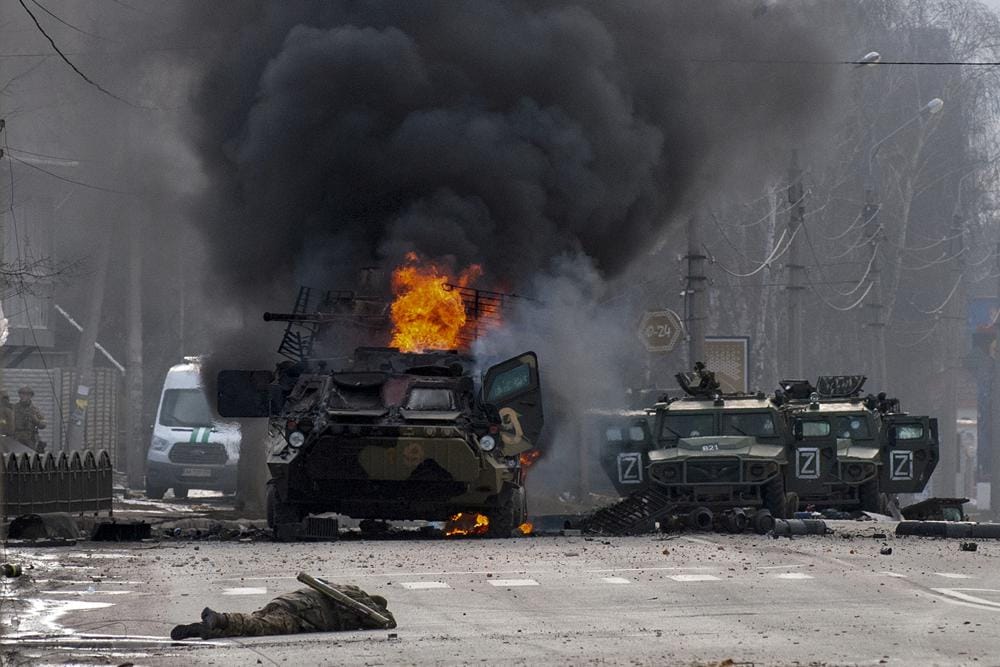
In the Ukraine crisis, the support to either party is given with a cautious cost-benefit analysis of the relative strategic gains. (AP Photo/Marienko Andrew)
India has been a votary of a multipolar, rules-based democratic world order. Its diplomatic history is a testament to the belief that a just and democratic international order is in the interest of every nation. The Covid-19 pandemic and the Russia-Ukraine crisis have, in their own ways, underlined the importance of multipolarity — instead of a minuscule minority of elite nations — to mitigate crises through broad-based cooperation and consultations.
Prime Minister Narendra Modi’s recent tour of Europe and the warm welcome extended to him by a host of European countries can be seen as ushering in a new era of multipolarity in the world order. That India can be a steady force in this era of world politics, is a potential being recognised by other countries.
In the coming months, multipolarity will become the operative term and Asian matters will come to the forefront, after being briefly eclipsed by the Ukraine crisis. With the Quad Summit held on May 24, the BRICS Summit on June 23-24, and the G7 Summit on June 26-28, for which India is also invited, Asiaa matters will likely be a key focus.
The reason for this is clear: The locus of international relations has shifted away from the transatlantic region to the Indo-Pacific. Though the Ukraine crisis has kept the world concentrated on Europe, this is bound to change. In this context, India's participation in Quad and BRICS — two seemingly opposite groups comprising the United States (US) and China along with Russia respectively — is a diplomatic tightrope, and the diplomatic deftness of India will be tested because of India's stance on the Ukraine war, and its historical dependence on Russia for its defence requirements. But why do the delicate tightrope walk at all?
International relations have always been conducted with an acute sense of the awareness of domestic compulsions and national interests. For every country, national interest is often the guiding principle that forms international ties and alignments. In the Ukraine crisis as well, the support to either party is given with a cautious cost-benefit analysis of the relative strategic gains.
The US and Europe see it as the moment to, once and for all, reduce Russia's power in the international order. China sees it as testing waters for its Taiwanese adventure and the US’s resolve to protect its allies. The situation in Europe and Japan is far more complex, as they have not completely done away with the Russian oil. If anything, it is a grim reminder of their national interests preceding their moral considerations. Therefore, if other countries are being asked to pick a side by those who have not quite picked a side themselves, it is all but a cruel joke.
India has, however, articulated its position on Ukraine and has communicated it in no uncertain terms. India has called for equal treatment regarding the imposition of economic sanctions on Russia and Russian entities against the background of European and Japanese purchases of Russian oil in comparison to India. This issue became clearer with two separate visits, one by deputy national security adviser to Joe Biden, Daleep Singh, to India, and the other by external affairs minister S Jaishankar to the US, where Jaishankar laid out the Indian position clearly and effectively, focusing both on the humanitarian crisis in Ukraine and India's dependence on Russia without conflating the two issues.
Beyond Ukraine, the issue with Afghanistan is also clear. Proximity in international affairs matters and this area is as proximate to India as it can be. The spillover effect of the US's unilateral exit from Afghanistan and the takeover by the Taliban, coupled with the volatile relations at the Indo-Chinese border, cannot be overlooked in the South Asian region. The superimposition of multipolarity is also informed by the fact that we can choose our friends, but we cannot choose our neighbours.
In the Russia-Ukraine crisis, the Indian position has been consistently on the side of peaceful resolution of the dispute, cessation of all kinds of violence, and adherence to international rules. PM Modi also telephoned leaders of both countries to end the hostilities. It can be argued that the Ukraine crisis could have taken the world back to the Cold War days when countries were asked to pick sides. However, by resisting choosing sides like India has, focusing on national interest while rooting for international peace, the "bloc mentality" has been resisted.
This brings us to the question of multipolarity in the world today, where increasing interdependence among nations has reduced the chances of exclusive groups. This multipolarity is not only India’s posture of choice, but it is being exercised by other countries as well.
Take the US, for example. It could have become the lone ranger in the Western Pacific Ocean bordering the Indian Ocean region in the bygone era, but it seems unlikely now, especially after its actions in Afghanistan and Iraq, and the shock of the Covid-19 pandemic. That the US needs like-minded democratic countries like India, Australia, and Japan — and hence, the resurrection of Quad — to create a rules-based free and open Indo-Pacific can be interpreted as the moment of multipolarity in the US context.
In the case of China and Russia as well, going alone is increasingly looking unlikely, especially with Covid-19 and the grim situation in Ukraine after more than 100 days of aggression, with no clear end in sight. International pressure is bound to rise for Russia. With crippling sanctions, the clock will set its economy backwards and general development.
Today, no country is bigger than the system. Active support and cooperation among nations is a pre-condition, as the international system becomes increasingly interdependent. Since multiple countries have a say in global decision-making, the rules-based democratic international order is the only solution to the present predicament.
In this context, Indian advocacy of multipolarity with one eye set on its national interest is a practical policy orientation. And when PM Modi goes to these summits, he will be symbolising this thrust of multi-alignments without antagonism.
Amritpal Kaur is a doctoral scholar at Jawaharlal Nehru University and contributing fellow at the Centre for Integrated and Holistic Studies, New Delhi

 E-Paper