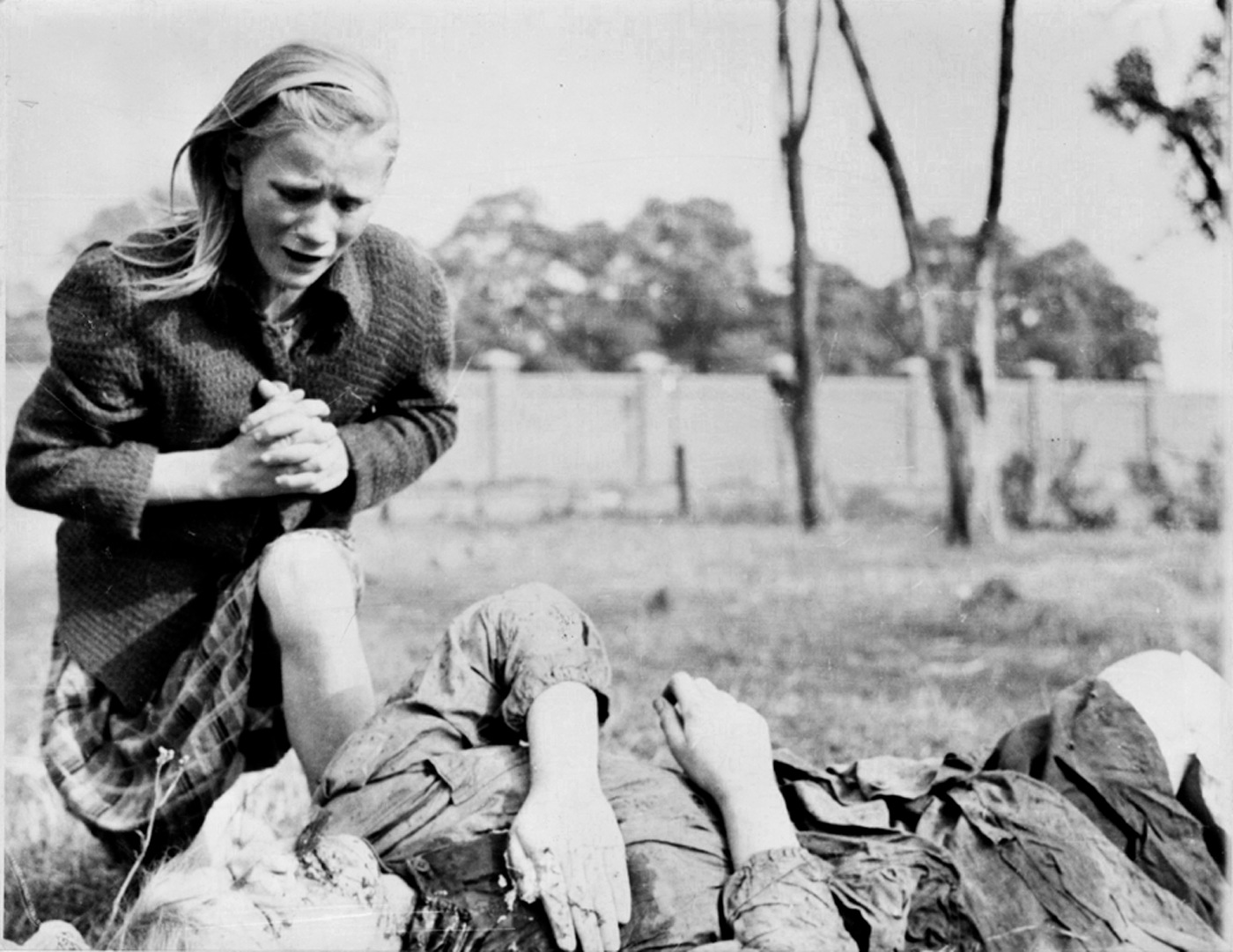
Some crimes can never be forgotten or fully forgiven. Not all western European countries understand the scale of the tragedy that Poland saw during World War II (WWII). From a western perspective, the war was a series of battles, troop movements and political decisions. For Poland, it was a set of crimes, atrocities and destruction, and lost opportunities for development.
Julien Bryan captured a 12-year-old Polish girl grieving over the body of her sister, whom a German soldier shot. Millions of such children in Poland mourned their family and friends. (Wikimedia Commons)
From the beginning, WWII was a cold-blooded crime planned with the goal of physical elimination and destruction of countries. But in eastern Europe, the situation was far worse. Although it is hard to imagine, three generations ago, Nazi Germany denied Poles the right to live. The Germans regarded us as a race of enslaved people on whom crimes and experiments could be carried out with impunity. Racial prejudice, a sense of superiority and the colonial ambitions of the Third Reich led to the greatest tragedy in the history of Poland.
Poland is still reeling from the effects of the war today. And it will continue to struggle with them even after the last eyewitnesses of that inhumane time are gone.
According to the German Generalplan Ost, Poles were to be mostly exterminated, and the small portion left alive was to be used as slaves. This criminal plan was implemented from the first days of WWII. Even the first bombs, which fell on Poland at 4:40 am on September 1, 1939, were not aimed at military facilities, but a hospital and residential buildings in Wieluń. The Germans dropped 380 bombs, weighing around 46 tonnes, on the quiet town. It was genocide.
As early as the first days of the war, the Wehrmacht and auxiliary units, consisting of ordinary Germans, burned defenceless children and women alive.
In a famous photo from 1939, American photographer Julien Bryan captured a 12-year-old Polish girl, Kazimiera Kostewicz, grieving over the body of her sister, Anna, whom a German soldier shot. Millions of such children in Poland mourned their parents, siblings, and friends.
The reality of Poland under German occupation consisted of massacres of civilians, massive looting of Polish property, and the theft of more than 500,000 paintings and sculptures. The criminal acts of violence were planned in detail and had names: Intelligenzaktion, Sonderaktion or Außerordentliche Befriedungsaktion. These were all organised operations that the Germans directed against the elite of the Polish nation — professors, lawyers, doctors, engineers, teachers and architects. In Operation Tannenberg, the Germans murdered some 55,000 Polish citizens. During the six years, more than 5.2 million Polish citizens were murdered, and the population was reduced by about 12 million. By the end of the war, Poland had a ruined economy, destroyed industry, and its cities were razed to the ground.
And what happened to those who waged terror in Poland? They became local elites in post-war West Germany, and lived in affluence, avoiding any responsibility for the crimes they committed. For example, Heinz Reinefarth, one of the executioners of the Warsaw Uprising, became mayor of the town of Westerland on the famous island of Sylt, and later became a member of the Landtag in Schleswig-Holstein.
That is why today we raise the issue of reparations, the issue of compensation for German crimes against the Polish people and citizens. Furthermore, we have prepared the report on the losses suffered by Poland due to German aggression and occupation during WWII 1939-1945. This three-volume report is a result of more than four years of work by experts. It is an account of Poland’s stolen future.
The lesson we should learn from WWII is that crimes that go unremembered, unnamed, unjudged and unpunished can only be a harbinger of more. The war crimes unleashed today on the Ukrainian people by the Russian forces only corroborate this fact. Today’s barbarians must know they will not escape responsibility for their genocide, destruction and looting.
Germany has taken the position that the subject of war reparations was settled long ago. Yet recently, it compensated the Herero and Nama ethnic groups for the genocide in Namibia over a century ago. After almost 50 years, Germany also agreed to pay reparations to the families of victims of the terrorist attacks on Israeli athletes during the Munich Olympics. It doesn’t matter whether 10, 50 or 100 years have passed since the crimes. What matters is whether they have been truly accounted for.
The victims of Germany’s totalitarian war machine deserve the same respect and remembrance as the victims of colonialism or terrorism. The unimaginable scale of the destruction inflicted on Poland between 1939 and 1945 makes reparations for losses a process that stretches over the years.
In an existential sense, these losses cannot be valued or compensated. After all, who can estimate the price of human life? This is where only history can judge the perpetrators. However, there is also the responsibility of societies and States. This responsibility can be measured and counted. We believe this responsibility for the wrongs committed is the foundation for building a shared future between nations. The only path that leads us forward is the path of truth. I hope that this is the path we are embarking on. I hope we can close one of the darkest chapters in the history of Poland, Europe and the world.

 E-Paper