
 E-Paper



Photos: Haitians abandon forgotten town, isolated for over a decade
A forgotten village in southeast Haiti, cut off from its own country, is slowly emptying as its residents leave for the neighboring Dominican Republic. Without health services, electricity, or paved roads, Boucan Ferdinand lost its only road to the nearest Haitian town, Bois Negresse, in devastating floods back in 2004. Those who remain live in thatch and stick hovels, collecting rainwater to drink and at constant risk of infectious diseases.
Updated on: Jan 14, 2019 10:12 AM IST


Share via


Copy link

1/12

 View Photos in a new improved layout
Published on Jan 14, 2019 10:12 AM
A man rides a motorbike across the trail that connects Boucan Ferdinand with the border between Haiti and Dominican Republic. Near the bottom of the island of Hispaniola in southeast Haiti is this forgotten village, cut off from its own country, and slowly emptying as its residents leave for the neighbouring Dominican Republic. (Andres Martinez Casares / REUTERS)
2/12
 View Photos in a new improved layout
Published on Jan 14, 2019 10:12 AM
Girls and a woman harvest corn in a field. Without health services, electricity, or paved roads, Boucan Ferdinand lost its only road to the nearest town, Bois Negresse, in devastating floods back in 2004. Some residents have left for Port-au-Prince, others cling on to a precarious life. Many have crossed illegally into the more prosperous Dominican Republic. (Andres Martinez Casares / REUTERS)
3/12
 View Photos in a new improved layout
Published on Jan 14, 2019 10:12 AM
“They do not have access to basic social services, this situation is at the root of the mass migration to the Dominican Republic,” said Jean Gilles Viola, mayor of the municipality that governs Boucan Ferdinand and around 20 other villages. Those who remain live in thatch and stick hovels, collecting rainwater to drink and at constant risk of infectious diseases. (Andres Martinez Casares / REUTERS)
4/12
 View Photos in a new improved layout
Published on Jan 14, 2019 10:12 AM
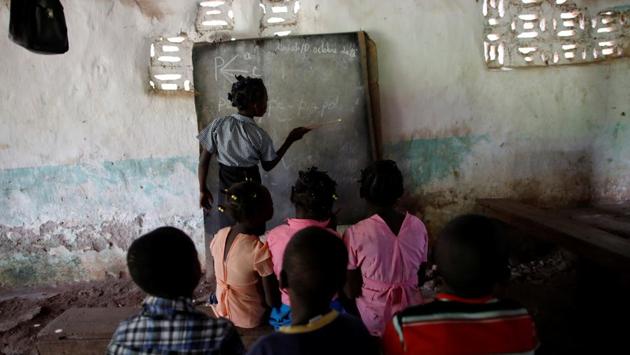
Children attend a class at the school at a Baptist church in Boucan Ferdinand. Some children, in impeccable blue uniforms, walk to a school in the town of Chapotin - a trip that takes an hour and a half over a narrow path, impassable in the rainy season. In the village are two makeshift classrooms, run by the Baptist and Catholic chapels. (Andres Martinez Casares / REUTERS)
5/12
 View Photos in a new improved layout
Published on Jan 14, 2019 10:12 AM
A boy carries sticks to be used as firewood in Boucan Ferdinand. “This year my children will not go to school,” said village farmer Wilber Jean in October, as his children played nearby. “Here you pay a ton. There,” pointing across the border, “the president pays.” (Andres Martinez Casares / REUTERS)
6/12
 View Photos in a new improved layout
Published on Jan 14, 2019 10:12 AM
Women use a homemade tool to make holes and sow seeds in a field. Children collect firewood or graze small flocks of goats and sheep to help their parents. During planting time, many skip school in order to help on the farms, earning less than $2 a day. (Andres Martinez Casares / REUTERS)
7/12
 View Photos in a new improved layout
Published on Jan 14, 2019 10:12 AM
Brothers Manes (L) and Fresnels Exalus (R), and Naida Ogisten have a snack with relatives in the house of Manes and Naida. “These people (politicians) win... and they forget about us,” Fresnels said. “When there is drought, we have to go to fetch water from the Dominican (Republic). They don't even send a little bag here,” Manes said. (Andres Martinez Casares / REUTERS)
8/12
 View Photos in a new improved layout
Published on Jan 14, 2019 10:12 AM
Tipiti cooks pasta as she combs her daughter’s hair. In the mornings, the village smells of burning firewood brought by the children as the women make breakfast: sometimes there is pasta, but more likely coffee and a piece of bread. Often there is rice and beans. Meat, a luxury. (Andres Martinez Casares / REUTERS)
9/12
 View Photos in a new improved layout
Published on Jan 14, 2019 10:12 AM
Boys walk along a trail, that was used in the past by terrain vehicles. Haiti, which according to the World Bank is the poorest country in the Americas, has not recovered from a powerful earthquake that hit it on January 12 2010, leaving more than 200,000 dead. The countryside has been emptying out. Less than half of Haitians live in rural communities compared to 84% in 1960, World Bank data shows. (Andres Martinez Casares / REUTERS)
10/12
 View Photos in a new improved layout
Published on Jan 14, 2019 10:12 AM
Boucan Ferdinand seems to have fallen off the map. Even the radios mainly capture Dominican signals. “I’m tired of looking for stations in Haiti,” complained Polo (L), a 64-year-old man who returned here with his wife and one of his grandchildren after spending more than 40 years in the Dominican Republic. (Andres Martinez Casares / REUTERS)
11/12
 View Photos in a new improved layout
Published on Jan 14, 2019 10:12 AM
Aurana Augustin ‘Timatant’ sold bread and sweets until a few months ago when the left half of her body was paralyzed. Today, the grandmother spends her days lying in bed. The nearest Haitian health center is across a mountain, so she has been crossing the border on a mule to seek care in the Dominican town of Duverge. (Andres Martinez Casares / REUTERS)
12/12
 View Photos in a new improved layout
Published on Jan 14, 2019 10:12 AM


