
 E-Paper



Maratha agitation turns violent with new leaders, lesser-known outfits
The agitation took a violent turn last week when protestors vandalised vehicles and set fire to a state transport bus in Solapur.


After massive ‘muk morchas’ (silent marches) across the state during 2016, the Maratha agitation to demand reservations in jobs and education took a violent turn this time with vandalism, heckling of politicians and suicide attempts.
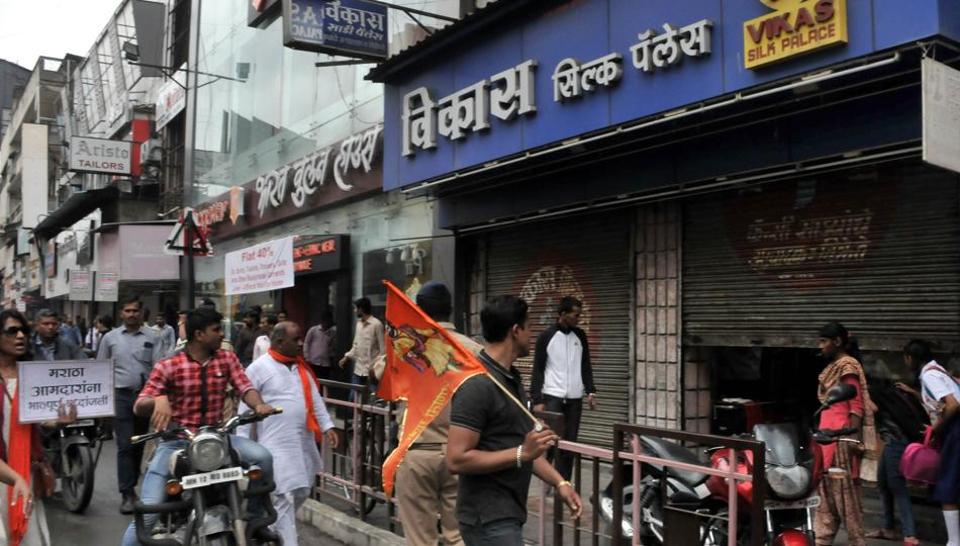
The series of violent incidents across the state during the ongoing Maratha agitation has shocked the state police force as much as Maratha politicians, who felt that the leadership of the protest has slipped from the hands of established community members to that of faceless outfits.
The agitation took a violent turn last week when protestors vandalised vehicles and set fire to a state transport bus in Solapur.
The protesting outfits also threatened to disrupt chief minister Devendra Fadnavis’s event at Pandharpur where he was to perform puja at Lord Vitthal’s temple. While the chief minister decided not to visit Pandharpur considering the possible law and order situation, his remarks about trouble being created by some outfits angered the protestors.
Swayed by the emotions, a 27-year-old protestor, Kakasaheb Shinde, committed suicide on Monday in Aurangabad district by jumping into the Godavari river.
On Tuesday, two more protestors attempted suicide; one person consumed poison while another jumped into a river in Aurangabad. The protestors were also angry about politicians. Shiv Sea minister Chandrakant Khaire was the one who had to bear the ire of protestors when he went for Shinde’s funeral on Tuesday as angry youths heckled him and asked him to leave the place.
A senior police official attached with state intelligence department said the violence during the current agitation was surprising as community organisations were aware that the matter of Maratha reservations was being heard in the Bombay high court. “The agitation this time is centered in Marathwada where younger community leaders are leading it. There is an outbreak of violence because of their limited command over the crowds,” said the official requesting anonymity as he was not authorised to speak to the media.
While most outfits are protesting under the banner of Sakal Maratha Samaj, an umbrella organisation, or Maratha Kranti Morcha, those leading the agitation this time are different, said a community member Vishal Shinde from Ahmednagar.
As observed by the police official, Tuesday’s bandh did not evoke any response in Pune, Nashik and Kolhapur, although it left a mark in Marathwada. Commenting on the poor response to the bandh in Pune and other big cities, office bearers of Sambhaji Brigade which has a strong presence in Pune said the call for the bandh was given by the organisations in Marathwada.
“The call for bandh was given by some Maratha outfits from Marathwada without keeping us in the loop. The bandh was originally planned on August 9,” said Pravin Gaikwad of Sambhaji Brigade.
Reacting to the violence, Chandrakant Patil, state revenue minister, said some anti-social elements had intruded the agitation and were indulging in violence. “I appeal to the protestors to stay calm. The matter is in the Bombay HC and protestors should wait for the court order. The government has already done whatever it could,” added Patil.
During 2016, the Maratha community held silent marches across the state without any violence, which was praised by all. The marches were mainly for demands, including reservation to the community and dilution of the Atrocities Act. While the Nationalist Congress Party (NCP)-Congress government had given 16 per cent reservation to the community, the case reached the high court with the state backward class commission scrutinising the claim of the community.


