
 E-Paper



Pune experts plan mental health support for Sangli, Kolhapur flood victims
Psychological relief initiative to provide focused and long-term support to affected


A team of psychologists have begun putting a relief plan in place to provide psychological first aid to the victims of the devastating floods in Sangli and Kolhapur districts.
Anagha Lavalekar, head of Jnana Prabodhini Institute of Psychology, is planning the Sangli-Kolhapur psychological relief initiative to provide focussed and long-term psychological support to the flood victims. “We are looking at creating a team of 25 people, who will receive training in trauma counselling from experts,” said Lavalekar.
Dr Sanjyot Deshpande, a clinical psychologist who specialises in grief counselling, recently finished training a team of volunteers who are already in Sangli and Kolhapur.
“My focus was on reinforcing their attitudes as facilitators who were merely helping people regain their lost resilience. We can’t go there as ‘saviours’ out to save ‘those poor victims’.
“I also told them about listening with empathy without offering unnecessary advice and how to help certain groups like children – some colouring activities or games can be very cathartic for the younger victims,” she said.
Self-care for volunteers is also an important aspect of training. “It can be exhausting, burdening for the volunteers to listen to victims’ accounts.
“It’s important that they know how to look after their own emotional health.” While a number of psychologists and volunteers are today aware about the need for mental health support for disaster victims, Dr Deshpande said the outpouring of help shouldn’t be impulsive.
“Many have expressed a desire to work on the mental health of flood victims, but it needs to be a co-ordinated effort with proper volunteer training in place,” she said.
Last year, after the Kerala deluge, Jnana Prabodhini Institute of Psychologyhad dispatched a team of volunteers to provide psychological relief to the flood victims.
“That experience has further equipped the institute to extend psychological help in a bigger and better way for Sangli Kolhapur disaster victims.
Speaking about the Kerala experience, Lavalekar said, “The team was sent 1-1.5 months after the floods, once the victims’ lives were somewhat restored to normalcy. “Groups of 2-3 volunteers would go to one house and tell them that we are here only to listen to you. The team had received training in active listening, the dos and don’ts of interacting with victims, how not to probe their pain but gently help them vent out their hurt, how to extend emotional support without giving false assurances, and so on.”
That the conversations helped the victims achieve some catharsis was evident.
“We would go with a translator, but even if language was a barrier, once the victims started talking, they wouldn’t stop.
“There’s no quantitative research on how it helped them, but we could see that it was a relief for them to speak to someone.
“We also worked closely with a suicide prevention NGO, referring severely disturbed people for further counselling,” said Chinmay Shete, a relief co-ordinator.
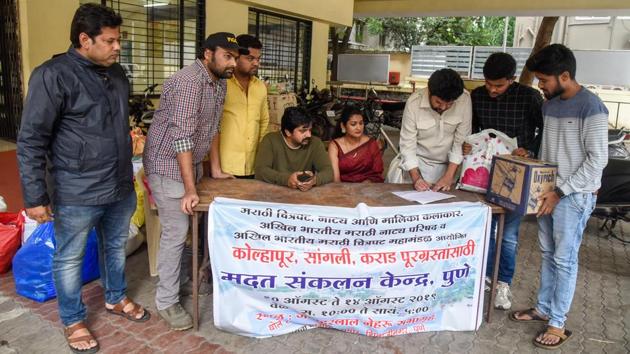
While the training at JPIP will be held this month, the team will go to the affected areas in October. Last week, a team of volunteers returned to Pune after delivering relief material to flood victims in Sangli. While the full scale of physical destruction was still sinking, one victim’s cry brought home the enormity of mental trauma of the victims, for the relief providers.
“This man, who was affected in 2005 floods in the same district, said that he had somehow pulled his life together then. This time around, he has no strength to cope up with the losses he’s suffered,” adds Shete.
Psychological Impact of Floods in Sangli, Kolhapur
According to psychologists, the emotional impact of extraordinary disasters on the victims is often wide-ranging and immense, ranging from shock, grief, anger to helplessness, resignation, anxiety and depression.
“People affected by such calamities often grapple with a multitude of losses all at once. With their homes and even entire village destroyed or damaged, their feeling of security is completely wiped out. There is often a deep sense of anxiety and uncertainty that haunts them. Anger against god, or even people who still enjoy safety, can also be seen and the magnitude of what is lost and what needs to be rebuilt can be very debilitating,” said Dr Sanjyot Deshpande, a clinical psychologist who specialises in grief counselling.
“Though human beings are naturally resilient, such out-ofthe-ordinary experiences give rise to the need for psychological support. If such emotions are left unresolved, it can give rise to a range of psychological issues,” she said.


