
 E-Paper



Your Space: Reminiscing, reliving and reinventing Gandhi
Is Gandhi still relevant for the everyday Punekar today?


Gandhi’s secular politics influenced Indian Muslim’s decision to not join Pakistan
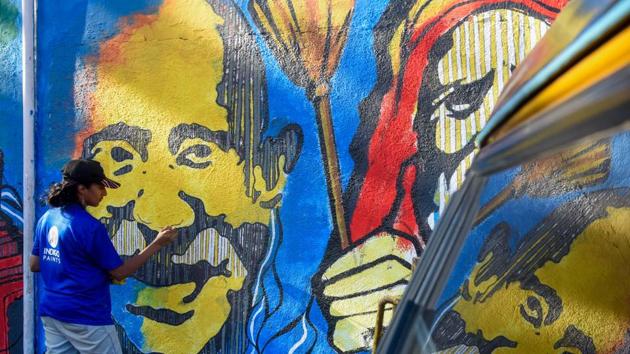
Mahatma Gandhi’s contribution to Indian democracy and secularism cannot be overemphasised. His commitment to secular politics, greatly influenced the decision of Indian Muslims to stay in India during the time of partition. It so happened that the leaders of Muslim League migrated to Pakistan, but their future electorate, the Muslim masses stayed in India thereby weakening the democratic foundations of Pakistan. On the other hand, during the Indian freedom struggle, ‘the father of the nation’ demonstrated to the Indian masses that even the most powerful empire can be challenged and the government can be changed through mass-based, non-violent democratic agitations like, non-cooperation movement, boycotting foreign goods, hunger strikes, peaceful processions, satyagraha among others. In September 1920, a special session of the Congress at Calcutta (now Kolkata) adopted Gandhi’s resolution of non-cooperation. Although initially non-violent, the movement generated a mob frenzy and violence, subjecting the police to serious social and domestic pressure. In February 1922, violent mobs burnt 21 police officers alive at Chauri-Chaura police station in Gorakhpur district. Instead of escalating the agitation, Gandhi decided to call off the mass movement. The Indian masses have learnt these lessons well, enabling India to enjoy uninterrupted democracy since freedom. Our masses never took up the arms or allowed any armed struggle to succeed in challenging the Indian democracy.
Armed insurgencies of various kinds, socialist, regional, tribal, ethnic have all failed in India as the democratic ethos inculcated by Gandhi ensured that these armed struggles remained localised and never acquired an all-India character. Using inclusiveness taught by the Mahatma, we could ultimately assimilate dissidents into our democratic experiment. In contrast, violent, elitist and feudal approaches of leaders in the neighbourhood saw the rise of military dictatorships in South Asia. Forgetting lessons taught by Gandhi has cost Pakistan very dearly, which has been in the grip of religious fanatics and military.
-Jayant Umranikar, former director-general of Maharashtra police and current director, competitive exams centre, Savitribai Phule Pune University.
Mahatma’s relevance for digital world
Mahatma Gandhi is everywhere, you walk any street or any corner of the country, statues are there, take out any denomination of our currency, his image stares right back at you. While Gandhi has remained caged in these images, his teachings and ideals of non-violence, trusteeship of society, upliftment of downtrodden and social harmony remain merely in books, libraries and paid lip services by leaders of all sections of the society. As an artist and author, to me his teachings are more relevant in the 21st century than it was during the freedom struggle. With the advent of the new chapter in technology more complex issues are being thrown up while a few unresolved from the last century continue to create violence and massive disruptions. He is more relevant today, when man’s greed is leading to massive consumption plundering earth’s natural resources causing climatic changes affecting the very survival of human beings. As an artist, I have been working on an art project on impact of “artificial intelligence” and keep in touch with groundbreaking advances in the field which will drastically change the way we live. I found it very interesting that some of the ethical questions and issues that come up due to the advancement of artificial intelligence to basic human values, could be answered using Mahatma Gandhi’s thoughts and ideology. His thought process can provide answers to these complex issues where there will be a battle between man and machine for supremacy. Mahatma who was very well aware of power of visual art and was himself like a muse for many contemporary artists. Gandhi had deep understanding of art processes and believed that art is not merely meant for the purpose of decoration, but it plays a vital role in affecting the human mind. The 21st century known for globalisation, free markets, liberalisation and challenges from AI where human beings find secondary importance, Gandhian way of thinking is a ray of hope for smooth passage through all hurdles.
- Prakash Bal Joshi
Gandhi’s moral character freed us from the yoke of British imperialism
Gandhi dreamt of an inclusive India and was against communalism and divisive politics premised in the name of caste and religion. He was an ardent supporter of Hindu-Muslim unity and a champion of humanity and high morals. Pertaining to everything I have read and heard about Gandhi, I see him as someone, who through his moral character changed the destiny of the nation and freed us from the yoke of British imperialism. He proclaimed the message of ‘Ahimsa’ which is non-violence and if this message is implemented in its true letter and spirit, all the fights based on religion will end in no time. He espoused the policy of “live and let live” and “Sarv Dharma Sabhav”. He fought for freedom and never gave up on his principles of justice and truth. His ideology and vision is the ideal formula required for bringing about peace in the society again.
Maulana Razin Ashrafi, Nazim, Darul Qaza, Pune
Too many fissiparous tendencies in the country in the name of religion
Gandhi has been rightly called the father of the nation. He was the champion of universal brotherhood and believed in the concept of a unified nation where people from different caste, religion and creed are treated equally. The country has always followed the principles espoused by Gandhi and till today India has been protected through Gandhian values and morals. However, times are changing and there are too many fissiparous tendencies in the country in the name of religion. These forces are indulging in violence and spreading fear in the minds of the citizens, for the sake of absolute power. This situation definitely needs to be condemned and the country must be taken back to Gandhian principles of equality and protection of the weaker sections of the society. Gandhi was an ardent champion and supporter of rural India and this same thought process must be adopted and cherished by the citizens of the nation. Gandhi inspires us to put an end to the menace of communalism, casteism and other divisions which are being sharpened by vested interests for their own selfish motives. Indians of diverse religious faiths strongly reject the fascist ideology and believe in a strong and vibrant democracy. It is high time that those ruling the country must adopt and practice the precepts of the father of the nation in the larger interests of humanity and brotherhood.
-Akramul Jabbar Khan, Chief Commissioner of Income Tax
Gandhi’s thoughts as a philosopher have an impact on creative minds
Gandhi has been with me since I was taught history, back in school. He is the constant source of influence in my life. His ideologies help me make decisions when the question of self-respect, self-determination comes into being. Gandhi’s thoughts as a philosopher, his ideologies and approach towards life have an impact on creative minds. As a poet myself, I certainly feel so. If anyone asks me in the arena of philosophers what quality differentiates Mahatma from others, I always answer saying that he fights for rights of those who due to various reasons would not have been able to oppose people in power, for example Harijans.
-Bhaskar Hande


