
 E-Paper



Wildbuzz: An owl, long heard
A lull ensued. As luck would have it, this owl — described as a “sparse and uncommon visitor” to India — finally came within the grasp of Chandigarh birders.


After a Swedish citizen, Per Undeland, spotted 17 Northern Long-eared owls outside Harike Wildlife Sanctuary on March 23, 1997, it set aflame the curiosity of regional bird-watching groups. The quest to see this owl, which migrates from the northern latitudes, eluded most bird watchers. The secretive owl even escaped the scanner of annual census surveys of avians conducted by the Chandigarh Bird Club and allied groups at Harike. Till, Undeland and HS Sangha came back to Harike and observed 10 owls downstream of the barrage on December 18, 2015.

The interest in the species revived and the media was abuzz with owl news. A lull ensued. As luck would have it, this owl — described as a “sparse and uncommon visitor” to India — finally came within the grasp of Chandigarh birders. The owl was spotted recently by a diligent trio — Amandeep Singh Channa, Narbir Kahlon and their unusual birding companion, Harmeet Singh Hundal, who is posted as superintendent of police (SP) (investigations), Sangrur. Hundal is a keen birding cop, who publishes desk-top calendars enlivened by bird photographs for distribution to close friends!
The owl sighting was at the Jawaharpur-Mukandpur scrubland jungles, just off the highway at Dera Bassi. The fortunate find was tempered by the sobering thought that sand-mining has robbed Jawaharpur-Mukandpur of its ecological buffer — the jungles, reeds and wetlands — and nothing may remain in six months from now.
This was the biodiversity hotspot where many new birds were added to the checklist of the Inter-State Capital Region, ie, the area falling within a 50 km radius of Chandigarh. The checklist proudly stands at 428 species due to awareness, a profusion of keen eyes and hi-tech lenses but the owl and other rarities may never be seen again at their “favoured dera”.
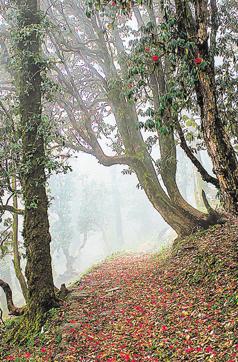
TRYST IN THE MIST
The journey is the destination, for those who dream by drifting with their feet. Chandigarh-based IT professional, Chandan Bhardwaj, had to abandon the trek-cum-pilgrimage to Churdhar in Sirmaur after heavy snowfall waylaid his bid to summit the 3,647 m peak, the highest in the outer Himalayas or the Shivaliks. Named after the deity, Chureshwar Maharaj, mythology holds that he was sent packing by Lord Shiva when the latter unleashed lightning at Churdhar top. The peak can be viewed from Solan, Kasauli and Shimla and affords one of the nearest alpine treks for the tricity’s nature enthusiasts.
Bhardwaj had to beat a premature retreat but it resulted in an unforeseen opportunity, a magical outcome and a photograph worthy of being titled, ‘A gateway to heaven’ or the more earthy, ‘At tunnel’s end’. The photograph came on display at a well-acclaimed exhibition, ‘Foto 2017’, at the Punjab Kala Bhawan. I will now let Bhardwaj’s words take gentle grip of our imagination and transit us to a blessed spot where ‘rhododendrons keep falling’ on my head’!
Bhardwaj: “With a bit of sadness for not having completed the trek, I started walking back. All of a sudden, the rain came down with such intensity that rhododendrons started falling on the track. Within minutes, the track was ablaze with nature’s very welcoming and soft, red carpet. I was awestruck: how nature was playing with its colours, mist, trees to create a masterpiece. I woke up from that dreamy moment and realised that a camera was hanging around my neck and it was a perfect moment to capture. I started walking again but regrets for not having completed the Churdhar trek had been washed away like the sins of those who are destination-crazy. I take credit only for pressing the shutter button, rest goes all to nature!”
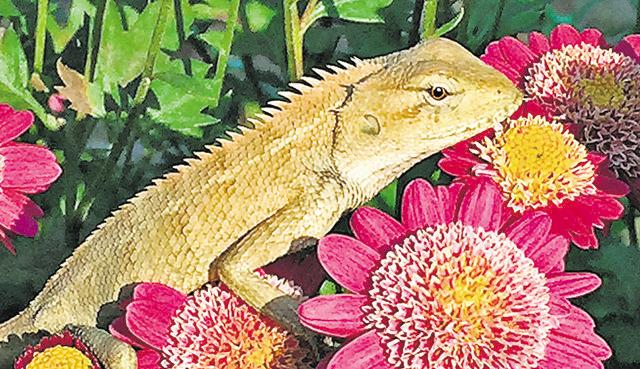
THE FLOWER HUNTERS
Our resident garden lizards just love wintering on chrysanthemums. As the sun’s warmth trickles into the garden’s hides by noon, lizards slip out from the dark labyrinth of the ‘Evening glory’ hedge where they spend 20 hours of a winter’s day. One of the experienced ones, with her lithe body and wiry claws, clambers across her territory of pink chrysanthemums. The blooms are attended by small honey bees and insects, which the lizard tracks with a shiftiness of her heavy eyelids. Her claws, shaped liked a sickle moon, invest the ambush with poise and stealth. A commando-like move commences with claws gripping at the heart of petals. It is a wonder, a hunter can tread so softly. It culminates in a sudden, successful lunge of the tongue for the bee busy in the pollen. The buzz is over, it has gone with the wind.
Not all are adept hunters. A younger lizard gets over-excited and scrambles across the dazzle of yellow chrysanthemums. But haste makes waste, and the bee alerted by the heaving of weak stems, flees to the invite of a flanking bed of blooms. The lizard returns to bask, her tongue sheathed like a bloodless sword.
(The author can be contacted at vjswild1@gmail.com)


