E-Paper



Kolkata Metro expansion to drive real estate growth with better airport and suburban connectivity
PM Modi’s launch of Kolkata’s Metro corridors is set to transform the city’s real estate markets, with improved connectivity to the airport, and business hubs

 Prefer HTon Google


With Prime Minister Narendra Modi inaugurating key stretches of the Green, Orange, and Yellow metro lines on August 22, experts say Kolkata’s real estate sector is set for a boost. The metro expansion is expected to drive at least a 5% rise in property values in the eastern and southern regions in the short to long term, they say.
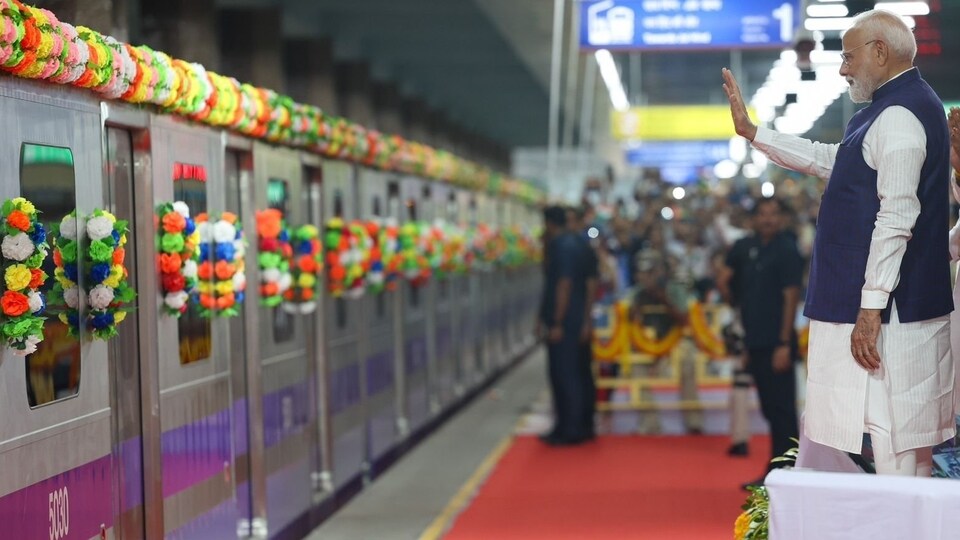
Launched just ahead of Durga Puja, the extended network will improve connectivity to the airport and IT corridor while making citywide travel more convenient, further fuelling housing demand and price growth, they say.
The new stretches cover Sealdah to Esplanade (2.45 km), Noapara to Jaihind Bimanbandar (6.77 km), and Hemanta Mukhopadhyay to Beleghata (4.39 km) across three different Kolkata Metro corridors.
Which areas will see improved connectivity through the Metro corridors?
The Green Line extension will connect Howrah Maidan to Salt Lake Sector 5, forming a key east-west corridor that links Howrah railway station with Kolkata’s growing IT and commercial hub in Salt Lake Sector 5. Experts say this line will significantly cut travel time, reduce reliance on road transport, and boost residential demand in Salt Lake, New Town, and nearby areas.
The Orange Line stretch will run from Hemanta Mukhopadhyay Metro station at Ruby Crossing to Beleghata, enhancing connectivity in the city’s southern and eastern regions. For real estate, this line is expected to spur new interest in areas along the EM Bypass, where residential and retail projects are already expanding.
The Yellow Line covers a 6.77 km stretch with four stations: Noapara, Dum Dum Cantonment, Jessore Road, and Jai Hind Bimanbandar. It provides Kolkata’s first direct metro link to the airport, a development for both commuters and tourists.
Also Read: PM Modi to inaugurate Kolkata Metro corridors today: What it means for real estate markets

Metro impact on peripheral areas
Kolkata’s metro expansion may lead to real estate growth, with its impact becoming increasingly visible as key corridors begin to connect the city’s peripheries, experts pointed out.
Saket Mohta, managing director of Merlin Group, said the new lines will catapult residential sales to new highs, particularly in the suburbs where homes are more affordable. He said that connectivity will not only link Howrah, North Kolkata, the Airport area, and EM Bypass to central Kolkata but also open up opportunities in far-off locations where people can now easily access healthcare, education, and other facilities.
Experts suggest that the price of peripheral areas in the southern bypass and beyond is also likely to go up. “It will especially see growth in the launch of new projects in North Kolkata. However availability of suitable land in North Kolkata will be a question. But the greater part of Kolkata, like Sodepur, Kamarhati, and Titagarh segment, will be impacted with this new metro line connectivity through Noapara and up to the existing metro line to Dakhnieswar,” Mohta said.
Most of these areas were earlier dotted with medium and large industries, many of which are closed and are lying unutilised; a suitable government policy can make these lands available for the development of housing and commercial real estate, he pointed out.
“Metro projects in Kolkata have been under construction for nearly 15–16 years, and while the image of the city’s potential was always there, the real impact will only be felt now as the lines become continuous and operational,” Biplap Kumar, president at NK Realtors, said. “Within a 2–3 km radius of metro stations, we can expect strong development activity.”
Howrah, traditionally considered on the far side of the city, is expected to see a major boost with direct connectivity to Sector V through the new east–west metro link. The new metro line is expected to cover a distance of about 20 km in just 12 minutes.
“This will make Howrah far more accessible, and adjoining localities within 3–4 km will now witness real estate traction,” Kumar explained. Premium residential projects are already emerging, with developments such as Ganga Riverfront apartments priced in the ₹2–3 crore bracket. “Where there is a distance from the riverfront, properties are trading closer to ₹1 crore,” he said.
The airport zone, long plagued by congestion and traffic bottlenecks, is also likely to transform with new metro connectivity. “Kaikhali, Jessore Road, and adjoining areas have significant land parcels available, and these will emerge as new growth pockets,” Kumar said.
Property prices in these locations range between ₹1–2 crore, with certain projects still available for under ₹1 crore, making them attractive for both mid-segment buyers and investors, he said.
Also Read: 3 new stretches of Kolkata metro likely to open by August end: Details here
Metro expansion to drive housing demand may lead to 5% appreciation in property prices
Experts said the expansion of Kolkata’s metro network may lead to a 5% rise in property values near new corridors, with better connectivity linking the airport to key hubs like Salt Lake Sector V, New Town, Howrah, and Ruby Crossing.
According to Shrinivas Rao, FRICS, CEO of Vestian, these corridors will make suburban areas more attractive for both residents and businesses. “Better connectivity will encourage more people to live in emerging areas like New Town, Salt Lake, and North Kolkata, driving up property values. Commercial centres will also see greater absorption of office and retail space, while shorter commute times will accelerate the growth of mixed-use projects,” he noted.
In the city’s northeast, New Town and Rajarhat are evolving as organic growth corridors, supported by strong airport connectivity, road networks, and quality healthcare infrastructure.
“New Town is now positioning itself as a luxury housing hub, with projects starting at around ₹2 crore. In Rajarhat, homes on Rajarhat Road are available from ₹75 lakh onwards,” Kumar said.
Prashant Kumar Chaturvedi, city head, Kolkata at ANAROCK Group, said that metro access will help suburbs evolve into self-sustaining hubs. “These corridors are very important and fast-growing in terms of activity. Residential prices in Kolkata have been rising steadily at around 5–7%, while commercial price growth has been stronger, in the range of 8–10%. While property appreciation here may not be as steep as in some other metros, the momentum is clearly building,” he said.
Vivek Rathi, head of research at Knight Frank India, stressed that infrastructure plays a pivotal role in shaping real estate growth. He said the new metro lines would not only ease access to established centres like Salt Lake and Rajarhat but also unlock new opportunities in peripheral areas, establishing Kolkata’s position as an increasingly competitive real estate market.
Also Read: Housing affordability: Ahmedabad, Pune, and Kolkata lead as Mumbai sees improvement
Impact on commercial real estate
Experts said that Kolkata has seen a steady pickup in commercial activity over the last two to three years, and metro connectivity will add further momentum. “The big value-add from metro projects comes when we break commuter thresholds, say 45 minutes to an hour. Locations that can now be reached quickly because of the metro will see the biggest impact. New areas like Salt Lake, Rajarhat, and Newtown, with new-age amenities and proximity to the airport, stand to benefit significantly,” he noted.
Experts said that IT-connected areas like Salt Lake City and Rajarhat are commanding strong office transaction volumes and rental premiums, showing that Kolkata has successfully created new business destinations that rival traditional centres. This comes at a time when third-party IT service businesses accounted for 45% of office transactions in H1 2025, highlighting Kolkata’s growing appeal as a technology hub, Knight Frank India data showed.