
 E-Paper



10 things to know about NASA's TEMPO satellite that monitors air pollution hourly over North America
Read the top 10 features of Nasa's new satellite TEMPO, the revolutionary air pollution monitor

 Prefer HTon Google


NASA's new satellite to hourly measure air pollution hourly has shown significant progress and now the space agency officials are already thinking about ways to extend its life.
“We want TEMPO to last for 10 years, if possible,” Barry Lefer, NASA tropospheric composition program manager, said Dec. 12 at the American Geophysical Union annual meeting here. “So, we are going to baby it.”
What is NASA's TEMPO
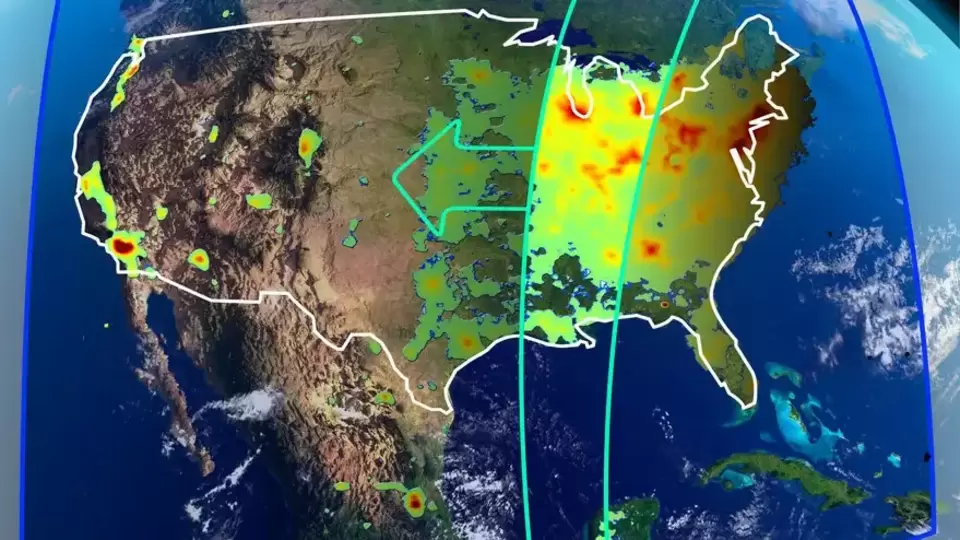
TEMPO is NASA’s first Earth-observation satellite in geostationary orbit and has developed further from previous polar-orbiting satellites provided daily observations to provide 10 to 12 daily scans.
Tropospheric Emissions: Monitoring of Pollution or widely known as TEMPO was sent aloft in April and built by Ball Aerospace to measure atmospheric pollution from Canada’s oil sands to the Yucatán Peninsula. It also gets data from the Atlantic Ocean to the Pacific Ocean and made its first North American scans in early August.
“It’s the first time to have the range of spectral data from a geostationary satellite,” said Hazem Mahmoud, an Earth scientist from NASA’s Langley Research Center. “We have been working on development of new software capability to handle this very high temporal resolution data.”
Hourly Pollution Data
A significant leap from previous satellites, TEMPO provides hourly updates on atmospheric pollutants, offering a more dynamic view of air quality.
Broad Coverage Area
TEMPO's monitoring range extends from Canada’s oil sands to the Yucatán Peninsula and across the Atlantic to the Pacific Ocean, making its first North American scans in August.
Comparative Analysis
NASA researchers are comparing TEMPO's data with airborne measurements for accuracy and consistency.
Impressive Performance
Since August, TEMPO has been rigorously tested, with NASA confirming its exceptional functionality and reliability.
Collaborative Efforts for Air Quality
The data gathered by TEMPO will be shared with the National Oceanic and Atmospheric Administration (NOAA) and the Environmental Protection Agency (EPA) to enhance air quality forecasting.
Accessible Data
Over 500 early adopters have access to TEMPO's data, with a public release of validated data expected in April.
International Collaborations
TEMPO is part of a virtual constellation with South Korea's GEMS and the European Space Agency’s upcoming satellite, aiming for comprehensive air pollution monitoring over the Northern Hemisphere.
Longevity Goals
While designed for a 20-month operation, NASA and Intelsat are nurturing hopes for TEMPO's functionality extending up to 10-15 years.
Pathfinder for Future Missions
TEMPO's success paves the way for NOAA's upcoming Atmospheric Composition Instrument, an enhanced version slated for a mid-2030s launch.


