
 E-Paper



NASA warns of giant building-size asteroid approaching Earth today. Details here
NASA has warned about a giant building-sized asteroid named '2024 OC', which is set to make a close approach to Earth on Sunday.

 Prefer HTon Google


NASA (National Aeronautics and Space Administration) has warned about a giant building-sized asteroid named '2024 OC', which is set to make a close approach to Earth on Sunday, August 4, around 9:40 pm IST. The enormous space rock measures 410 feet (125 metres) in size. According to the US space agency, the asteroid is moving at a speed of 35,996 km per hour.
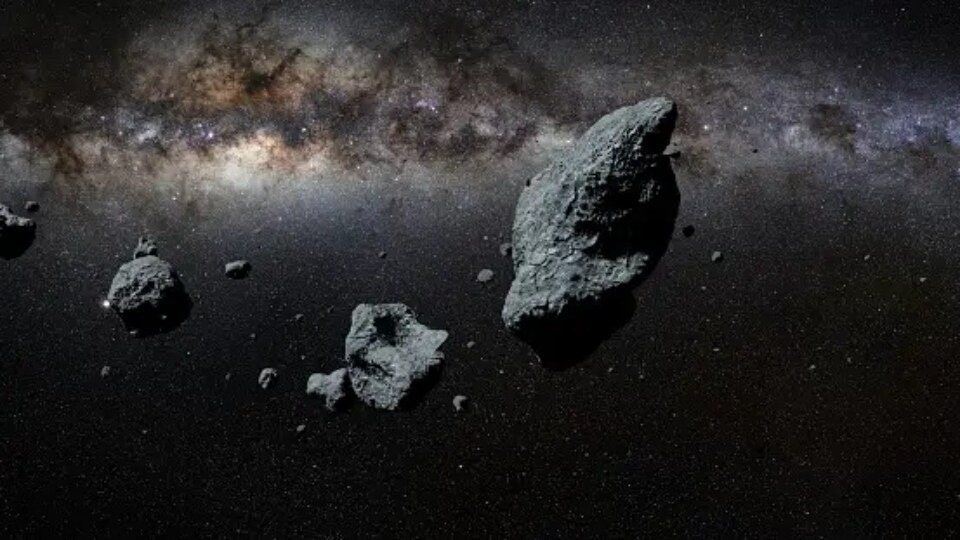
The giant rock belongs to the Appollo group - a class of near-Earth objects (NEOs) that have an orbital semi-major axis greater than that of the Earth.
Also read: Sunita Williams' Earth return mission makes progress after NASA's successful tests, but pressure is far from off
This comes a day after a 110-foot airplane-sized asteroid ‘OJ2’ passed the Earth on Saturday at a distance of approximately 4,450,000 miles. Earlier on August 1, two large asteroids ‘2024 OE’ and ‘2024 OO’ – approximately 190 feet and 88 feet in diameter, respectively – passed the Earth.
Does asteroid ‘2024 OC’ pose a threat to Earth?
According to NASA, most near-Earth objects (NEOs) do not pose any threat to the paths they pass by. However, some NEOs are potentially hazardous asteroids (PHAs) - which are defined as larger than 460 feet in size.
The ‘2024 OC’ asteroid is smaller than the PHA criteria, reducing its possibility to pose a threat.
What are asteroids?
Asteroids are small, rocky objects that orbit the sun. Most asteroids can be found orbiting our Sun between Mars and Jupiter within the main asteroid belt. According to NASA, the total mass of all the asteroids combined is less than that of Earth's Moon.
“Sometimes, asteroids and comets are nudged into Earth's neighbourhood by the gravity of nearby planets. These objects are called Near-Earth Objects, or NEOs,” NASA said in its blog.
Also read: NASA smacked a spacecraft into an asteroid – and learned details about its 12-million-year history
According to the Center for Near Earth Object Studies (CNEOS) at NASA's Jet Propulsion Laboratory (JPL), there are more than 35,000 NEOs, and about 99 per cent of them are asteroids.
Most asteroids are irregularly shaped, though a few are nearly spherical, and they are often pitted or cratered, the space agency said.
“As they revolve around the Sun in elliptical orbits, the asteroids also rotate, sometimes quite erratically, tumbling as they go. More than 150 asteroids are known to have a small companion moon (some have two moons). There are also binary (double) asteroids, in which two rocky bodies of roughly equal size orbit each other, as well as triple asteroid systems,” it added.


