E-Paper



Sreeshankar's long jump onto the world stage
It wasn't his best performance but on the big stage, the medal mattered more -- to the 23-year-old and to India.

 Prefer HTon Google


Murali Sreeshankar read aloud a mental list, like an overtly geeky kid bragging about his school topping spree. Except, in Sreeshankar’s case it was about his largely medal-less international hall of fame. “7th at the World Indoors. 7th at the World Outdoors. 6th at the World Juniors. 4th at the Asian Indoors. 6th at the Asian Games,” Sreeshankar rambled on. “Every time 6-7, 6-7, 4 or so.”
Slot in a 2nd there, at long last.
The narrative around the Indian long jumper ought to be an elite athlete’s nightmare: falters when it matters most. It accentuated after the World Championships last month, where despite a season of consistent 8m-plus jumps including a personal best of 8.36m in April, Sreeshankar finished 7th with 7.96m in the final. Consistent success in the domestic circuit was well in his grasp yet, save a bronze at the 2018 Asian U-20 Championships, big international meets would breeze past an empty-handed Sreeshankar.
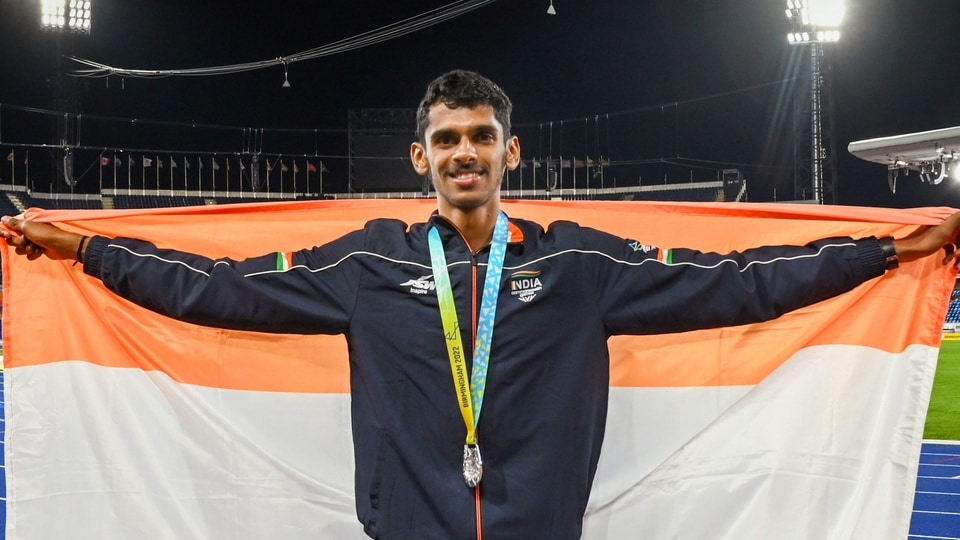
The winds of change blew on a chilly night in Birmingham on Thursday. Fighting the weather, considerable tailwind, a “smallest of margins” foul and the reputation for big stage fright, Sreeshankar won the 2022 Commonwealth Games (CWG) silver medal in the men’s long jump with a best of 8.08m in his fifth and penultimate effort. The Bahamas' LaQuan Nairn also leapt 8.08m for gold, his second-best jump of 7.98m the deciding factor.
Sreeshankar fouled his last attempt going for gold that he and fellow compatriot Muhammed Anees Yahiya—whose best of 7.97m put him 5th—were sure would be around an Indian’s neck chatting up before the final with the kind of jumps they’ve patched together this season. The silver hardly felt like a downgrade for Sreeshankar; he collapsed on his knees on the track with the flag resting on his shoulders, covered almost the entire Alexander Stadium for his celebratory lap with it and obliged a little kid’s selfie proposal from the stands.
Sreeshankar too felt the long, at times, desperate wait to live those scenes playing in his mind. Talking to the reigning high jump Olympic champion Miltiadis Tentoglou in Greece recently calmed his itch.
“He has been 7th, 6th, 4th multiple times and then won the Olympic gold. He is in a different league now. So it’s a step-by-step process,” Sreeshankar said. “Every small step counts towards a big target. You can’t come out and win a gold medal in one World Championships. Every champion has gone through it. Keep out legends like Carl Lewis or Mike Powell, but every athlete has gone through all these phases.
“It takes time. We need to give the talent some time to groom, mentally and physically.”
It's a paradigm shift in Sreeshankar from four years ago, when an emergency surgery for a ruptured appendix pulled him out of the Gold Coast CWG days ago and pushed him into the territory of restlessness for the months to follow. His father-coach Murali, understanding his son’s body better than the rest, knew the recovery path would be a slow grind.
“Shanku, we will wait, you don’t worry,” the father would insist. “He was not ready to wait; extremely anxious,” he added. “But I knew his body and muscles are weak. I told him day by day you’ll improve but it will take time.”
He did, little by little jump after jump, before it came crashing down at last year's Tokyo Olympics: a season-poorest 7.69m, four months after the 8.26m at Federation Cup. The father and son attributed it to the Covid vaccine, those weak muscles compromised again. The finger-pointing virus, however, had already spread as Murali was removed from the national camp and questioned in his additional role as coach to his son.
Reinstated now, Murali still trained Sreeshankar taking an eight-month unpaid leave. He knew exactly what the problem with his most loyal trainee was: “He had become too weak (after the vaccine). When your body is free, you will jump freely”.
“We really had a tough time after Tokyo,” Murali said. “Our entire family sat together and decided that we will win a medal for India and only then stop. I didn’t bother about the leave and money. I told him, ‘I’ll leave you Shanku, I’ll leave you, just make one more 8m jump’. Because everyone was saying that you have to change his coach.”
Leave alone one, Sreeshankar has notched up nine 8m jumps so far this season, including in the qualification here where he needed the sole 8.05m attempt to progress. That was in warmer conditions of the day, the final in the typically British nip of the night. The tailwind factor showed up significantly too—there were fouls aplenty from all jumpers while Sreeshankar's first attempt of 7.60 was +3.1 wind-assisted.
It took three jumps (7.60, 7.84, 7.84) for the Indian to cope with the natural challenges, and just when he thought he did with a “perfect takeoff” in the fourth, he felt short-changed by technology.
A laser-assisted foul check system, set in place in November last year, red flags a no-jump even if any part of the take-off shoe or foot goes past the perpendicular plane of the take-off line. Sreeshankar's did by the barest of 1cm margins. “I was shell-shocked,” Sreeshankar, conversing animatedly with the official, said later. “I felt like that jump was 8.10. So I started raising my hands.”
Murali instructed him to pull back by 5cm and ensure a valid jump for the remaining two. Sreeshankar regathered from his worked-up reaction, knowing “I could do just one jump and win a medal”. He duly did moments later.
“In terms of performance, it was not a big one. It is far away from my personal best,” Sreeshankar said. “But when it comes to global championships like the Commonwealth Games, a medal is more important.”
A bit more so for Sreeshankar.