E-Paper



Ada Hegerberg: Norway women’s skipper on leading and taking a stand
The forward has returned after taking a five-year break from the national team demanding a better deal for women players

 Prefer HTon Google


New Delhi: When Ada Hegerberg speaks, the football world ought to listen. Not just because of the goals she scores and the trophies she wins but because of the stands she’s willing to take. The generational talent is also the first woman player to win the Ballon d’Or.
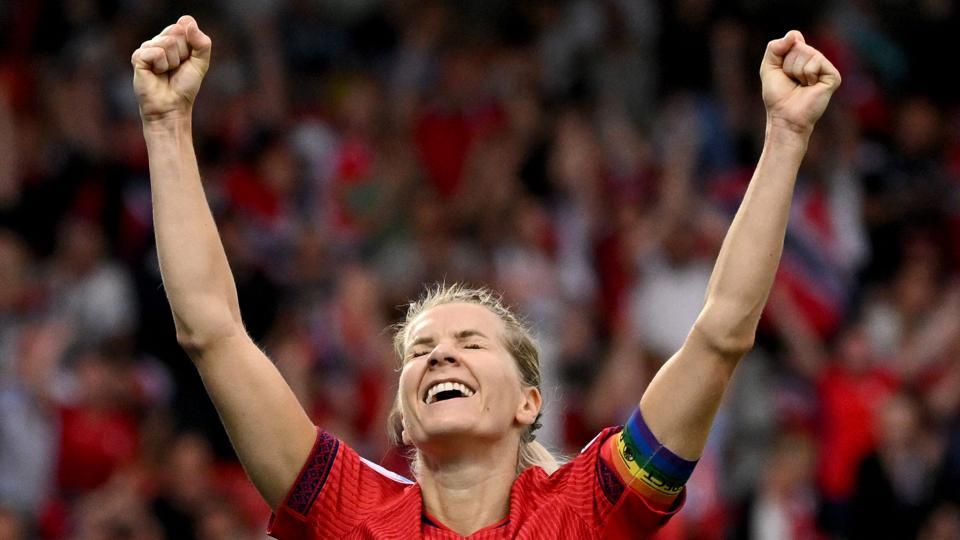
However, at the peak of her powers, she walked away from the Norwegian national team because she believed that women’s football deserved better – equal treatment, better facilities, stronger support.
Now, after five long years away, she’s back, as player and captain. Leading from the front, Hegerberg, 30, has helped power Norway to the top of Group A at the UEFA Women’s Euro with a flawless run.
The Scandinavians came from behind to beat hosts Switzerland 2-1, edged out Finland too 2-1, and won a thriller against Iceland 4-3 to finish with maximum points. Hegerberg’s header against Switzerland marked her 50th international goal.
“Contributing to a win against Switzerland is what matters,” Hegerberg told HT in a conversation facilitated by Fancode. “Being nominated captain is a huge opportunity. It’s a level of trust that I appreciate a lot. It’s very motivating. I’m very inspired to give all the experience I have to this group.”
She has returned to a team that looks and feels different. “We’ve been very lucky to have Lisa Klaveness as our new president of Norwegian football,” Hegerberg said. “She 100% understood what I talked about when I was away. She’s felt it herself.”
There’s also a new dynamic with Gemma Grainger having taken over as team manager in 2024, adopting an approach rooted in empathy. “She’s all about wanting to help us out and support us. We’re human first of all, not robots. So, having a leader that cares for you is huge.”
And it seems to be working. Norway have entered the quarter-finals, a big improvement after their early exits in the last two editions.
“Sometimes we’ve got to pinch ourselves,” Hegerberg smiled. “We’re small Norway and we’re going to play a quarterfinal in the Euros. It’s beautiful.”
Hegerberg though is still concerned about the structural issues that plague the women’s game. Studies have shown that women footballers are significantly more prone to ACL injuries than men, yet research and frameworks lag behind.
“I don’t think we’re there yet at all. I’m asking myself the question all the time, do we have enough competence? Is the research that is already found being put in so that women players are much more taken care of?
“The demands for players are going up with more games, more travel. But everything around them needs to go up, too. For starters, not taking studies from the men’s sports and applying them to women’s sports. We’re completely different.”
Her own battle with injury has been painful. After tearing her ACL, she recovered only to suffer a long stress fracture that almost derailed her career. “To not get that help and competence was very hard for me, but once I got it, I healed and I’ve been playing on the highest level ever since.”
Her immediate focus is on the Euros, but she is also conscious of the legacy she will leave.
“I really just hope that I’ve given it all,” she said. “Every time I stepped on that pitch I gave it all. For my sport, for my teammates. That’s the end feeling I want to have. I’m sure I’m going to be looking back at it and think, ‘What didn’t I experience? I think I’ve been through it alI. If I wrote a book about it people won’t believe.
“But, seriously… leaving the sport in a better place than I found it in. That’s the legacy I want.”