
 E-Paper



India held Panama, but the real story lies deeper: What the draw reveals before Brazil and Uruguay land in Kolkata
India's 1-1 draw with Panama offered encouraging signes, but Brazil and Uruguay will test whether Khalid Jamil's emerging blueprint can truly travel.

 Prefer HTon Google


India’s 1-1 draw against Panama should not be read as proof that the gap between the Blue Tigers and the world’s top 50 has suddenly disappeared. It should, however, alter the terms of the conversation around this team. Against opponents ranked 44th in the world, India did not spend 90 minutes merely protecting their penalty area. They competed, scored through a repeatable attacking pattern, continued to look for openings after conceding, and survived the final phase without losing their shape.
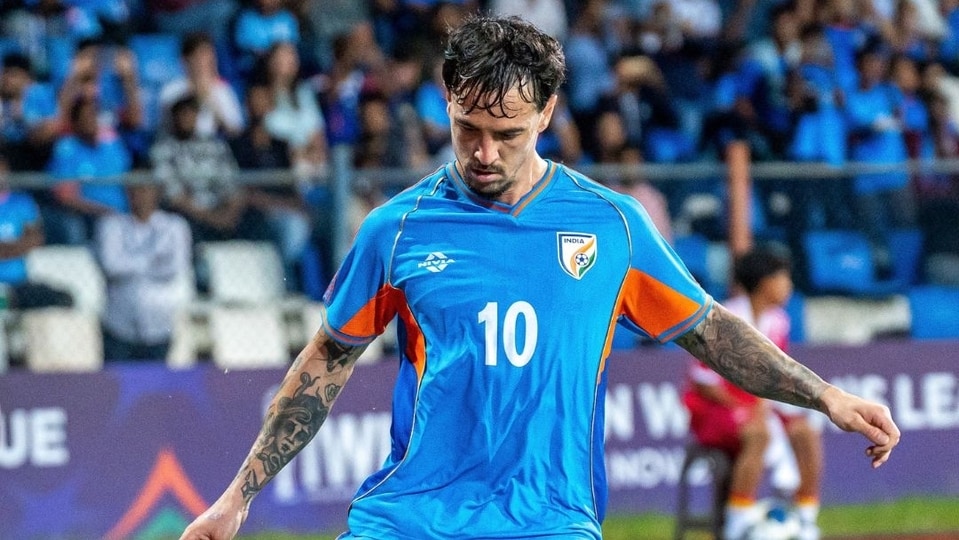
That matter because Panama were not ceremonial opposition. Fourteen members of their travelling squad had featured at the 2026 World Cup, and India entered the contest ranked 138th. The difference in pedigree was enormous, yet the game itself rarely looked like a mismatch of that scale. Ryan Williams’ 41st-minute opener came from purposeful movement rather than chaos: Akas Mishra advanced the move from the left, Williams attacked the space behind the defensive line and finished decisively. It was the kind of goal India can reasonably attempt to reproduce against stronger sides.
The more revealing period came after Omar Valencia equalised in the 68th minute. India had an obvious excuse to retreat. Instead, Khali Jamil’s side continued to release Ashique Kuruniyan down the left and manufactured two late chances, first for Edmund Laridinka and then for Manvir Singh. That refusal to turn the final 20 minutes into pure damage limitation may be the most valuable part of the performance.
What India can carry into Brazil and Uruguay clashes
The first lesson is that India need an escape route. Against Brazil on October 3, possession will inevitably be harder to sustain and the defensive line will spend longer periods under pressure. But defending deep is only viable if the team can occasionally force the opposition to run backwards. Williams and Ashique offered that possibility against Panama. Their speed and willingness to attack space mean every clearance did not automatically return as another wave of pressure.
That must remain central against Brazil. India are unlikely to enjoy equal possession, but they cannot allow the match to become and uninterrupted siege. Even three or four successful transitions can change the rhythm of a game, force Brazilian full-backs to hesitate before advancing and give India’s midfield time to reorganise. The objective should not be chase possession for its own sake, but to make possession meaningful whenever it arrives.
The second lesson is structural. Panama still created enough danger to expose where India remain vulnerable. Valencia’s goal came because Lalengmawia Ralte arrived a fraction late to close the shooter, and that fraction will become even more expensive against Brazil’s quicker combinations and superior execution. India therefore cannot carry only the aggression of Bengaluru into Kolkata; they must carry the compactness too. The spaces between midfield and defence, especially the channels outside the centre-backs, will need to be narrower and better protected.
Anwar Ali’s performance offers the template. He defended on the front foot, stepped into danger rather than endlessly retreating, and helped India survive Panama’s late push. Against Brazil and Uruguay, that courage will need to be matched by collective discipline. If one centre-back steps out, a midfielder must cover. If a full-back advances, the opposite side cannot become exposed. At this level, isolated defensive quality is rarely enough; the distances between players become the defence.
Uruguay, three days after Brazil, will pose a different examination. India may face fewer extended possession sequences than against Brazil, but the physical and second-ball contest could be harsher. That places greater importance on what happens after the first clearance. Against Panama, India sometimes defended the initial action successfully only to concede the next phase. Agaisnt Uruguay, repeatedly surrendering second balls would eventually trap Jamil’s side around their own box. India face Brazil on October 3 and Uruguay on October 6 in Kolkata.
Also Read: Football: India denied a win by Panama
The Panama result also offers a psychological gain, though that should not be confused with tactical evidence. India now know they can lead, concede and still remain competitive against a much higher-ranked opponent. That experience will help them when next two fixtures threaten to become intimidating occasions before a ball has even been kicked.
The larger conclusion, therefore, is not that India are suddenly close to Panama’s level, stull less Brazil’s or Uruguay’s. It is that the team showed a method that can travel upward. Compact defending, brave transitions, width through Williams and Ashique, Anwar’s aggression and the willingness to keep playing after momentum turns against them all survived a substantial increase in opposition quality.
Against Brazil and Uruguay, the score line may ultimately be less informative than whether those behaviours survive another jump. Panama showed India can withstand a higher level without abandoning their football. The next two matches will reveal whether that was an exceptional evening or the beginning of a genuinely more competitive international identity.


