
 E-Paper



How Praggnanandhaa turned Candidates heartbreak into a lesson in resilience
Praggnanandhaa makes history as the first Indian to win the Grand Chess Tour title, overcoming a six-point deficit to claim victory.

 Prefer HTon Google


It was a little after 3am on Friday in India, and a relieved, sleep-deprived Vaibhav Suri was shooting off delirious texts in all caps. The recipient of his uppercase excitement, Praggnanandhaa, had just become the first Indian to win the Grand Chess Tour title.
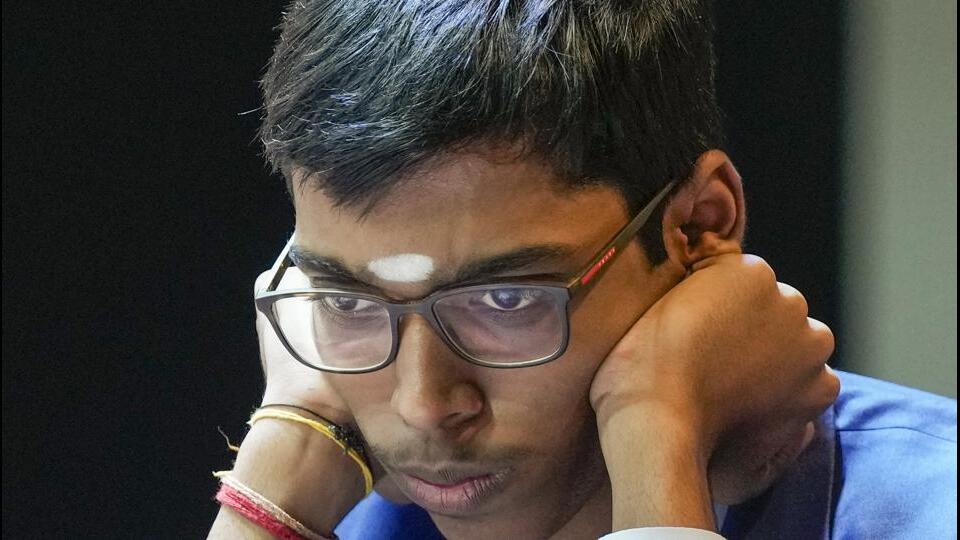
The 21-year-old grandmaster did it in thrilling fashion.
When Pragg walked into the final day of the Grand Chess Tour Finals, he had a mountain to climb. He was six points behind Fabiano Caruana, one of the strongest players in the world, with the title seemingly slipping away.
But somewhere in that deficit was a version of Pragg that his team had been trying to build for the past two years – more ambitious, more resilient and, crucially, less willing to give up.
That mindset became the defining feature of a remarkable comeback.
“He was in this headspace that, ‘yeah, I am trailing, but screw it, I will give it everything because I really want to win’, I could see that in the way we were preparing, the way we were talking about things,” Suri, who has been working as Pragg’s trainer for roughly two years now, told HT.
“We had to win the first rapid game else it becomes really challenging,” Suri pointed out.
Praggnanandhaa did exactly that.
“Fabiano was clearly under pressure when that happened. It was evident in the way he collapsed in Game 2,” the 29-year-old grandmaster said. “Our plan was to put pressure on Fabiano as soon as possible, gain some time advantage and hopefully things start falling in place from there on.”
Suddenly, the match had changed completely: from trailing by six points, Praggnanandhaa was two points ahead.
In the four Blitz games that followed, the first with an opposite colour bishop endgame ended in a draw before Caruana levelled scores with a win in the second. Pragg prevailed in a time scramble in the third and a draw in the last game was all he needed to walk away with the title.
Pragg had been in St. Louis, Missouri, for nearly a month, winning two of the three tournaments he played, while Suri, his trainer, back in India, had upended his sleep schedule to match American time. The original plan was for Suri to travel with Pragg, but after his US visa application was rejected, he found himself pulling coffee-and junk-food-fuelled all-nighters from India.
“The Rapid and Blitz days were slightly tricky in terms of staying up because there’s this break between games so we would discuss about the next game and there are decisions to be made based on results and how other players are faring.”
Pragg spoke of not being too optimistic of his chances, ahead of the final day. “Honestly, I didn’t think I had many chances today. Six points is a lot,” he said. “It would have been nice to have it in the Candidates, but it’s still nice to win tournaments like this.”
The Candidates tournament where Pragg finished seventh out of eight players with a solitary win in 14 rounds earlier this year, still rankles. For a tournament that arrives once in two years, there was a lot that rode on it for Pragg and his team. Hope, primarily.
“It was painful because we really wanted to win it. But we took our lessons from it,” Suri said.
As a trainer, he speaks of keeping his ear to the ground, and being open to feedback. “I remember being in this common room with Wesley So during a Tata Steel Kolkata event that Pragg was playing. He said something along the lines of Pragg needing to improve his Rapid and Blitz play. He was right because clearly the results were not there. We have been working on to trying to get better at Rapid and Blitz in terms of openings approach and making efficient decisions.”
“In last two years, both Pragg and I have been trying to be extremely self-reflective. The objective has been to examine games, identify what worked and what did not, and constantly reinvent the process.”
The approach has coincided with an extraordinary run of results. Pragg won Norway Chess, beating Magnus Carlsen twice before his stunning run in Saint Louis this month.
“I see a small change in Pragg’s character too. He’s a lot more ambitious and resilient today.”
Suri’s relationship with Pragg has evolved too. “I remember when we started out, our conversations were restricted to chess. Now, we can discuss literally anything – from politics to art to movies. I get the feeling he values my views beyond chess as well. The way I see it, it’s easier to put in long hours if you like the individual you work for. ”
Pragg, who takes home a whopping $404,354 from the Grand Chess Tour alone, will want to catch a break before the Olympiad in September. He has easily been the most impressive player of the year, apart from Javokhir Sindarov’s terminator mode at the Candidates.
“Pragg and I have this little tradition of celebrating a win with dessert,” Suri said. “After he won, I was texting him in all caps, telling him he gets to have two desserts this time.”


