
 E-Paper



Rafa, Novak: Giants of the game
It ebbed, flowed, swung one way, swayed the other, peaked, plateaued and peaked again before Nadal came out a 6-2, 4-6, 6-2, 7-6(4) quarter-final winner over Djokovic at the 2022 French Open.


As spectators sat wrapped in blankets on a cold Tuesday night in Paris, Rafael Nadal and Novak Djokovic unleashed one shot after another in their cat-and-mouse tussle of one-upmanship. Here were two guys 58 battles old, putting on a spectacle of shot-making for over four long hours, leaving all those watching in awe and thirsty for more. Not just on the day but beyond.

It ebbed, flowed, swung one way, swayed the other, peaked, plateaued and peaked again before Nadal came out a 6-2, 4-6, 6-2, 7-6(4) quarter-final winner over Djokovic at the 2022 French Open.
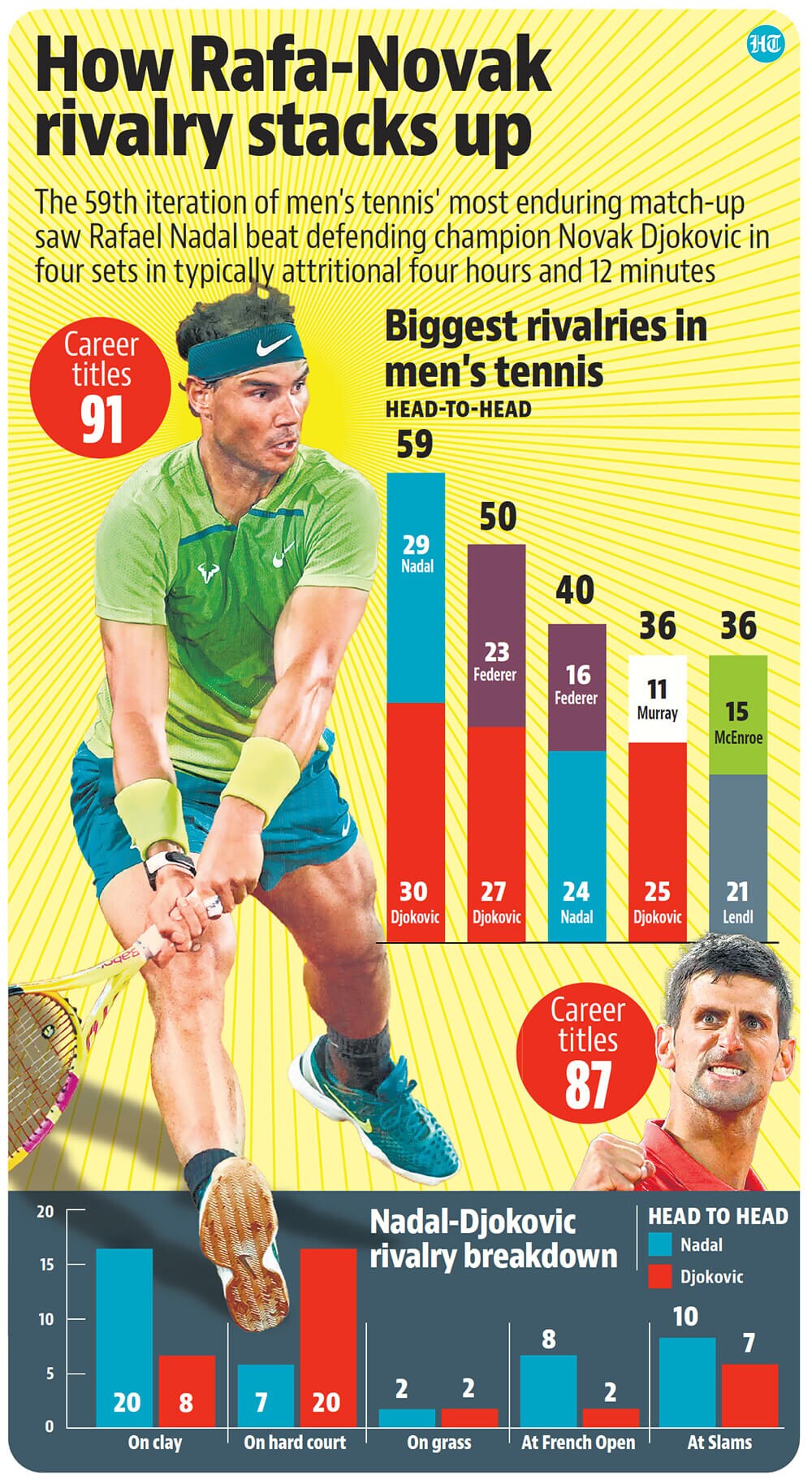
Contest No 59 between these two indomitable forces was as momentum-shifting as the last time they crossed paths. Then, Djokovic beat Nadal for just the second time at Roland Garros, in the semi-final, rolling on to win the title. Now, Nadal ensured lightning did not strike two years on the trot.
And that is what makes this great rivalry richer with each passing match. Not only do Nadal and Djokovic continue to push each other 16 years after they first stood across the net at the 2006 Roland Garros, but also pull each other from running away with the bragging rights. The head-to-head record now stands at a tighter-than-ever 30-29 in Djokovic’s favour. Nadal has won three of their last five meetings while Djokovic has come out on top in three of their last five Slam outings.
No other rivalry in modern-day men’s tennis comes close in terms of quantity or quality. Sure, the Roger Federer-Nadal duels may carry a different emotional vibe, but they reached its crescendo as a contest before either player dominated in clumps (Nadal won five straight meetings between them from 2013-14; Federer six consecutive from 2015-19). The “fedal” express has also increasingly slowed down. In the last six years, Nadal and Federer—with a 24-16 record—have faced each other in only two seasons (2017 and 2019). Djokovic and Nadal, meanwhile, have competed at least once each year since 2006.
“Of course we have a lot of history together,” Nadal said. “A lot of important moments playing against each other. (It) always is a special match, playing against Novak.”
Like it was on Tuesday night on Court Philippe-Chatrier, where Nadal delivered another age-, skill- and fitness-defying masterclass against the world No 1 to bolster his chances of claiming French Open No 14 and Grand Slam No 22.
Forehand firing; backhand bruising
Nadal ended up ticking both the winners (57 to 48) and unforced errors (43 to 53) boxes against Djokovic. But it’s the consistent damage he inflicted with his lethal forehand, which Djokovic could not match from his efficient backhand wing, that was telling.
Nadal fired 10 forehand winners in the opening set. It shot up to 16 in the second but so did the error count to 13 from that side of his racquet, which provided Djokovic a window to sneak back in from 3-0 down and steal the set. The southpaw course corrected and got more solid with his forehand, which trimmed his errors to six each in the third and fourth sets while keeping the winners volume high at six and 10 respectively.
Djokovic’s backhand, among his most trusted weapons, remained erratic; the two back-to-back errors to end the first set and a fluffed put away at the net in the second, for example. Djokovic had six backhand unforced errors in the first set, which increased to 10, seven and seven in the next three. The Serb managed to turn things around in the second set courtesy eight winners from his backhand wing. But once it crashed to zero in the third, so did Djokovic’s momentum.
Drop shot, shot down
During Nadal’s straight-sets thrashing of Djokovic in the 2020 French Open final in October played under similar conditions as this night quarter-final, Djokovic won 7/11 and 4/7 drop shot points in the first two sets. It stood at 2/10 in the third as Nadal began reading the change of pace from the other side a lot better.
The ineffective Djokovic drop shot carried on from one chilly night to another two years on. The world No 1 produced just two winners from the 21 attempted drop shots, winning four other points by inducing an error from Nadal (who, by the way, won 10 points off the drop shot). From the second game of the match where Nadal ran to meet the ball at the net with ease right until the tiebreaker where a Djokovic drop shot crashed into the net at 5-1 down, the strategy from the Serb never bore fruit. Nadal could read it, chase it and counter it.
(Second) serve it right
Nadal enjoyed a 60% win on the second serve while Djokovic tottered at 42. So impressive was Nadal with his second serve that he lost just two points on it during the first and fourth sets. Nadal, in fact, had better serving numbers throughout, getting 71% first serves in (Djokovic had 68%) and winning 65% of those points. The Serb’s 64% win rate on points behind the first serve was much lower than his 77% from the first four matches.
No physical troubles
By the time the marathon 18-minute sixth game of the second set ended, Nadal was sweating profusely. Not only did that game see Djokovic spring back to life at 3-3, it seemed to take a bit out of Nadal. It was reminiscent of their four-set semi-final last year, where Djokovic was able to sustain his level physically even as Nadal’s waned.
No such troubles this time for the Spaniard two days shy of turning 36. Nadal maintained his physical shape, strength and stamina during the 252-minute tug-of-war even as his foot showed no signs of discomfort. As he hobbled in his Rome defeat two weeks before the French Open, the lingering foot issue was the biggest cloud around Nadal’s 2022 Roland Garros rendezvous. Not anymore.
Djokovic dusted, bring on Alexander Zverev. The French Open favourite is back.


