
 E-Paper



A Buddhist Monk’s Alleged Indulgence in Money and Sex Transfixes China
An official probe into the jet-setting abbot of China’s Shaolin Temple has fueled cynicism about capitalism and religion.


Shi Yongxin rode in luxury cars, traveled the world to meet the rich and powerful, and presided over a globe-spanning business empire.
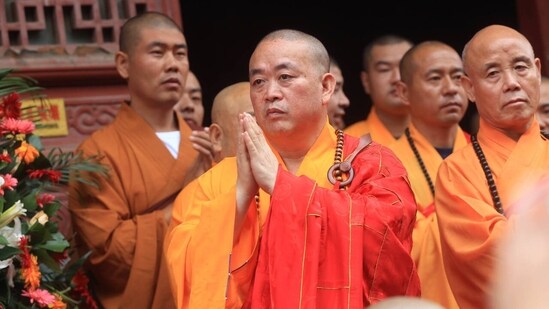
He’s also a monk and the abbot of China’s Shaolin Temple—perhaps the world’s most famous Buddhist monastery, founded more than 1,500 years ago and renowned today as the birthplace of Zen Buddhism and a cradle of Chinese martial arts.
For years, allegations of his distinctly un-Zenlike lifestyle have fueled salacious rumors and drawn government scrutiny. But Shaolin’s announcement on Sunday that its abbot is again under investigation for embezzlement and sexual misconduct has spurred a wave of cynicism across China, a country that had celebrated capitalistic derring-do—such as the kind Yongxin showed in building the monastery’s business interests—but is now less tolerant of materialistic excess.
The investigation resurfaced past claims against Yongxin, who survived an earlier probe into allegations publicized a decade ago that he committed financial malfeasance and fathered a child. The news also fed suspicions of corruption in religious groups and a government coverup, at a time when China’s economic slowdown is reviving interest in spiritual matters among many Chinese.
On social media, users mocked Yongxin, questioned the government’s perceived lapses in policing the abbot’s conduct and lamented what they saw as moral decay in a materialistic society.
“When someone reported him 10 years ago, who protected him at the time?” one user wrote on the Weibo platform, where a hashtag on the Yongxin probe garnered more than 860 million views by Tuesday.
Some users recalled how a famous Chinese martial-arts novel featured a Shaolin abbot disgraced by revelations that he fathered a child. Others called on Beijing to cleanse the graft plaguing faith groups in China, where the officially atheist Communist Party supervises all religious affairs.
“We should conduct a proper nationwide rectification of this ‘industry’ that harbors filth and moral corruption, and even overrides moral traditions, party discipline and state law,” Ren Yi, an influential commentator who uses the pen name “Chairman Rabbit,” wrote on Weibo.
Shi Yongxin transformed Shaolin Temple into a kung fu academy and commercialized its fabled past.
Shaolin, in a brief statement on Sunday, said several agencies are jointly investigating Yongxin for alleged crimes that include misappropriating funds and temple assets; as well as severe violations of Buddhist precepts—maintaining improper relationships with several women and fathering illegitimate offspring.
The following day, the state-backed Buddhist Association of China, which oversees the practice of Buddhism, condemned Yongxin for his “very vile” actions and agreed with a recommendation to revoke Yongxin’s ordination certificate—thus defrocking the 59-year-old monk.
Yongxin couldn’t be reached for comment.
China’s Buddhist faithful are no strangers to scandal. In 2018, the president of the Buddhist Association of China resigned after he was publicly accused of sexually harassing nuns and embezzling funds.
The probe against Yongxin, however, threatens to tar not just China’s Buddhist community, but also a global cultural icon.
Founded in the late fifth century in the central province of Henan, Shaolin Temple was transformed from a dilapidated sanctuary to a gleaming kung fu academy under Yongxin, whose commercialization of the monastery’s fabled past prompted local media to dub him “Shaolin CEO.”
For a man sworn to asceticism, Yongxin cut a flashy figure. He sported an iPhone, traveled in luxury cars, and accepted lavish gifts from devotees. He traveled the world to meet luminaries including Queen Elizabeth II, Nelson Mandela and Apple CEO Tim Cook.
Born as Liu Yingcheng into a Buddhist family, Yongxin went to Shaolin in 1981 at the age of 16, according to his 2010 memoir, “Shaolin Temple in My Heart.” The monastery was poor and had fewer than 30 people at the time, he wrote.
Yongxin became a trusted assistant to Shaolin’s abbot, managing the temple’s daily affairs before assuming control as its de facto head—at the age of 22—after the abbot’s death in 1987, according to the memoir. Yongxin formally became Shaolin’s abbot in 1999.
Under Yongxin, Shaolin monetized its reputation as a kung fu capital, tapping the popular imagination fired by TV shows and movies, including the 1982 film “The Shaolin Temple.” The monastery trademarked and licensed the use of its name, staged martial-arts performances, promoted tourism, sold merchandise including kung fu manuals and incense and pushed to build overseas temples.
Shaolin’s monastic complex and the surrounding areas were added to the Unesco world heritage list in 2010, boosting its appeal to foreign tourists—including NBA star Victor Wembanyama, who visited the temple for a spiritual retreat in June.
“What we have done is spread Buddhism and its spirit of universal love,” Yongxin told The Wall Street Journal in 2007.
Yongxin also parlayed his success into political influence. He became a vice chairman of the Buddhist Association of China in 2002 and was a member of China’s national legislature from 1998 to 2018.
Critics accused Yongxin of adulterating Shaolin’s spiritual roots with crass commercialism. The abbot defended his entrepreneurial efforts as necessary for securing the temple’s future. “It not only promotes Buddhism but also solves our existential problems, so what’s not to like?” Yongxin wrote in his memoir.
For years, rumors swirled about Yongxin’s conduct. Hackers attacked Shaolin’s website in 2009, posting a note telling the abbot to go to hell, as well as a fake apology letter from Yongxin listing his alleged misdeeds.
Yongxin faced claims that he stashed money and owned luxury properties abroad, had illicit affairs with women and fathered a child, according to a 2011 profile by a state-run magazine. In an interview with the magazine, Yongxin denied wrongdoing and rejected claims that he lived lavishly and had earned an MBA. If the online allegations were true, “we would have run into problems a long time ago,” he said.
It couldn’t be determined what prompted the latest probe against Yongxin. Caixin, a Chinese financial magazine, reported late Monday that authorities imposed an exit ban on Yongxin after he returned from an overseas trip earlier this year, before local officials moved into Shaolin in May and set up a group to oversee the temple’s management.
Yongxin’s Weibo account most recently published a post on Thursday. “When one’s own nature is pure, the pure land is present,” it said.
The post has since been peppered with derisive and sardonic comments. “Who’s your protector?” one asked. Another user riffed off a Buddhist expression, saying, “If you don’t descend into hell, who will?”
Write to Chun Han Wong at chunhan.wong@wsj.com


