
 E-Paper



China records new daily high of Covid cases and night of rare protests
While the rest of the world has mostly moved on to an endemic existence with the virus, China continues to adhere to the recently eased but stringently implemented “zero-Covid” policy of isolating every single infection with isolation, lockdowns and mass tests


Beijing: China on Saturday reported a third consecutive daily record for new Covid-19 cases amid numerous social media reports of citizen protests against restrictions including a large scale demonstration in the northwestern city of Urumqi and sporadic ones in Beijing, indicating a seething resentment among people over lockdowns and unexplained curbs upending lives and shrinking incomes.
While the rest of the world has mostly moved on to an endemic existence with the virus, China continues to adhere to the recently eased but stringently implemented “zero-Covid” policy of isolating every single infection with isolation, lockdowns and mass tests.
Given the fast spreading, and country-wide, Omicron-driven outbreak, the worst since the pandemic began, the policy has disrupted normal lives and depressed the economy.
China on Saturday reported 35,183 new Covid-19 infections for Friday including a handful of “imported” cases, the national health commission (NHC) said in its daily bulletin, of which 3,474 were symptomatic while the remaining were asymptomatic.
The big cities of Guangzhou, Chongqing and Beijing continued to struggle to contain raging outbreaks with the capital recording another single day high of nearly 2,600 new infections.
Beijing, a city of nearly 22 million people, has literally grinded to a halt in the past week with Covid-19-related restrictions implemented in all of its 16 districts - this when a lockdown has not been formally announced.
The worst hit, and most populous, Chaoyang district has all but been locked down with local authorities shutting down offices, restaurants, malls and most public spaces. Residents are being discouraged from stepping out of their homes unless necessary.
Many apartment blocks in Beijing have been partially sealed only because of a single case in a neighbouring compound; in some places, residents have not been told why their apartment buildings have been put under “static management” or lockdown.
Mass tests, meanwhile, continued in the southwestern city of Chongqing, a municipality of over 30 million people.
“In southwest China’s Chongqing Municipality, which has registered more than 60,000 infections since November 1, authorities organised retail companies to set up temporary stands outside the residential complexes that were under closed-off management,” the official news agency, Xinhua said in a report on Saturday.
The Commerce ministry said it will make greater efforts to ensure the supply of daily necessities, especially for residents in areas hit hard by the Covid-19 resurgence.
The southern Chinese city of Guangzhou, home to nearly 19 million residents, continues to be the current epicentre of China’s ongoing wave of Omicron-driven outbreaks.
Between October 22 and Friday, the city recorded more than 120,000 infections, mostly asymptomatic cases, according to official information compiled by news website Caixin.
Citizen protests
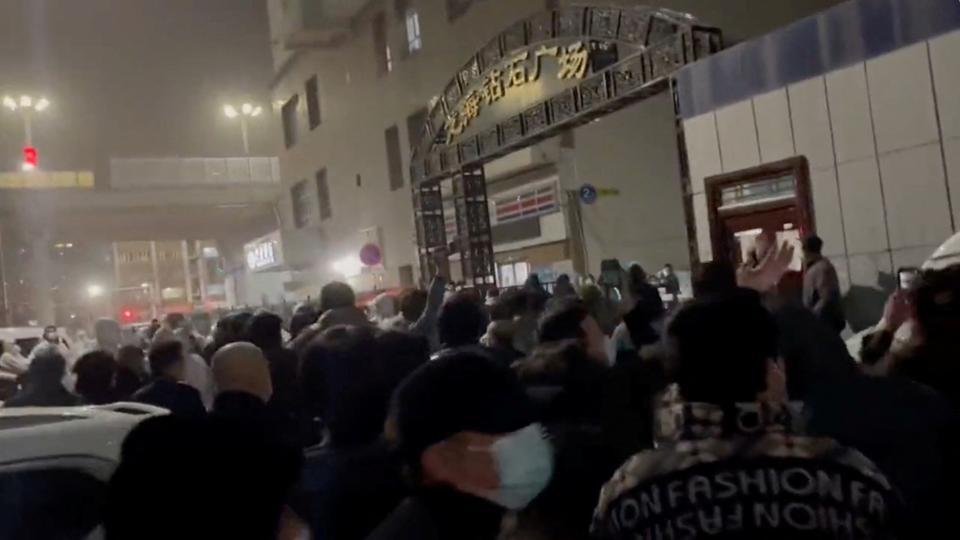
Many reports of protest by citizens against China’s “zero-Covid” rules were shared over social media especially on Twitter through the intervening night between Friday and Saturday, giving a rare glimpse of the simmering anger among many residents over Covid control policies.
Video footage and pictures showed people protesting, in large and small groups as well as individuals, across China in cities like Urumqi, Beijing, financial capital Shanghai, Zhengzhou in central China and Chongqing.
Thousands of residents in northwest Xinjiang’s capital Urumqi spilled over to the streets and gathered in front of the provincial government’s office on Friday night in protest following two incidents: The death of 10 persons in a blaze in a high rise where fire brigade personnel could not reach in time, and security personnel beating up a resident in Lianxing neighbourhood for questioning Covid control policies.
Videos showed massive crowds chanting “end the lockdown” as they marched towards the provincial government office; some footage showed citizens arguing with security personnel.
Many of Urumqi’s four million residents have been barred from leaving their locked down homes for over two-to-three months, in some cases for over 100 days, because of the “zero-Covid” policy despite infection numbers being low.
The fire incident trended on China’s Twitter-like Weibo platform with many describing the incident as a tragedy related to Beijing’s Covid control policies. Related news was shared and viewed over 780 million times.
One particular comment, which referenced deaths including suicides related to the “zero covid” policy, was shared on Chinese social media before being censored.
Posted on Twitter by user @haifeng_huang, the translated comment said: “I was the one who jumped off the building, I was the one who was in the overturned bus, I was the one who walked away from Foxconn…It was me who had no income for a month...and it was me who died in the fire. If it’s not me, then next time it will be me.”
Responding to the situation, the Xinjiang government announced on Saturday, according to state-run tabloid, Global Times, that the city has “…basically cleared Covid-19 cases at community level, and will restore order to the lives of residents in low-risk areas in a phased manner.”
An investigation team had been set to probe the cause of the fire and those found guilty of causing the accident will be punished, the Global Times reported.
News and footage of community-level protests in Beijing showing irate residents demanding that compounds be reopened were shared on social media as well. In at least one case, the lockdown was revoked.


