E-Paper



Delhi may soon get its 3rd flyover with trees
If opened in its current state, the flyover will become the third in Delhi where vehicles are forced to navigate around standing trees.

 Prefer HTon Google


The public works department (PWD) is preparing to open the Nand Nagari flyover to traffic by August—even as trees remain standing in the middle of its carriageway due to pending forest clearances. The 1.5km stretch, part of Delhi’s ₹157.85 crore push to make Wazirabad Road signal-free, is nearly 85% complete, officials said. But delays in securing tree-felling permissions have left more than 60 trees rooted along the alignment, raising concerns about potential traffic hazards.
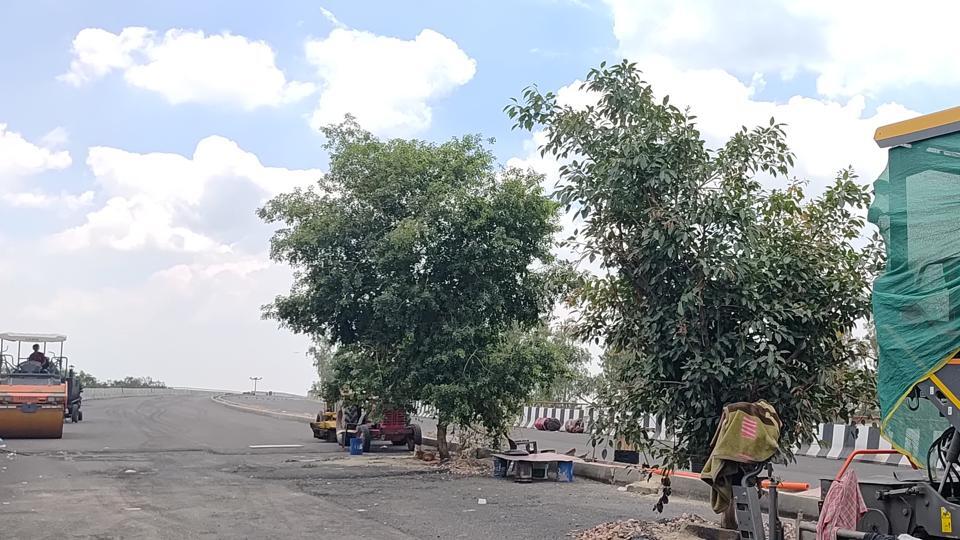
If opened in its current state, the flyover will become the third in Delhi where vehicles are forced to navigate around standing trees. Earlier this year, the Anand Vihar and Punjabi Bagh flyovers were inaugurated with full-grown trees left under or even between traffic lanes, as the forest department’s nod failed to arrive in time. The PWD is now taking a similar approach here—treating the removal of trees as a “pending work” to be handled post-opening through a supplementary agreement.
“Opening the traffic flow is a priority as it will offer relief from congestion along the stretch,” said a senior PWD official, adding that the agency aims to make the flyover operational around Independence Day.
A report dated June 21 said the core structure will be ready by July-end. However, it flagged multiple safety concerns, including sewer lines and manholes obstructing the retaining wall near the Nand Nagari depot, debris on service roads, and missing drain covers—each posing accident risks. “Debris, silt and malba near the ramp must be removed immediately… Lighting should also be improved for safe traffic movement at night,” the report stated.
The project, which began in February 2023, was originally slated for completion by July 2024. In addition to the elevated corridor, it includes road improvements, footpaths, upgraded drainage, and rainwater harvesting.
The six-lane flyover starts from the Nand Nagri junction and ends near the Gagan Cinema T-junction, covering a 1,500-metre stretch of National Highway-9. It serves commuters travelling between North Delhi and Uttar Pradesh and connects densely populated colonies such as Dilshad Garden, Gonda, Mustafabad, and Karawal Nagar.
Tree-related delays have proved to be a major stumbling block. While 63 trees are listed for felling or transplantation—36 on the e-Parivesh portal and 27 under the Delhi Preservation of Trees Act (DPTA)—approvals are still awaited. On June 4, Lieutenant Governor VK Saxena invoked a special exemption under Section 29 of the DPTA to lift area restrictions and allow the application to be reviewed. However, final clearance from the forest department is still pending.
Once operational, the corridor is expected to halve the current 30-minute travel time for those commuting to Bhopura via Signature Bridge. A foot overbridge on the stretch will be demolished and replaced with a subway for pedestrian access.