
 E-Paper



HistoriCity: The 1000-year-old Indian connection to the Thailand-Cambodia dispute
The Prasat Preah Vihear Temple complex is at least two hundred years older than the more famous complex, Angkor Wat, which was built in the 12th century.

 Prefer HTon Google


At the beginning of the Common era, two millennia ago, trade had begun between the Indian peninsula and Southeast Asian countries. The Buddhist Jatakas are replete with references to outflow of sailors, who worshipped in particular Buddha Dipankara. In the later centuries, Buddhist adherents were joined by Brahminical clans from along the entire eastern coast who eventually conquered the region and established their rule, which lasted till the 15th-16th centuries.
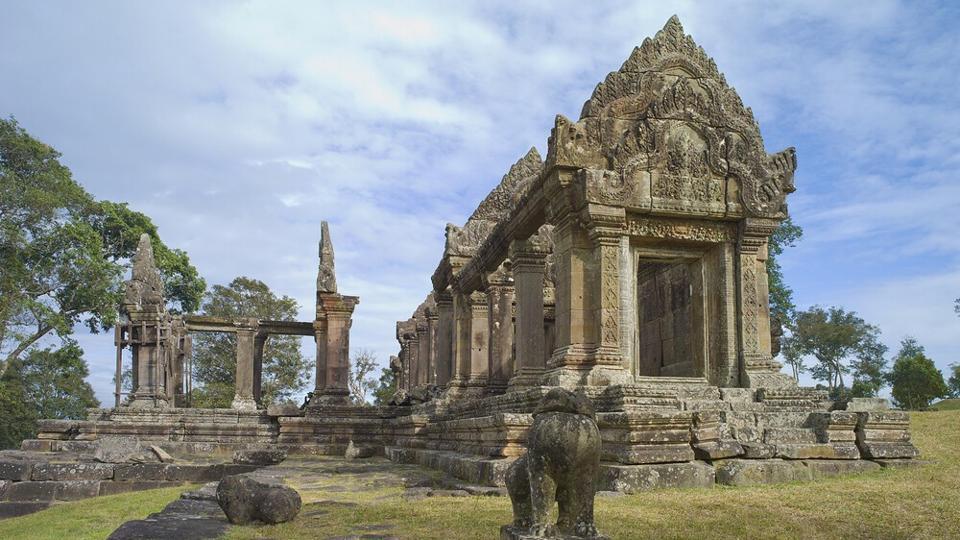
What were the processes of Indianisation of Southeast Asian countries like Thailand, Cambodia and Indonesia? How deeply did these Indianised kingdoms of Sri Vijaya Khmer, Sukhothai and others influence the pre-existing cultures and practices; were they limited to elite circles while citizens remained out of their pale? These questions are worth revisiting in the wake of the deadly conflict between Cambodia and Thailand over the Prasat Preah Vihear Temple situated among the Dangrek mountains at their border.
The temple in dispute
The Prasat Preah Vihear Temple complex is at least two hundred years older than the more famous complex, Angkor Wat, which was built in the 12th century. Prasat (Prasad or religious offering in Sanskrit) Preah Vihear began as a monastic complex during the reign of king Yashovarman I (889-910CE), sometimes also called the leper king.
George Coedes writes in his seminal work, ‘The Indianized States of Southeast Asia’: “During the reign of Yasovarman that construction was begun on the Sivaite temples of Sikharisvara ( “the Siva of the summit”) at Preah Vihear and of Bhadresvara at Sivapura (Phnom Sandak)”. Notable among Yashovarman I’s other architectural achievements was the construction of dozens of monasteries (serving Buddhists too), a 7km X 2km large artificial reservoir and the foundations of Yashodharpura, which would later become the foundation of the Angkor Wat complex in the 15th century.
It must be remembered that a fusion of Mahayana-Buddhism and Shaivism evolved in Cambodia. This diversity is also discernible from the patronage of various sects such Shaivas, the Pashupatas, and the Tapasvus as well as Vaishnavite sects such as the Bhagvatas, the Sattvatas, and the Buddhists. A balance was struck in terms of Buddhism and Brahminism as the kings were often Shaivites while the high-ranking officials were both Brahmins and adherents of Mahayana Buddhism.
The kings who followed Yashovarman continued the patronage of religion. With Suryavarman II whose nearly four decades long reign (1113-1150 CE), the Angkorian or Khmer empire (also known as Kambuja in Sanskrit records), reached the zenith of its power and architectural glory. Suryavarman II diverted an unprecedented amount of state resources in the construction of the Angkor Wat complex, making it the largest Hindu temple in the world, and dedicated it to Vishnu.
Codes writes, “The reign of Süryavarman II, as it appears in epigraphy, was marked by endowments at Phnom Chisor, Phnom Sandak, Vat PhU, and Preah Vihear and by a series of buildings including the principal elements of Preah Pithu in Angkor Thom, Chau Say Tevoda and Thommanon east of the city, and finally the masterpiece of Khmer art, Angkor Wat, constructed during the lifetime of the king for whom it was to serve as a funerary temple. It was in Angkor Wat that Süryavarman II was to be deified in the form of a statue of Vishnu with the posthumous name Paramavishpuloka.”
His dedication of the Angkor temple to Vishnu was a break from the customary primacy of Shiva in the Varman dynasty. The reasons for his preference for Vaishnavism remain a matter of debate. Even though Angkor Wat remained the focus, the Preah Vihear temple too received major offerings in the form of new Gopurams, monasteries, and a gold statue of Nataraja. Suryavarman II also continued to have friendly ties with the Chola empire of Tamil Nadu, who was their ally against the neighbouring Thallassocratic Sri Vijaya empire centred in the island of Sumatra.
The India-South East Asian Acculturation
Beginning with trade, the centuries-long interaction between Indians and Southeast Asian regions led to the Indianisation of the region. K A Nilakanta Sastri writes in The History of South India: “Just as in classical times the Greek colonists carried with them the fire from the sacred hearth of the city, a token of their filial relation to the land they left in search of new abodes, so also the Hindu colonists carried a cult with them, the cult of Saivism in which Siva played the role of the guardian of the state, thanks to the kind offices of his chief devotee. . .”.
This would explain the presence of both Buddhist deities as well as Hindu gods like Shiva and Vishnu. Codes sums it up well, “Indian-style kingdoms were formed by assembling many local groups— each possessing its guardian genie or god of the soil— under the authority of a single Indian or Indianized-native chief. Often this organisation was accompanied by the establishment, on a natural or artificial mountain, of the cult of an Indian divinity intimately associated with the royal person and symbolizing the unity of the kingdom.”
Codes continues: “This custom, associated with the original foundation of a kingdom or royal dynasty, is witnessed in all the Indian kingdoms of the Indochinese Peninsula. It reconciled the native cult of spirits on the heights with the Indian concept of royalty, and gave the population, assembled under one sovereign, a sort of national god, intimately associated with the monarchy. We have here a typical example of how India, in spreading her civilization to the Indochinese Peninsula, knew how to make foreign beliefs and cults her own and assimilate them—an example that illustrates the relative parts played by Indian and native elements in the formation of the ancient Indochinese civilizations and the manner in which these two elements interacted.”
HistoriCity is a column by author Valay Singh that narrates the story of a city that is in the news, by going back to its documented history, mythology and archaeological digs. The views expressed are personal.


