After Prabowo Subianto was elected president of Indonesia last year, he told his younger brother that he would finally be able to “carry out programmes from papi” and fulfil their father’s “aspirations and dreams”. That father is Sumitro Djojohadikusumo, the architect of Indonesia’s post-independence development. He served as a minister under both Sukarno, Indonesia’s first president, and Suharto, the dictator who ruled for 32 years.
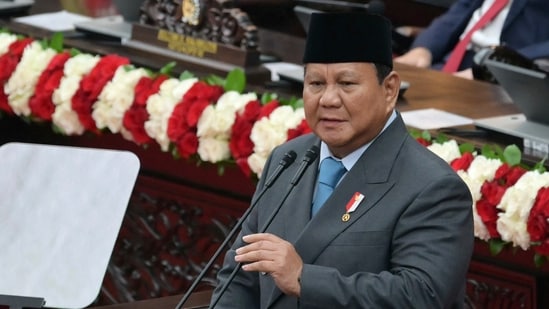
Indonesian President Prabowo Subianto delivers his annual State of the Nation Address, ahead of the country's Independence Day in Jakarta Friday, Aug. 15, 2025. (AP)
But the uncomfortable truth is that if Sumitro were alive today, he would be appalled by the economic populism masquerading as his legacy. The cosmopolitan economist, who founded the economics faculty at the University of Indonesia, would probably see Mr Prabowo’s signature policies—free school lunches, village co-operatives and a new sovereign-wealth fund—as precisely the kind of undisciplined state spending he spent his career warning against.
Sumitro’s economic philosophy wasn’t ideological. Rather, he was pragmatic, believing in rigorous training and evidence. Though he came of age as a socialist in Paris, his approach was grounded in a clear method. First, identify the right problem; second, establish the facts; and only then apply logic to find a solution. When Indonesia lacked trained economists, he persuaded the Ford Foundation to send students to the University of California. That produced the “Berkeley Mafia” of technocrats who would later drive Suharto’s economic success. He argued as early as 1952 that the government should avoid direct economic intervention if there was little capacity to execute it well.
Mr Prabowo’s pledge to spend $28bn a year on free school meals is the kind of sweeping state intervention Sumitro warned against. Indonesian children eat enough, but not well. But instead of nutritional quality, the programme increasingly prioritises raw numbers of meals served, says Arianto Patunru of Australian National University. The best way to reduce stunting is to help pregnant women and toddlers; the current policy misdirects resources to schoolchildren.
Or consider the example of co-operatives. Sumitro supported them as tools for genuine, decentralised development, not as instruments of political control. This perspective had deep roots. In 1942 he completed his PhD thesis on rural credit in Java while he was living in the Netherlands, which was occupied by Germany at the time. For the rest of his career this research fuelled his belief that small traders throughout Indonesia would remain trapped in poverty unless the government invested in education, training and co-operatives.
This spirit of grassroots empowerment could not be more different from Mr Prabowo’s latest initiative of “red-white co-operatives”. Unveiled in July, the programme imposes a uniform model on 80,000 co-operatives nationwide, requiring each to run the same services regardless of local needs, says Kevin O’Rourke, a political analyst. This betrays the spirit of genuine co-operatives. The policy is designed to extend central control into rural areas, rewarding loyal village heads.
The most glaring case of historical revisionism is Danantara, Indonesia’s new $900bn sovereign-wealth fund. Mr Prabowo’s brother, Hashim Djojohadikusumo, has said that it fulfils their father’s vision of consolidating state assets and directing strategic investment. But Sumitro might well have thought its structure was a mess. Danantara reports directly to the president, is chaired by Mr Prabowo’s former campaign manager and has little oversight. Sumitro would have recognised this as a textbook case of what he called Indonesia’s “institutional disease”: the corrosion of public policy by vested interests. He diagnosed this problem at the height of the Asian financial crisis in 1998, when Suharto was bending state power to serve his family’s businesses. This week the head of a state-owned farming firm quit six months into the job, blaming Danantara for needless red tape.
Sumitro understood that a developing economy faces a delicate balancing act. His policies aimed to attract foreign investment while steadily building Indonesia’s institutional capacity. His son, by contrast, has chosen to trade fiscal stability for flashy, vote-winning programmes that entrench his power and do little to drive long-term growth. His administration blends authoritarian control with populist spending. This is a travesty of Sumitro’s real legacy: of the disciplined fiscal policy and strong institutions Indonesia badly needs.
Subscribers to The Economist can sign up to our Opinion newsletter, which brings together the best of our leaders, columns, guest essays and reader correspondence.
Get the latest headlines from US news and global updates from Pakistan, Nepal, UK, Bangladesh, Russia and US Iran war Live, get all the latest headlines in one place on Hindustan Times.
Home/World News/Indonesia’s New President Has Daddy Issues

 E-Paper