Sign in

Intel agencies say IS behind Dhaka attack, Bangladesh still silent

Though the Sheikh Hasina government blamed recent attacks on local Islamists opposed to her regime, IS propaganda magazine Dabiq carried an article titled “The Revival of Jihad in Bengal with the spread of light of the Khilafah” in May.

Updated on: Jul 3, 2016, 17:26:16 IST
Hindustan Times | By , New Delhi
Share
Share via
  • facebook
  • twitter
  • linkedin
  • whatsapp
Copy link
  • copy link

Though Dhaka insisted the Gulshan café massacre was instigated by local Islamist fundamentalists, Indian and western intelligence agencies confirmed that Friday’s attack was mounted by the Bangladeshi module of the Islamic State led by Abu Ibrahim al-Hanif with foreigners as the main target.

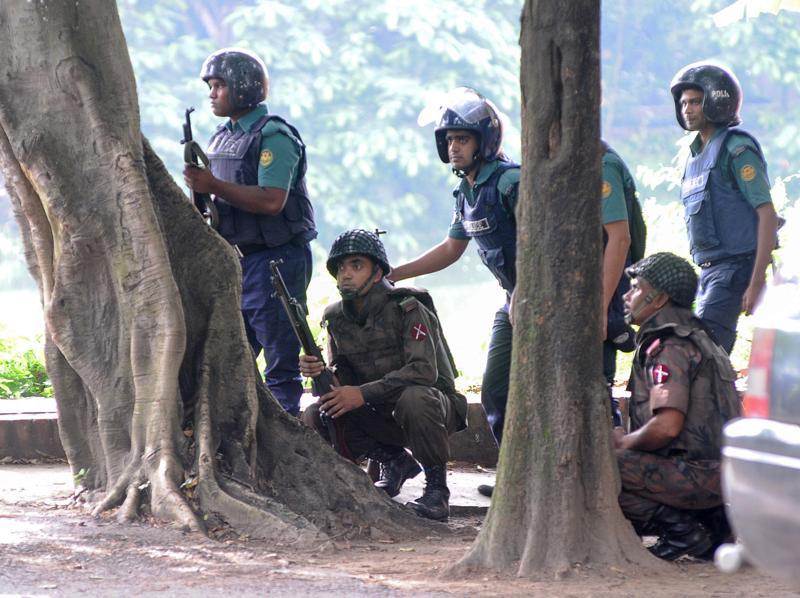
Army soldiers take their positions near the Holey Artisan restaurant after Islamist militants attacked the upscale cafe in Dhaka. (REUTERS)

Top government sources told HT that Indian agencies were briefed by their Bangladeshi counterparts on Saturday afternoon after being tight-lipped about the attack for more than 12 hours. The attack led to Indian agencies alerting the police in West Bengal and Assam, where the Jamaat-ul-Mujahideen Bangladesh (JMB) has been active since 2006.

The JMB terror group, which owes allegiance to the IS, declared West Bengal its 65th chapter in 2006. After a October 2, 2014 explosion in Burdwan, Indian security agencies busted the JMB’s bomb-making modules in West Bengal, Assam and Jharkhand, which had already sent five or six bomb consignments to Bangladesh. The chief bomb maker was identified as Hath Kata Nasrullah, who absconded and has been at large since.

Read | Dhaka attack: Bangladesh may be confronting a more fearsome militant foe

Though the Sheikh Hasina government blamed recent attacks on local Islamists opposed to her regime, IS propaganda magazine Dabiq carried an article titled “The Revival of Jihad in Bengal with the spread of light of the Khilafah” in May.

The first evidence of IS activity in Bangladesh was available when Asif Adnan, Mohammed Faile Elahi and Samiun Rahaman were arrested for planning to travel to Syria to join the IS.

There has been a series of Indian intelligence inputs that a large number of Bangladeshis have been radicalised by the IS over the internet.

Consequent to the ban on the Hizb-ut-Tehrir, JMB, Harkat ul Jihad al-Islam, Ansarullah Bangla Team and Shaheed Hamza Brigade, their leaders formed groups with different names.

“The crackdown by the Bangladeshi government on terror groups has furthered the inclination of some radicals towards the IS. The mushrooming of radical Islamists has added to terrorist activity, with these groups capturing the online space in Bangladesh,” a senior intelligence official said.

  • Shishir Gupta
    ABOUT THE AUTHOR
    Shishir Gupta

    Shishir Gupta is Executive Editor at Hindustan Times and one of India's top journalists covering national security, strategic affairs, foreign policy and geopolitics. Over the past three decades, he has extensively reported on India's military, diplomatic and security landscape, covering every major conflict and national security challenge, from the 1999 Kargil War and the 2020 East Ladakh standoff to Operation Sindoor in 2025. He has also covered major terror attacks, including the IC-814 hijacking, the 26/11 Mumbai attacks and the 2025 Pahalgam terror strike, along with numerous Pakistan-backed terrorist incidents in the Kashmir Valley and across India. He has reported on national and state elections for more than three decades. A recognised authority on strategic affairs, Gupta has covered India's nuclear programme since the Pokhran-II (Shakti series) tests in May 1998 and has written extensively on global nuclear issues, Indian diplomacy and the country's expanding global outreach. He has also reported widely on international conflicts and terrorism, with a special focus on the Indian subcontinent. Gupta has interviewed Prime Minister Narendra Modi more than four times, including Modi's first interview with the print media after becoming Prime Minister in May 2014. His other interviews include three with the Dalai Lama, as well as conversations with Benjamin Netanyahu, Amit Shah, Yogi Adityanath, S. Jaishankar, Nirmala Sitharaman and Piyush Goyal. He is the author of Indian Mujahideen: The Enemy Within (Hachette, 2011) and Himalayan Face-off: Chinese Assertion and Indian Riposte (Hachette, 2014). He was awarded the Chevening-Wolfson Joint Scholarship at Wolfson College, University of Cambridge, UK, in 1998 and participated in the International Visitor Leadership Program (IVLP) of the US State Department in 2006. He received the Ben Gurion Prize from Israel in 2011 and the K. Subrahmanyam Prize for Strategic Studies in 2015 from the Manohar Parrikar Institute for Defence Studies and Analyses (MP-IDSA). Since 2024, he has hosted Point Blank, Hindustan Times' weekly YouTube show on global geopolitics.Read More

Get the latest World News, breaking headlines and global updates from the US, UK, Pakistan, Bangladesh, Russia and other countries. Follow major international events on Hindustan Times.