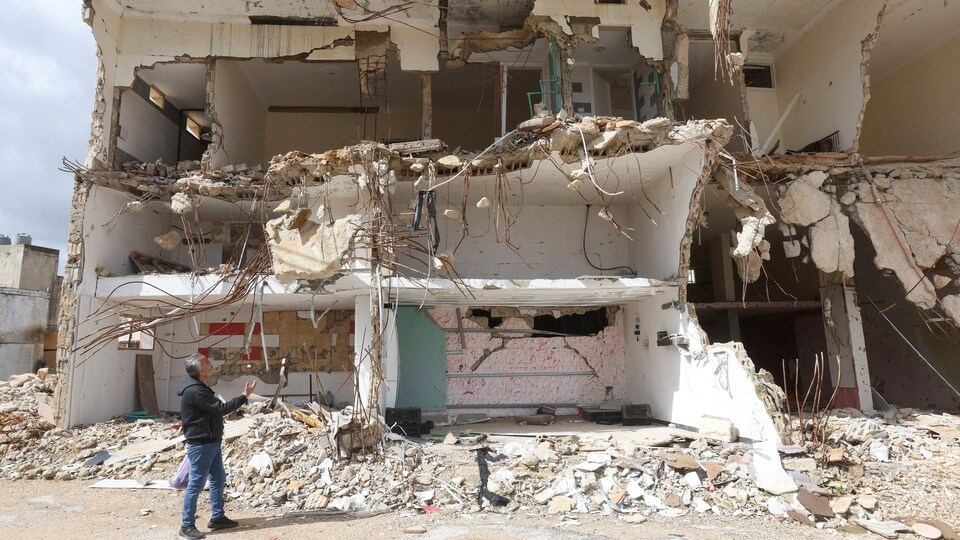
The border between Israel and Lebanon bears the scars of its most recent war
Updated on: Mar 8, 2026, 15:24:51 IST
The Economist
Prefer HTon Google
Share via
Copy link
The border between Israel and Lebanon bears the scars of its most recent war. On the Lebanese side, the village of Mais al-Jabal—used by Hizbullah, an Iran-backed militia, to launch many of its attacks—is now empty, with many buildings destroyed by the Israel Defence Force (idf). On the Israeli side, many of the north-facing homes on the small kibbutz of Manara are pockmarked and scorched, with marks left by Hizbullah’s missiles. Most of the residents in Manara and other Israeli border communities have returned home over the past year. Now a new conflict, triggered by America’s and Israel’s war in Iran, is brewing in Lebanon.
The border between Israel and Lebanon bears the scars of its most recent war (REUTERS)
map
Hizbullah has already joined one war against Israel. In October 2023 it began firing on the country the day after Hamas launched its surprise attacks from Gaza. That time it took nearly a year for the Israeli-Hizbullah war to escalate. Eventually Israel killed Hassan Nasrallah, the group’s veteran leader, and many of his cadres in air strikes, and launched a ground invasion.
In the early hours of March 2nd Hizbullah joined a second war against Israel, launching rockets and drones towards the country in support of its patron, Iran. This time Israel immediately responded with hundreds of air strikes on Hizbullah sites in Beirut and other parts of Lebanon. The idf, which already had five outposts on the border, jutting into Lebanese territory, sent more troops and pushed deeper into the country. For now its commanders claim they are holding only “enhanced defensive” positions, but they are already mustering as many as two armoured divisions by the border in anticipation of a much broader ground operation. Israeli soldiers and Hizbullah fighters have begun skirmishing.
Other signs suggest that Israel is preparing for a bigger war. For days, convoys of Israeli tanks, infantry-fighting vehicles and mine-clearing bulldozers have been making their way to the border. Tens of thousands of reservists have been called up. Although Israeli generals say the government has not yet ordered them to send in their main forces, there seems little doubt it will. With the region and wider world distracted by the war in Iran, and with Hizbullah still weakened from the last war in Lebanon, Israel reckons it is unlikely to have a better opportunity to wipe out its enemy.
Meanwhile, Israeli air strikes are becoming more frequent, hitting hundreds of targets throughout Lebanon, including the Dahiyeh neighbourhood of Beirut, Hizbullah’s stronghold. Israel has warned civilians to leave Dahiyeh, parts of Bekaa Valley in the east, and the area between its border and the Litani River, around 20 miles to the north. Hundreds of thousands face displacement, for the second time in two years.
A ceasefire signed in November 2024 mandated the withdrawal of Hizbullah’s forces to the Litani River. It also included assurances that the Lebanese army would take up positions on the border. Some of the rockets fired this week were launched from south of the Litani according to the idf, giving them a license, they argue, to launch their counter-offensive. Whereas Israel has intercepted most of Hizbullah’s missiles and drones (those that hit have caused no casualties), its strikes have killed over 200 Lebanese in four days, according to the country’s health authorities.
Israel had been expecting Hizbullah’s attack. It had detected messages from Iran urging them to enter the fray. Hizbullah has long been Iran’s most important proxy, and Ayatollah Ali Khamenei, the Islamic Republic’s supreme leader, was one of Hizbullah’s main patrons. The group retains an allegiance to him and his regime even after his assassination on the first day of the war.
In fact, Israel’s generals were hoping for Hizbullah to attack so that they could justify a renewed offensive. Israel destroyed much of its enemy’s formidable missile arsenal and communication networks in 2024, leaving the group severely weakened. But Hizbullah has been rebuilding its power since then. It still has missiles capable of reaching Tel Aviv, even if the ones it has fired in the past few days have been intercepted. It seems to be co-ordinating some of its salvoes against Israel with ones from Iran, in the hope of misdirecting Israel’s missile-defence batteries. It has also launched drones against a British base in Cyprus.
Above all, the group remains both a military and political force within Lebanon. “To destroy Hizbullah’s military force, we need to pressure the Lebanese government,” says David Azoulay, head of the local council in Metula, another Israeli border town. But the Lebanese army, while deploying south of the Litani over the past year, has proven incapable of reining in Hizbullah. On March 2nd Nawaf Salam, Lebanon’s prime minister, declared “all Hizbullah’s security and military activities” illegal, effective immediately, and demanded it hand over its weapons to the state. Hizbullah rejected the call.
Instead, Israel’s generals argue, they will have to do the job themselves. They warn that it will take months of ground manoeuvers inside Lebanon to destroy what remains of Hizbullah’s infrastructure. Even then, the group may retain considerable support among Lebanon’s Shia community and from Iran, at least for as long as the regime clings on.
Israel hopes that, if the Iranian regime is toppled, this may be the last of its wars in Lebanon. But it has been fighting in the country since before the Islamic revolution in 1979, first against Palestinian organisations and then against Hizbullah. Hizbullah was established in 1982 with the Iranian regime’s support and inspiration. It plans to outlast its patron.
Get the latest World News, breaking headlines and global updates from the US, UK, Pakistan, Bangladesh, Russia and other countries. Follow major international events on Hindustan Times.
Home/World News/Israel Sees A Chance To Destroy Hizbullah At Last

 E-Paper





 Prefer HTon Google