As Vice President JD Vance arrived in New Delhi Monday for a four-day visit to India, small groups of protesters carrying red-and-white hammer-and-sickle flags gathered in towns and villages across the country. “Vance go back! India is not for sale!” they chanted.
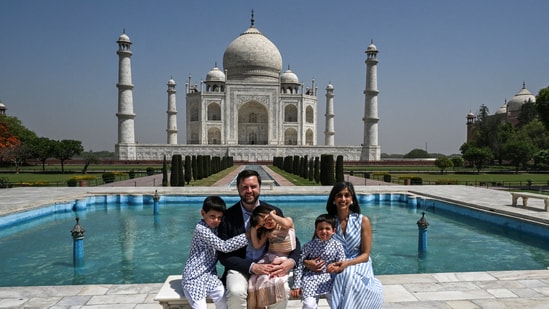
U.S. Vice President JD Vance and the Second Family visit the Taj Mahal, in Agra, India April 23, 2025. Kenny Holston/Pool via REUTERS (via REUTERS)
For many decades, a visiting U.S. dignitary in India was all but guaranteed to attract legions of angry demonstrators clogging the streets of major cities. The tepidness of the protests against Mr. Vance underscores a quiet but remarkable change. Anti-Americanism, once a staple of street protests in India, has largely lost its bite.
Prime Minister Narendra Modi set the tone of the visit by presenting peacock feathers to Mr. Vance’s three children, who accompanied their parents to India. In a speech in Jaipur, southwest of New Delhi, Mr. Vance lauded India’s “sense of infinite possibility” and national pride, which he said is “a striking contrast with too many in the West.”
On Tuesday, as news broke of a brutal Islamist terrorist attack in Kashmir that claimed at least 26 lives, Mr. Vance tweeted his solidarity with India. President Trump posted a similarly supportive message on Truth Social. If the attacks are traced to Pakistan, as appears likely, and if India retaliates, the Indian public will expect America to stand behind them as it has in the past.
Why did India’s anti-Americanism—a glaring reality for anyone who visited the country during the Cold War—lose its appeal? Terrorism is one reason. Since the 9/11 terrorist attacks, the U.S. has become increasingly sympathetic to India’s problems with attacks sponsored by its neighbor, Pakistan.
Two factors in particular soured Washington on Islamabad—Pakistan’s support for the Taliban and the U.S. discovery that Osama bin Laden was hiding in Abbottabad, less than a mile from Pakistan’s premier military academy.
Economic growth in India also eroded anti-American sentiment. Until India began opening its economy in 1991, it was one of the most obvious economic losers of the postwar period. About half of Indians lived in extreme poverty. Politicians preferred to channel voters’ frustrations toward alleged American perfidy rather than their own failings.
Today India is far better off. Less than 10% of the population lives in extreme poverty, and many Indians have higher self-esteem after more than three decades of robust economic growth.
Worries about China have also taken the wind out of anti-Americanism’s sails. Indian diplomats once fretted about Washington growing too powerful in places like neighboring Nepal and Sri Lanka, which India regards as within its traditional sphere of influence. Now, with China making deep inroads across the region, New Delhi is more worried about Washington’s presence being too weak than too strong.
Domestic politics has also come to reflect a changing economic and geopolitical landscape. When President George W. Bush visited India in 2006, an alliance of communists and Muslims prevented him from addressing Parliament, marring his visit with massive protests. Communists at the time controlled 62 of the 543 seats in India’s directly-elected lower house of Parliament. Today they hold only nine.
By contrast, Mr. Modi’s ruling Hindu nationalist Bharatiya Janata Party alone has 240 seats. The BJP has its share of nativist and xenophobic elements, but the dominant view in the party is that it’s in India’s interest to forge a close relationship with the U.S.
India’s first prime minister, Jawaharlal Nehru, inherited an upper-crust English disdain for America from his years at the Harrow School and Cambridge University. But his once-dominant Nehru-Gandhi dynasty has been reduced to a shadow of its former self. In the 1970s, Nehru’s daughter, Indira Gandhi, surrounded herself with British-educated Marxists. Such people no longer hold sway in Indian public life.
Finally, emigration plays a role in India’s closer ties with the U.S. In a phone interview, Ashok Malik, head of the Indian branch of the Washington consulting firm The Asia Group, points to the success of the 5.2 million strong Indian-American diaspora as an important factor in diminishing Indian America-bashing. “The fact is that Indians like America,” says Mr. Malik. “All of us have a third cousin in America who has done well, and we believe the American system has been fair to him or her. For Indians, America as the land of opportunity is not just some abstraction.”
Get the latest headlines from US news and global updates from Pakistan, Nepal, UK, Bangladesh, Russia and US Iran war Live, get all the latest headlines in one place on Hindustan Times.
Home/World News/JD Vance’s India Visit Highlights Closer U.S. Relations

 E-Paper