
 E-Paper



Guru Granth Sahib's 300-yr-old manuscript open to public in Scotland: How it got there, and its Kohinoor connection
The scripture, one of the three Sikh religious text at the university, once belonged to Maharaja Kharak Singh of Punjab, the second ruler of the Sikh Empire.

 Prefer HTon Google


A 300-year-old handwritten manuscript of the Sikh holy scripture Guru Granth Sahib in Scotland, believed to be the oldest of its kind in the UK, will soon be open to devotees to pay their respects.
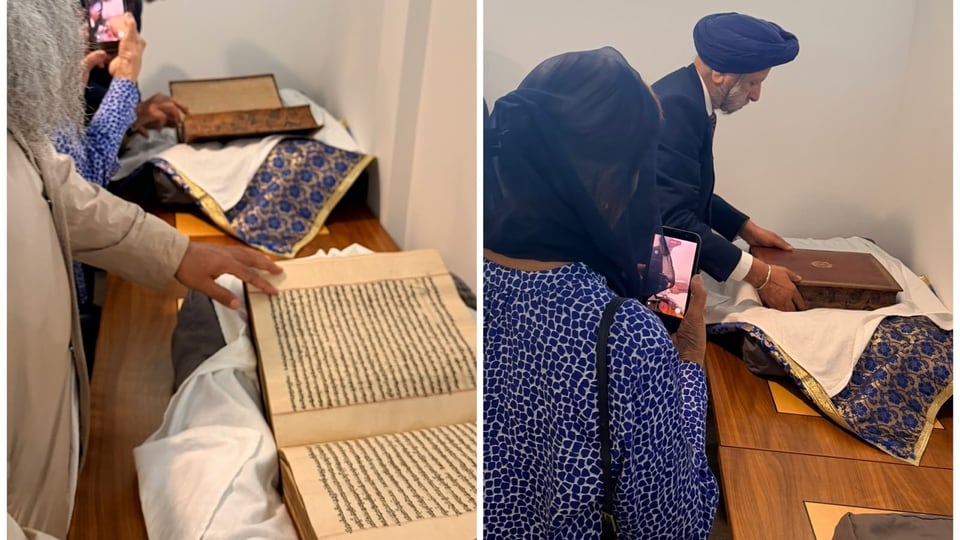
The sacred manuscript, which once belonged to Maharaja Kharak Singh of Punjab, was discovered in the University of Edinburgh's archives in 2020. Kharak Singh was the eldest son and successor of Maharaja Ranjit Singh, the founder of the Sikh Empire.
The Consulate General of India (CGI) in Scotland, joined a meeting with gurdwara representatives from the region and officials of the university to facilitate the darshan.
"The Consulate team was pleased to join Gurudwara Representatives from Edinburgh and Glasgow, Mrs. Trishna Singh of Sikh Sanjog and University of Edinburgh @uniofedinburgh officials for a coordination meeting to facilitate darshan of the 300-year-old manuscript of Sri Guru Granth Sahib Ji Maharaj at Central Gurdwara, Glasgow," the consulate general said in a statement.
How manuscript reached Scotland
The manuscript is believed to be the oldest of its kind in the UK and was discovered in the Scotland University archives in 2020. Dating back to the 1700s, it was discovered after researchers found it in the digital archives of the library.
It is one of the three Sikh religious texts at the university, and once belonged to Maharaja Kharak Singh of Punjab, the second ruler of the Sikh Empire. From Kharak Singh, the scripture is believed to have been taken from the Fort at Dullewalla in Punjab during its capture by the British in 1848.
The handwritten scripture was then handed over to the archives of the University of Edinburgh through Sir John Spencer Login, who also brought the Kohinoor diamond from the Sikh Empire to Queen Victoria during colonial rule.
How the scripture was discovered?
According to Trishna Singh, managing director of community organisation Sikh Sanjog, Sikh researchers from England were looking for artefacts and found the entries on the university's website.
After the holy manuscript was discovered, the Sikh community held a special ceremony in a gurudwara last November in Leith, a suburb of Edinburgh. Sikhs from across Scotland gathered to view it. The sacred manuscript has since then undergone extensive restoration and preservation.
Trishna Singh recalled her first encounter with the scriptures as a "mind-blowing experience".
“I was so amazed, but there was part of me that was upset. I thought of my grandparents and my parents who'd lived in Glasgow, Scotland, since the late 1930s and never knew that there was this wonderful, amazing piece of our history sitting here in the university,” PTI quoted her as saying.
The University's Heritage Collections team has since been involved in conserving the scriptures, alongside an ongoing dialogue with the Sikh community in Scotland.


