
 E-Paper



Singapore Airlines tragedy: What's in-flight turbulence? Top 10 most turbulent routes
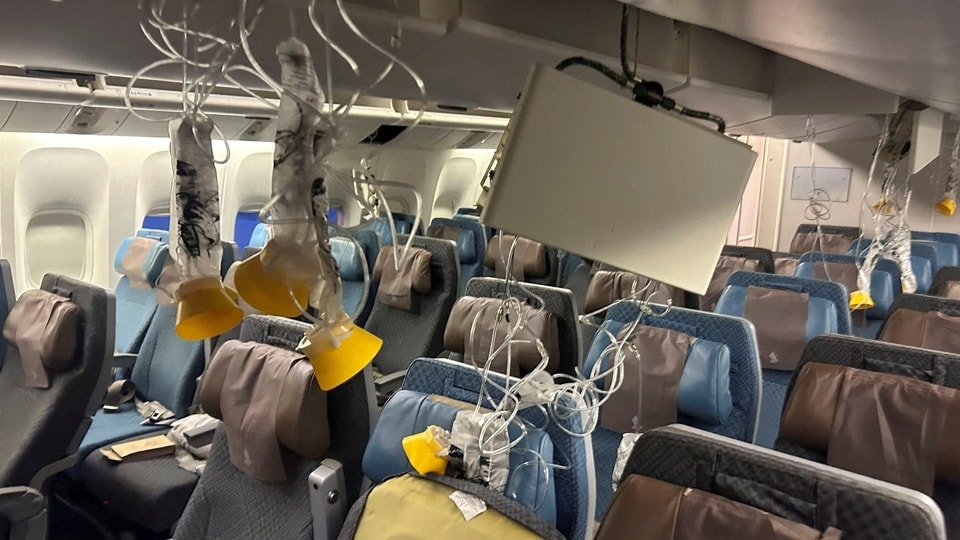
Singapore Airlines flight horror: The flight descended 1,800 metres in severe turbulence. 73-year-old British man died.

 Prefer HTon Google


A Singapore Airlines flight experienced severe turbulence over the Indian Ocean on Tuesday, causing it to descend 1,800 meters in three minutes, the airline said. A 73-year-old British man died as the Boeing 777 shook severely.
ALSO READ- Who was Geoff Kitchen? Singapore Airlines passenger who died in turbulence horror: 5 points
What is in-flight turbulence?
Turbulence is unstable air that moves unpredictably. While often associated with storms, the most dangerous type is clear-air turbulence, which occurs without visible warning.
Due to wind shear, clear-air turbulence typically happens near high-altitude jet streams, where two large air masses move at different speeds. If the speed difference is significant, the atmosphere breaks into turbulent patterns, similar to eddies in water. Thomas Guinn, chair of the applied aviation sciences department at Embry-Riddle Aeronautical University, explained that strong wind shear near the jet stream causes chaotic air motions.
ALSO READ- Singapore Airlines flight horror: 3 Indians among passengers hit by turbulence
How common are turbulence-related injuries?
In the United States, more than one-third of airline incidents from 2009 to 2018 were due to turbulence, resulting in serious injuries but typically no plane damage, according to the National Transportation Safety Board (NTSB).
From 2009 to 2022, 163 people were seriously injured during turbulence events, requiring hospital treatment for at least two days. Most of these injuries involved flight attendants, who are more vulnerable because they are often out of their seats during flights.
“It's not uncommon to have turbulence encounters that cause minor injuries up to, say, a broken bone,” said Larry Cornman, a project scientist at the National Science Foundation's National Centre for Atmospheric Research. “But fatalities are very, very rare — especially for large transport aircraft.”
Top 10 routes that encounter most turbulence
According to Turbli website which has produced its rankings by analysing 1,50,000 routes using data from UK and US government meteorological agencies, the routes with the highest average turbulence:
1. Santiago - Santa Cruz
2. Almaty - Bishkek
3. Lanzhou - Chengdu
4. Centrair - Sendai
5. Milan - Geneva
6. Lanzhou - Xianyang
7. Osaka - Sendai
8. Xianyang - Chengdu
9. Xianyang - Chongqing
10. Milan - Zurich
(Inputs also from PTI)


