
 E-Paper



Stephen Hawking’s voice to be beamed towards nearest black hole in final send-off
His ashes will be interred between major British scientific figures Isaac Newton and Charles Darwin at Westminster Abbey on Friday.


The voice of Stephen Hawking will be beamed into space in a message of peace and hope on Friday, his daughter said, as the British physicist is laid to rest during a service at Westminster Abbey.
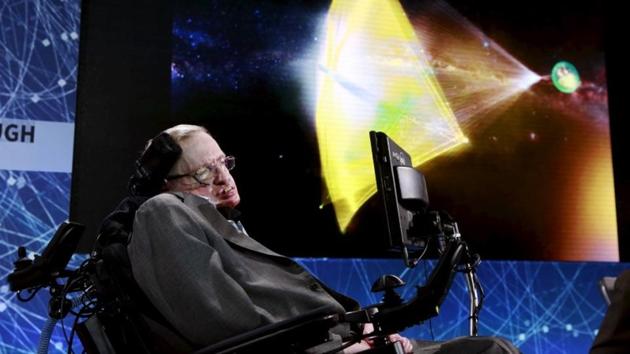
The world’s most recognisable scientist died in March aged 76 after a lifetime spent probing the origins of the universe, the mysteries of black holes and the nature of time itself.
His ashes will be interred between major British scientific figures Isaac Newton and Charles Darwin at Westminster Abbey, a location made famous worldwide for generations of royal coronations, weddings and funerals.
Around 1,000 members of the public, selected by a ballot, will join Hawking’s family for the service. The physicist’s voice will also be sent into space by the European Space Agency.
“The broadcast will be beamed towards the nearest black hole, 1A 0620-00, which lives in a binary system with a fairly ordinary orange dwarf star,” his daughter Lucy Hawking was quoted as saying by the BBC.
“It is a message of peace and hope, about unity and the need for us to live together in harmony on this planet.”
Hawking will be laid to rest between Newton, who formulated the law of universal gravitation and laid the foundations of modern mathematics and Darwin, whose theory of evolution was one of the most far-reaching scientific breakthroughs of all time.
Internment inside Westminster Abbey is a rarely bestowed honour. The most recent burials of scientists there were those of Ernest Rutherford, a pioneer of nuclear physics, in 1937, and of Joseph John Thomson, who discovered electrons, in 1940.


