
 E-Paper



Terms of Trade: Rhetoric cannot spare the world Donald Trump’s belligerence
Trump’s aggression vis-à-vis his western allies is primarily driven by his belief that the US should be entitled to more rewards and less responsibilities.

 Prefer HTon Google


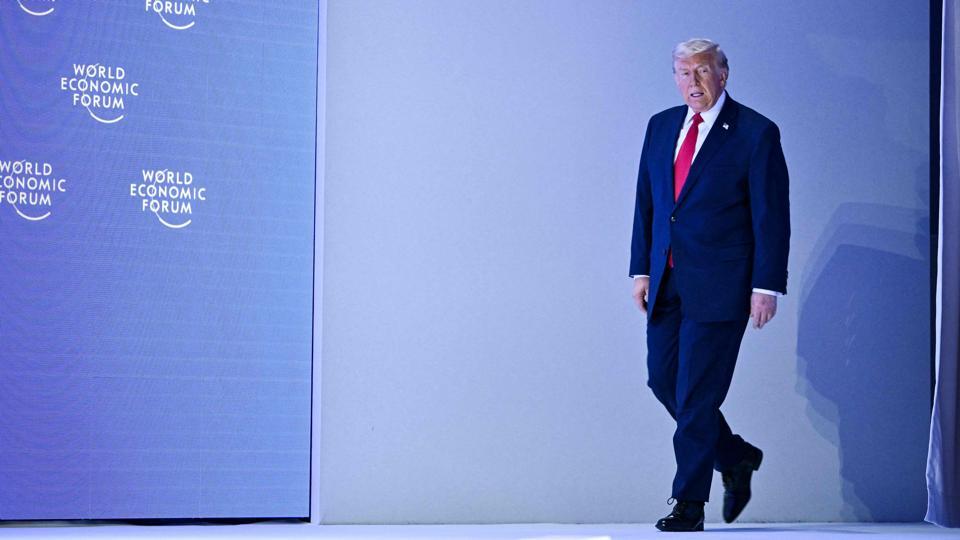
If the commentariat had its way, Canadian Prime Minister Mark Carney’s “Havel’s Greengrocer” inspired speech at the World Economic Forum in Davos would be put on the same pedestal as Winston Churchill’s “We will fight them on the beaches” speech delivered in the British parliament in 1940. The outpouring of sentiment is not without reason. Western liberalism is perhaps facing its biggest existential threat since fascism threatened it during the Second World War. Carney’s refusal to continue “living with a lie” is at least a declaration of an intent that the Western world sans the US will not surrender to Trump’s threats which entail nothing but complete liquidation of sovereignty.
Intent or articulation, no matter how goosebump-giving, does not make realpolitik. All of Churchill’s speeches would have meant nothing if the US and USSR had not come to the rescue of a beleaguered Europe against fascism. The current global order is no different. US’s pivot from the virtuous to the vulgar and vicious notwithstanding, it is still the global economic leader in global capitalism’s scheme of things. In fact, all of Trump’s tariffs are premised on the US’s leadership in the global economic order. If you do not do what I want, I will squeeze your access to US markets is his primary threat to the world. Of course, negotiations are being held according to each country’s strengths and it should not be surprising at all that China, the second largest economic and military power in the world has managed the best deal without doing what Trump wanted it to do.
To say this does not mean that the status quo is not without its instabilities. The biggest reason the US has Trump in power and the rest of the world is now having to bear with him is that the country is finding it increasingly untenable to deliver on its role as the global capitalist leader.
The idea and importance of a global capitalist leader was made popular by the economic historian Charles P Kindleberger. Kindleberger attributed the Great Depression of 1929 to the inability of the existing capitalist leader, namely, Britain, to carry on with the function of the global capitalist leader and the unwillingness of the next capitalist leader, namely, the US to take over those responsibilities.
Kindleberger’s global capitalist leader was expected to deliver on five key responsibilities, as described in the concluding chapter of his book The World in Depression 1929-1939. They are, in Kindleberger’s order of priority: maintaining a relatively open market for distress goods (providing import markets), providing a countercyclical, or at least stable long-term lending, policing a relatively stable system of exchange rates, ensuring the coordination of macroeconomic policies, and acting as a lender of last resort by discounting or otherwise providing liquidity in financial crisis.
The US is still the most important economic power when it comes to providing an export market to the rest of the world, is critical to coordinated macroeconomic policy via things such as being committed to inflation targeting, etc. (which is why the world is losing its sleep over the Federal Reserve’s independence) and is central to exchange rate regimes across the world, thanks to the dollar’s dominant currency status. One can agree that functions such as lender of last resort are not so important in today’s world as they were in the first half of the 20th century and what we have instead is the US’s role as the leader of the western military block.
The problem, as far as the US is concerned, is that it cannot even furnish its limited role as the global capitalist leader without inflicting significant pain on its domestic population. The core economic base which propelled Trump into power is the rust belt electorate which has seen its economic fortunes decline with the hollowing out of US manufacturing and its substitution with imports, primarily from China. His other theatrics, such as forcing the Federal Reserve to bring down interest rates and capping credit card interest rates etc. are aimed at mitigating the economic pain of his poorer voters who are unlikely to have benefitted from his short-sighted tariffs. To be sure, he would also like things such as the equity market etc. to gain from low interest rate induced booms, but that could very well be more personal than political .
Trump’s aggression vis-à-vis his western allies is primarily driven by his belief that the US should be entitled to more rewards and less responsibilities for its role as the leader of the military alliance which is supposed to protect the global liberal order. Trump rightly sees it as a US-led order than his naïve allies who convinced themselves they were protecting liberalism. Moral outrage aside, none of the NATO allies can afford to plug the financial hole a US withdrawal would create in the military alliance.
Where does this leave the “middle powers” then, a category Carney seems to have invented in his Davos speech? Can they really build “something bigger, better, stronger, more just”, as Carney called for? Are more reforms, tax-cuts, free trade agreements, diversification etc. the way to do it, as the speech suggested?
All such proclamations tend to escape a basic economic reality. It is the unprecedented disruption China has unleashed on the global economic order by introducing a critical asymmetry in capitalism as we know it today.
China is now sitting at the level of development of productive forces where there are very few things which it cannot make on its own. In fact, it can make most things far more efficiently than other countries, especially in the West. More and more advanced economies are now trying to get China to buy low value-added products from them (US wants to sell soybeans and the Canadians are pitching shrimps to China) in return for buying industrial goods from the Chinese. China has achieved this advancement of productive forces without building a social security apparatus like Europe’s, which is now turning out to be impossible to fund, or facing democratic anxieties like the US does over loss in living standards or cultural rupture thanks to historical or migration-induced fault lines.
The biggest takeaway of this asymmetry, as far as our question is concerned is that China can continue to increase its squeeze on the social-political contract in the western world without facing similar problems at home despite having economic fault lines which, while they might be different, are not insignificant by any means. The world, especially the West, got more than an inkling of the implications of an economic decoupling from China during the latter’s zero-Covid policy when supply chains went haywire and inflation spiked out of control.
The global economic order, for lack of a better term, can be compared to a Siamese twin, where the child with the finance head is the US and that with the production head is Chinese. In the short run, it is next to impossible to live without either . It is delusional to think that either will surrender their positions voluntarily. For the “middle powers” to be able to even pose a credible challenge this unpalatable status quo, they would have to do more than trying to secure shrimp markets with the Chinese or appeal to the US to maintain the sanctity of inflation targeting.
Even getting close to posing such a challenge would require an economic language which can appeal to the larger population at home rather than a privileged gathering of the global elite, who have made the biggest gains from the current world order, in a snow-capped Swiss resort. For all of his problems, Trump has proved to be better at this task than many of his newly “morally upright” peers. Successful politics often requires identifying a zero-sum game and winning it rather than giving sermons.
That is why it is called the art of the possible.
Roshan Kishore, HT’s Data and Political Economy Editor, writes a weekly column on the state of the country’s economy and its political fall out, and vice-versa.


