
 E-Paper



Top US general Mark Milley regrets park walk with US President Donald Trump
Defense Secretary Mark Esper had earlier sought to distance himself from the controversial walk that some are saying will be a watershed moment for the Trump presidency.

 Prefer HTon Google


General Mark Milley, America’s top military officer, on Thursday expressed regret for accompanying President Donald Trump on his controversial walk through a park outside the White House violently cleared of peaceful protestors on June 1 by law enforcement forces.
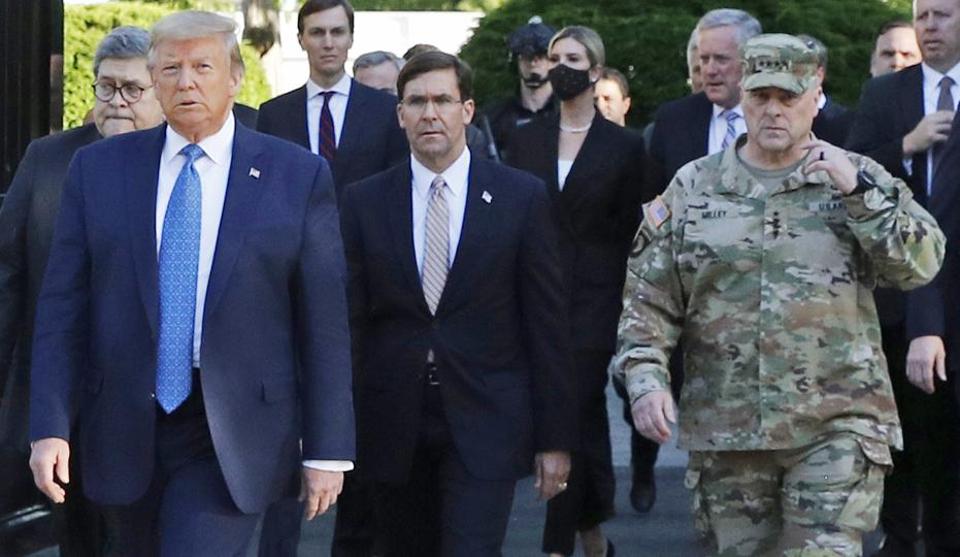
“I should not have been there,” Milley, chairman of the joint chiefs of staff, said in a pre-recorded video commencement address to National Defense University. “As a commissioned uniformed officer, it was a mistake that I have learned from, and I sincerely hope we all can learn from it.”
Defense Secretary Mark Esper had earlier sought to distance himself from the controversial walk that some are saying will be a watershed moment for the Trump presidency.
President Trump had strode out of the White House accompanied by a large entourage of officials and walked through a park swept clean of protestors with the heavy use of pepper spray canisters, tear gas shells and flash-bang grenades, to pose for pictures in front of a church damaged in protests earlier. He had just held up a copy of the Bible, but said nothing.
Esper, Milley and Attorney General Willam Barr were in the president’s entourage. Milley’s’ presence in military fatigues, which he wears every day to work, had attracted a lot of criticism as it was taken to indicate the US military was taking sides in a political event, contrary to its standing as an apolitical, non-partisan institution.
“That sparked a national debate about the role of the military in civil society,” Milley said. “My presence in that moment and in that environment created a perception of the military involved in domestic politics.”
“We who wear the cloth of our nation come from the people of our nation, and we must hold dear the principle of an apolitical military that is so deeply rooted in the very essence of our republic,” he added.
US military leaders have differed with the president also on the issue of renaming army bases names after general of the confederate army, in the wake of countrywide protests triggered by the death of George Floyd and the fierce debate that is under way to deal with persisting racism in the country. Esper and Milley were “open” open to discussions about renaming these bases. But the president shut it down in a string of tweets.


