
 E-Paper



London needs 1.1 million homes. Its 1940s planning rules stand in the way.
Home construction in the U.K. capital is nearing a standstill, with ground broken on just 4,170 housing units in 2024-25. The knock-on effects are far-reaching.


 Prefer HTon Google


LONDON—Shoreditch Works is the kind of real-estate project big cities say they need: It aims to revitalize a rundown block in east London, delivering about 80 new homes, retail space for several thousand workers, a green tech incubator and new pedestrian lanes and public space.
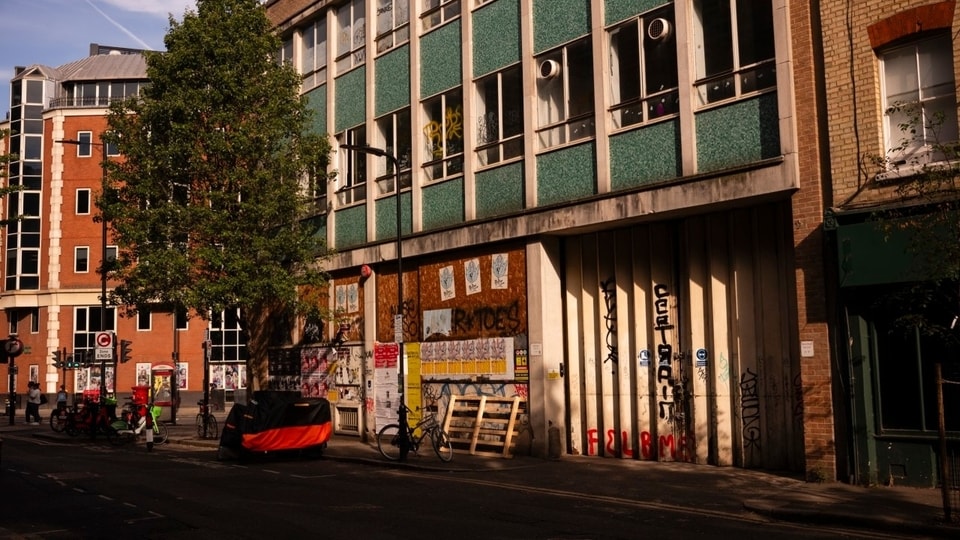
Developers have spent four years trying to convince authorities to approve their plan, submitting more than 9,000 pages in documentation. Local planning officers denied the bid earlier this year, saying it lacked detail. Among the other reasons noted: Tearing down two drab office buildings would “erase an interesting period in industrial history.”
The U.K. capital is at a crisis point. Home construction is nearing a standstill, thanks to a toxic mix of Byzantine regulations, increased building costs, high interest rates and politics.
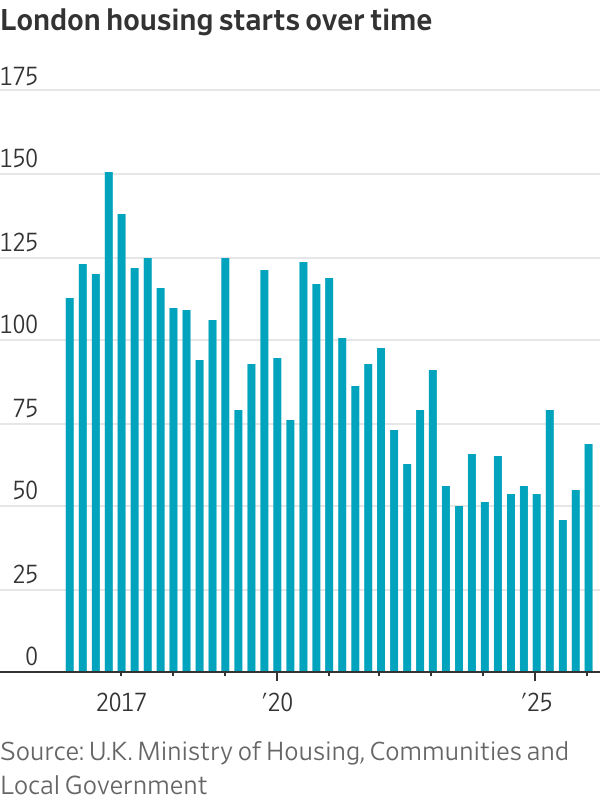
London has an official annual target of 88,000 new homes. It broke ground on just 4,170 housing units in 2024-25, according to data from the Centre for Policy Studies, a center-right think tank. During that period, the population grew by around 100,000.
Even among older cities in industrialized nations, where it’s often hard to find the space to build, London stands out. It would need to build 1.1 million more homes to reach the western European average of homes per capita, according to the CPS. Last year, Vienna built three times more houses than London, despite being a much smaller city.
The failure to build doesn’t just hold consequences for the livability of a city. It has knock-on effects that can distort the economy, politics and social mobility. The capital city, one of the few bright spots in the U.K. economy, is dimming under the strain.
Economic growth and productivity have taken a hit. Construction employment in London has weakened by 21% since 2017, according to government data. In the last quarter of 2025, work stopped on more than 5,000 homes at some 50 development sites, often because the building contractor went bust. Sky-high prices have weakened demand, while construction costs continue to climb.
“It’s holding London back, which is holding back the entire country,” said Anthony Breach, director of policy and research at the Centre for Cities think tank.
‘Strangling the city’
Cities across the Western world are struggling to address housing and affordability crises, squeezing residents and developers alike and breeding discontent.
Swelling anger in New York over rising living costs propelled the city’s first Democratic socialist mayor into office. Barcelona residents took to spraying tourists with water guns as Airbnb rentals exacerbated a housing shortage.
In London, the crisis has had far-reaching consequences. “It’s strangling the city,” said Paul Rickard, CEO of property developer Pocket Living.
London once attracted young graduates with good career opportunities and the chance to scale the property ladder, starting with a tiny apartment and upgrading when a promotion or baby arrived. For many, that’s now unattainable. More 20-somethings are choosing to move to more affordable cities like Manchester, which has a pro-development approach, Rickard said.
Housing prices in London have trended lower over the past year thanks to higher interest rates, but the lack of new supply is keeping prices higher than they should be.
First-time home buyers now pay an average of half a million pounds, or around $672,000—that’s 10 times the average annual salary, up from about 7.5 times in 2010. And the amount of space they get to enjoy ranks last among wealthy Western cities, with fewer square feet per person than Manhattan.
Those who can’t afford to buy spend years paying artificially high rent—renters today spend 42% of their income on housing costs, up from 15% in the 1950s and ’60s—delaying their ability to save or start a family, leaving many feeling alienated and disillusioned. The U.K., meanwhile, spends roughly £18 billion a year subsidizing rents for low-income families in London, according to the CPS.


Like many people his age, 34-year-old Nye Jones shares an apartment in London, and sees little prospect of being able to buy a place of his own. He pays around £1,000 in rent each month, excluding bills, and has to be careful about how he spends his money if he wants to save anything.
“In the winter it means trying to avoid putting the heating on to help with bills,” he said.
Jones, who grew up in London, always thought he’d own a home by the time he reached his 30s. Instead, he worries about a sudden rent increase. “I can’t really afford to pay any more.”
High rents have forced Laurence Fredricks, 25, to move six times in three years.
“I was briefly homeless because there was nowhere available to rent that I could afford,” said Fredricks, a Cambridge graduate who works as a researcher. Friends, meanwhile, are considering leaving the U.K. because they’re priced out.
The discontent over housing and broader economic malaise is also pushing voters away from the political mainstream. The populist Green Party has surged in popularity among London’s youth, in part by pitching strict rent controls. Older voters, meanwhile, are flocking to Reform UK, which blames immigration for increasing housing demand in an already tight market.
Intensifying that generational divide, longtime homeowners are staying put in their homes as they increase in value.
Jones says most of his peers feel demotivated. “Why should we work hard when we get to keep so little?”
Stalled sites and stagnation
The root of London’s stagnation lies in a 1940s-era system designed specifically to curb the city’s expansion.
Unlike the zoning-based models used elsewhere across the developed world, London planning operates on a case-by-case system that is largely up to a small group of bureaucrats in each of the capital’s 32 boroughs and the City of London. They consider a range of subjective criteria: whether a proposed project is out of character with existing buildings, or out of scale, or blocks too much light.
Local authorities set their own framework for development, designed to set the tone for all planning decisions. “But in practice, on the ground planning systems are often made by elected councillors whose main objective is usually to get re-elected, not to follow the plan,” said Sam Long, senior analyst at research firm Molior.

On top of that, rising construction costs have made it difficult to build a profitable high-rise, he said. A shortage of planning officers, meanwhile, means local authorities can’t keep up with the backlog.
“It’s Kafkaesque,” said Nicholas Boys Smith, chairman of Create Streets, a London-based think tank specializing in urban design.
He attended the February council meeting on Shoreditch Works, which went late into the evening. The majority of council members tried to persuade the planning officers it was a good development, he said, but to no avail.
“The development was better than most I’ve seen in London,” said Boys Smith. “I still don’t understand why they disliked it so much.”
A Hackney Council spokesperson said large projects like Shoreditch Works require careful consideration to ensure they meet policies around affordable housing, workspaces and impacts on neighboring buildings. “It is important these are properly assessed so that we can secure the best outcome for Hackney’s economy and our residents.”
The bid, after another raft of changes, now sits in the mayor’s office awaiting a final decision.
Fredricks, the researcher, says building in the city needs to be easier. “We treat developers like public services instead of businesses, layering on expectation after expectation,” he said.

The rate of refusal for residential projects across the U.K. has increased over the past two decades from 20% in 2000 to more than 30% in 2024, according to research published by the University of Warwick.
In London, 37 building projects with more than 20 units have been rejected since the start of 2025, according to data from Molior. After an application is turned down, the developer can choose to adjust the proposal and resubmit it, or submit an appeal. Three of the 37 subsequently made it through the appeals process.
Some London councils, like Croydon, briefly experimented with deregulation to spark a building boom, only to retreat following a political backlash from residents. “One distinctive feature of the British planning system is the degree to which it empowers local opposition,” said economist Christian Hilber.
In Lewisham, one recent development in Blackheath (population 17,000) was derailed by 1,000 objections, including a public campaign fronted by celebrities such as Jude Law.
The regulation has undoubtedly preserved London’s charm and character. One 1937 policy, known as St. Paul’s Heights, forbids any building from obstructing views of the cathedral’s dome from vantage points up to 10 miles away. The protected vistas have forced modern developers to shave the tops off skyscrapers or adopt slanted silhouettes. The city today consistently ranks among the world’s most visited, drawing millions with its historic buildings, abundant parks and rich culture.
But the lack of new homes hurts its residents. Waiting lists for social housing are at their highest level in more than a decade, with 336,000 households registered—a quarter of the national total. One not-for-profit social-housing provider said an eight-month delay to one of its regeneration projects resulted in a £2.2 million increase in building costs. Another developer said current approval rates have increased the financing costs of a £100 million project by £5 million.

Many blame the growing crisis on a lack of support from national and local leaders.
Andy Burnham, set to become the U.K.’s sixth prime minister in seven years, said he would launch the biggest social-housing building program in 70 years.
In late March, the government unveiled an emergency plan to spur home construction in London, including fast-track planning for sites delivering at least 20% affordable housing and removing guidelines holding up delivery of homes already earmarked for development.
Berkeley Group, London’s biggest house builder, welcomed the changes—but still warned it was scaling back its business in response to the “unprecedented increase in cost and regulation” in recent years.
As if to emphasize the point, a month later, the company’s application to convert a shopping center in southeast London into almost 900 homes was rejected for a second time. The planning officer acknowledged the critical need for new homes in London but ruled the harm to heritage buildings in the area outweighed the benefits of the development.
The local authority celebrated a “great day for Peckham” when the verdict came out. Berkeley Group is considering seeking a judicial review.
Still, the company hasn’t given up on the capital. “It offers security, heritage, and innovation in an uncertain global environment,” it wrote in an April letter.
There are success stories London could follow.
Auckland, New Zealand, made its planning rules more flexible in 2016, and doubled the rate of construction, which decreased rents and home prices over the following decade, according to the Centre for Cities. Vancouver, British Columbia, after revamping its regulation, exceeded its annual target by 54% last year. Austin, Texas, recently loosened its planning system and is now building 32,000 homes a year—the per capita equivalent of London building 113,000 a year, according to the CPS.
But getting there won’t be easy or quick.
Rules and more rules
The last time London got close to meeting its official target of 88,000 new homes a year was in the 1930s, when planning rules were simple.
Back then, planning permission took just three weeks to obtain and usually involved a dozen or so pages, according to Sam Dumitriu, head of policy at Britain Remade, a campaign group focused on promoting economic growth. Now, it usually takes years.
Some planning experts argue that slow construction is the result of nonregulatory complications, such as skill shortages, high material costs from postpandemic inflation and supply-chain shortages and higher interest rates that make financing more difficult.
“Regulation is one part of a complicated process, but a part that everyone seems to focus on,” said Hugh Ellis, director of policy at the Town and Country Planning Association. He says that without regulation, you end up with homes that flood, overheat, have space challenges or, worse, lead to another Grenfell disaster.
The 2017 Grenfell Tower fire, which killed 72 people, is the deadliest blaze in modern British history. It was blamed in part on the building’s highly flammable cladding and lack of alarms, sprinklers and a fire escape. Checks on other housing around England revealed hundreds of fire-safety failures.
Planning rules implemented in London after the fire, however, are so detailed that seven in 10 projects have since failed to get a green light, creating a bottleneck, according to the CPS.
One rule introduced this year requires any building taller than 18 meters, or about six stories, to have two independent staircases to improve fire safety and evacuation. Even projects that were close to being completed had to be redone to comply retroactively. The government’s own analysis found that the costs were 294 times greater than the safety benefits.
A spokesperson for Mayor Sadiq Khan said he is “using every power available to accelerate housebuilding despite the perfect storm of Brexit, high interest rates, increased building costs and global instability.”
Britain’s departure from the European Union, which promised to free the country of additional regulation, hasn’t eased the burden on developers. The U.K. has instead retained some of the most stringent EU environmental directives even as it added more of its own. Britain requires detailed environmental assessments for projects of just 150 homes, while in many EU nations, the threshold is 2,000.
“It’s a huge risk to get something through the planning process, and many projects become unviable,” said Phil Irwin, a London-based developer. In 2025, London had 281,000 unbuilt homes—houses that were conditionally accepted but never built, often because the developer decided the conditions were too arduous.

Irwin spent £40,000 on a planning application in 2024 to convert a small derelict building in east London’s Hackney into two modern apartments. The council said the decision would be made within eight weeks. It’s been two years.
The council repeatedly asked for new reports—arboricultural, sustainability, sunlight analysis. Each time, the project had to go back to public consultation, Irwin said.
“Councils can drag everything to a glacial pace, just going round and round in circles,” he said.
The delay cost him nearly £100,000, covering the interest on the loan to pay for the site, security and insurance.
Irwin said he’s been chasing the council on a weekly basis. Twice his application was given to a council officer who proceeded to leave during the process, which cost months. He estimates that by the time he gets the green light, it will have cost him more than £200,000.
Write to Natasha Dangoor at natasha.dangoor@wsj.com


