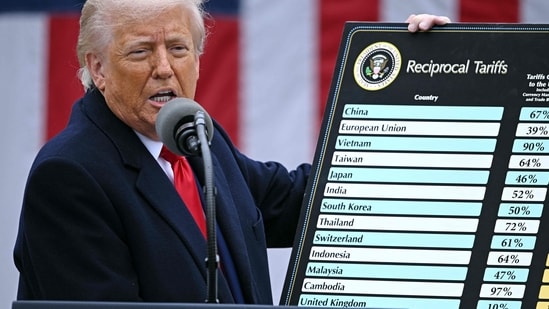
DONALD TRUMP’S beloved tariffs have been dealt a blow. On August 29th, a month after the Federal Circuit Court of Appeals voiced scepticism about the president’s authority to refashion America’s trade policy, a majority of that court upheld a three-judge panel’s judgment that Mr Trump cannot single-handedly rejig America’s tariff schedules. Does this mean the president will be forced to back down?
Mr Trump’s characterisation of the court as highly partisan is belied by the vote on his tariffs (AFP FILE)
The 7-4 vote in VOS Selections, Inc v United States triggered a quick response from the president. Less than an hour after the decision, Mr Trump attacked the Federal Circuit as a “Highly Partisan Appeals Court” whose ruling “would literally destroy the United States of America”. But his missive emphasised that the tariffs remain in place pending appeal to the Supreme Court.
A court rarely in the headlines, the Federal Circuit takes an average of several months to issue a ruling; a case like VOS Selection heard en banc (by all its judges) can take up to six months. Producing 127 pages of opinions on such a significant matter in 29 days shows unusual speed. And Mr Trump’s characterisation of the court as highly partisan is belied by the vote on his tariffs: the majority included a George W. Bush appointee, while two of the dissenters were appointed by Barack Obama. (The Federal Circuit is the only appellate court to which Mr Trump has yet to nominate a judge.)
The crux of the dispute in VOS Selections is whether Mr Trump had the authority to issue his sweeping tariffs by invoking the International Emergency Economic Powers Act (IEEPA) of 1977, which allows presidents to “regulate…importation” to “deal with any unusual and extraordinary threat…to the national security, foreign policy or economy of the United States”. The government cited two emergencies to justify the duties: the fentanyl crisis and “large and persistent…trade deficits” with America’s trading partners. When he imposed “trafficking” and “reciprocal” tariffs to address these purported crises, the Federal Circuit majority held, Mr Trump exceeded his authority under the IEEPA.
According to the constitution, Congress alone has the power “to lay and collect taxes, duties, imposts and excises”. Unlike other statutes that explicitly empower presidents to raise duties, the IEEPA contains no such words—“tariffs”, “duties”, “surcharges”—which, the court concludes, makes Mr Trump’s move a constitutional overreach. The majority acknowledges that an appeals court permitted Richard Nixon “to address a balance of payments deficit” under a predecessor to the IEEPA in 1971 by imposing a 10% additional tariff, but this modest surcharge “lasted less than five months”. Every time Congress has delegated tariff policy to the president, the court writes, it imposed “well-defined procedural and substantive limitations”.
Despite the loss, Mr Trump predicts the Supreme Court will eventually “help” him save the tariffs. They could do that in VOS Selections or another case, Learning Resources, Inc., v Trump, which is already at the top court’s doorstep. He may be right. In a separate opinion in VOS Selections, four judges on the Federal Circuit argue that the IEEPA does not permit presidents to tweak tariffs at all. The majority’s more nuanced view—that the law permits some tariffs, but not Mr Trump’s trafficking or reciprocal ones—could be more vulnerable. The Supreme Court’s six conservative justices may pick up on the dissenters’ contention that the majority never pinpoints “why these particular tariffs constitute an exercise of ‘unlimited’ tariff authority or are otherwise unauthorised by IEEPA”.
The high court’s conservative 6-3 majority—typically indulgent of even novel claims of presidential power—will also be inclined to match the Federal Circuit dissenters’ “considerable deference” to Mr Trump’s judgments about national security and foreign affairs. Yet a long list of conservative and libertarian challengers to the tariffs may give the justices pause. And if it sides with Mr Trump, the Supreme Court will have to explain why it rejected Joe Biden’s plan to forgive student loans for lacking congressional sanction, but does not think Congress needs to be in charge of the most sweeping rewrite of America’s trade and tariff policy in a century.
Even if the president does lose this one, though, he has other legal authorities to try out on the courts. Anyone hoping for a refund on tariffs already paid will be waiting a while.
Get the latest headlines from US news and global updates from Pakistan, Nepal, UK, Bangladesh, Russia and US Iran war Live, get all the latest headlines in one place on Hindustan Times.

 E-Paper