
 E-Paper


Aurora forecast today: Will you see Northern Lights amid G3 storm? Know here
A strong geomagnetic storm will produce northern lights in nearly two dozen US states on Saturday night

 Prefer HTon Google


A strong geomagnetic storm will produce northern lights in nearly two dozen US states on Saturday night, the National Oceanic and Atmospheric Administration (NOAA) prediction states. The forecast map and typical aurora visibility patterns during a G3 storm show that states from the Pacific Northwest to the Northeast will see the aurora borealis under favorable weather conditions.
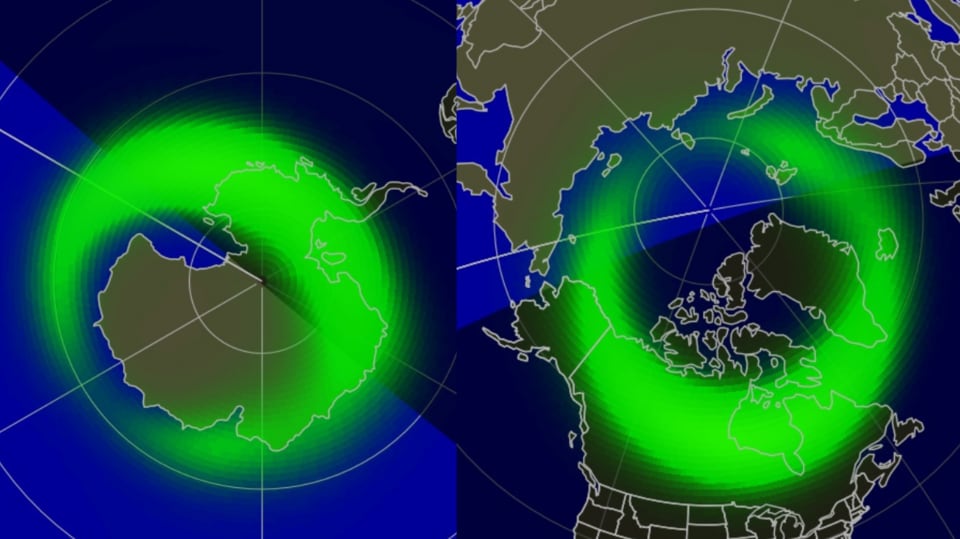
Alaska, Montana, North Dakota, and Minnesota have a ‘high likelihood’ of seeing the aurora. If you live in these stats, you will likely see the Northern Lights tonight.
Read More: Northern lights this week? NOAA predicts strong G3 geomagnetic storm
Here's the list:
1. Alaska
2. Washington
3. Oregon
4. Idaho
5. Montana
6. Wyoming
7. North Dakota
8. South Dakota
9. Nebraska
10. Minnesota
11. Iowa
12. Wisconsin
13. Michigan
14. Illinois
15. Indiana
16. Ohio
17. Pennsylvania
18. New York
19. Vermont
20. New Hampshire
21. Maine
22. Massachusetts
This list starts with Alaska and includes northern states commonly within the auroral view line during strong geomagnetic storms, extending to states like Illinois and Oregon (mentioned as the southern limit for G3 visibility) and eastward to the Northeast.
Best time to see the lights
The Northern Lights are best viewed when it is dark outside, particularly between 10 PM and 2 AM local time, according to the NOAA. Visibility depends on factors like clear skies, minimal light pollution, and the storm’s intensity (forecasted Kp index of 6.67), and not all states may see the aurora equally well.
Why do Nothern Lights form?
The northern lights form when charged particles from the sun, carried by the solar wind, hit Earth’s atmosphere. During solar events like coronal mass ejections, these particles—mostly electrons and protons—travel to Earth and get trapped by its magnetic field. Funneled toward the poles, they collide with nitrogen and oxygen in the upper atmosphere, exciting the gases. As the gases release energy, they emit light: nitrogen glows purple or pink, oxygen green. This creates the aurora’s colorful display.


