
 E-Paper


How Donald Trump’s 100% US tariff plan on semiconductors could impact phone, chip-makers
President Trump plans a 100% tariff on imported semiconductors from non-US producing countries. Tim Cook said Apple will invest $100 billion in the US.

 Prefer HTon Google


US President Donald Trump said on Wednesday that the United States will impose a tariff of about 100% on semiconductors imported from countries not producing in the US or planning to do so. He, however, said the tariff would not apply to companies that had made a commitment to manufacture in the US or were in the process of doing so.
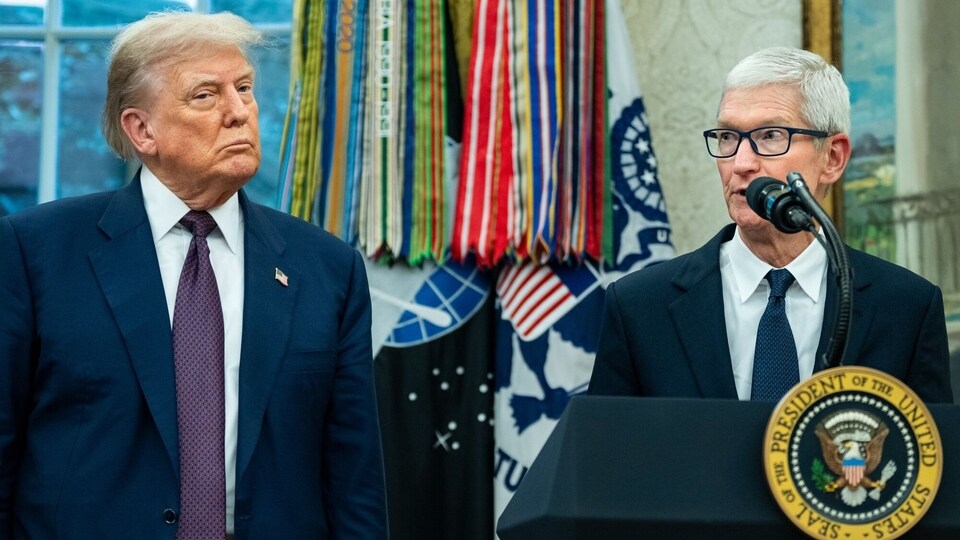
Donald Trump's comments were not a formal announcement and much remains unclear.
Also Read | Donald Trump eyes 100% tariff on semiconductor import, to exempt Apple after $600 billion commitment
Trump also announced that Apple will invest an additional $100 billion in the US, a move which will expand the company's domestic investment commitment and could help it sidestep potential tariffs on iPhones.
Apple Inc. CEO Tim Cook and the US president announced the investment plan from the Oval Office.
The new pledge brings Apple's total investment commitment in the US to $600 billion. Earlier this year, the company had announced it would invest $500 billion and hire 20,000 workers across the country over the next four years.
Also Read | Why was India singled out for ‘penalty’ tariff over buying Russian oil? Trump answers
What will be the impact?
Bloomberg reported that the implementation of Trump’s tariff decision, which he admitted was not communicated to Tim Cook ahead of the announcement, could significantly impact the tech sector.
However, if Trump’s remarks imply that companies with existing or planned manufacturing facilities in the US are exempt, several major tech firms may remain unaffected.
Also Read | Trump plans 100% tariff on computer chips, unless companies build in US
Companies such as Taiwan Semiconductor Manufacturing Co., Samsung Electronics Co., Texas Instruments Inc., Micron Technology Inc. and GlobalFoundries Inc. have already made public promises, often in coordination with the White House, to extend their production networks, promising outlays of tens of billions of dollars, according to Bloomberg.
Intel Corp., whose ambitious building plans in Ohio are being slowed due to its losses, still operates factories in at least three US states: Oregon, New Mexico, and Arizona.
However, many so-called chipmakers do not actually own factories; they prefer to outsource that function mainly to TSMC and, to a lesser extent, Samsung.
Companies such as Nvidia Corp. — whose CEO met earlier on Wednesday with Trump — and Advanced Micro Devices Inc. have promoted their commitment to sourcing chips from TSMC’s new plants near Phoenix.
Still, there is not enough advanced production outside East Asia, let alone in the US, to satisfy their needs. Nvidia, like Apple, has pledged to invest heavily in the US and to localise procurement. Nonetheless, the company remains part of a complex global supply chain that cannot be easily uprooted and replicated in the US.
South Korea says Samsung, SK Hynix will not be subject to 100% US chip tariffs
South Korea's top trade envoy Yeo Han-koo said on Thursday that Samsung Electronics and SK Hynix will not be subject to 100% US tariffs on chips.
Yeo said on radio that among various countries, South Korea will face the most favourable US tariff rates on chips under the trade deal between Washington and Seoul. He did not elaborate, news agency Reuters reported.
Chip-related stocks fall
Chip-related shares were down in early Asian trade on Thursday, after the US President said he planned to impose a 100% tariff on imported semiconductors.
Tokyo Electron, a major Japanese producer of chipmaking equipment, plunged 3.4% as markets opened in Tokyo, and chipmaker Renesas was down 2.5%.
In Seoul, chip giant SK Hynix plunged 2.9%, while traders awaited the market's opening bell in Taipei, where TSMC — the world's largest contract chip maker — is listed.
(With inputs from agencies)


