
 E-Paper


Something remarkable happened in the years immediately preceding and, especially, following the pandemic: Wages for poor workers began rising much faster than they did for the rich.
The Era of Big Raises for Low-Paid Workers Is Over
Wage growth for top earners once again outstripped gains for those at the bottom.
Published on: Aug 12, 2025, 18:15:16 IST

WSJ

 Prefer HTon Google
Share via
Copy link
That era may have now come to at least a temporary halt. And with worries about the health of the job market heightened following the disappointing July jobs report, it may have ended altogether.
Wage growth for low-income workers looks to have significantly deteriorated in recent months, while wage growth for their higher-income counterparts has held up much better. It is a shift that could matter not just for low-paid workers, but the overall economy.
The jobs report released at the start of this month was revealing. It showed that average earnings for leisure and hospitality workers, at $22.83 an hour, were up 3.5% from a year earlier. Meanwhile, average hourly earnings for workers in the information sector were up 5.4%, to $52.61.
It is a far cry from, for example, December 2021. Back then, earnings for workers in leisure and hospitality—the lowest paying of the broad sectors tracked by the Labor Department—were up 14%. Earnings in the high-paying information sector were up less than 2%.
The years from the early 1980s through much of the 2000s were characterized by widening wage inequality. But around 2015, the gap between low- and high-income workers’ pay began to narrow. It was a change that economists believe was driven, in part, by a sharp drop in the unemployment rate that made it harder to fill low-paying jobs. In February 2020 the unemployment rate was at 3.5%, its lowest level since the late 1960s.
The dynamic was amplified by the pandemic. Businesses swiftly laid off a number of workers, including low-wage employees at retail stores, hotels and restaurants. But then those same businesses reopened and were desperate for workers—allowing many people in low-wage jobs to level up to better pay. A dishwasher at one restaurant, for instance, could easily switch to a dishwashing job at another restaurant that was paying an additional $1 an hour.
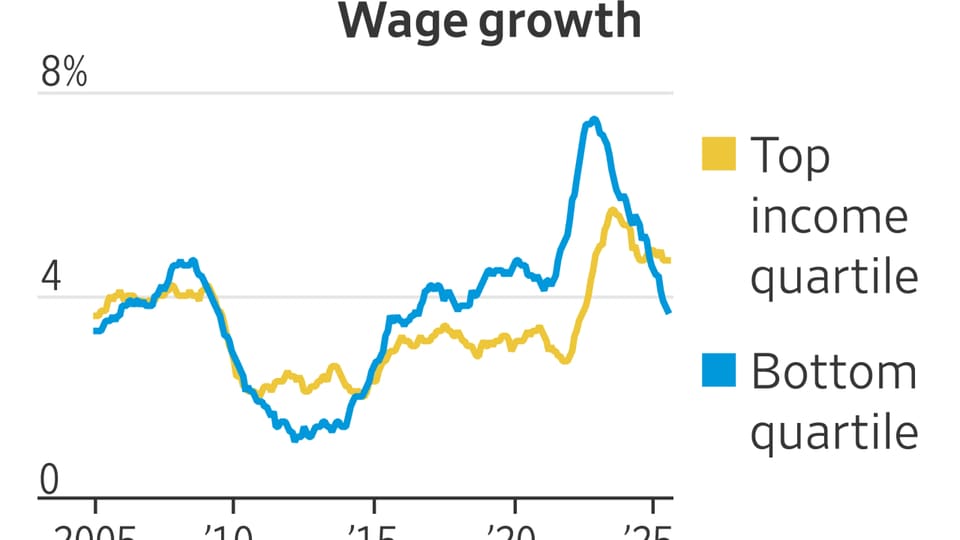
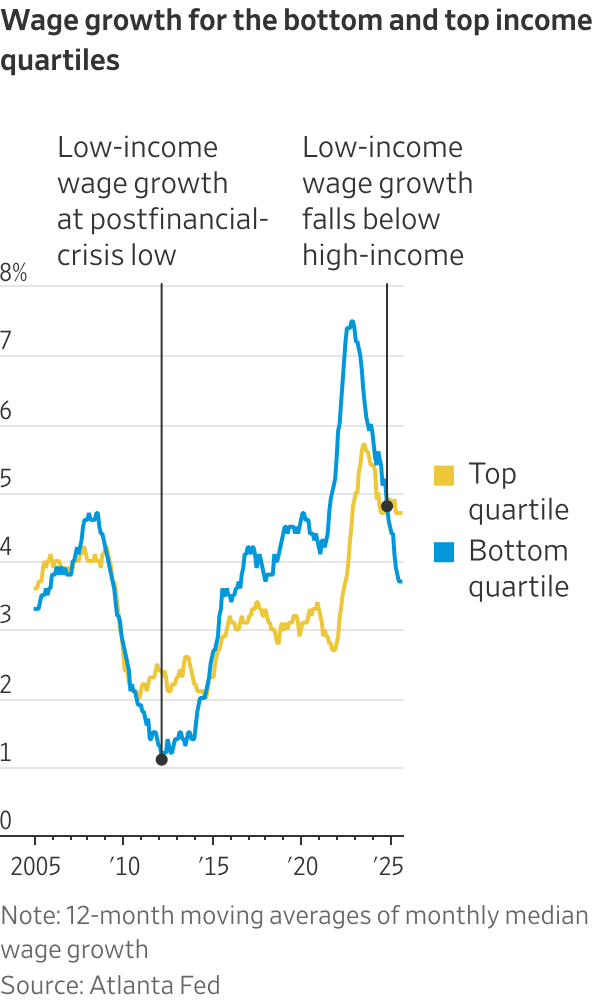
The effects were large. A wage tracker developed by the Federal Reserve Bank of Atlanta, using data that underlies the Labor Department’s employment report, showed that annual wage growth for the median worker in the bottom quarter by income had shot up to 7.5% in November 2022. That compared with 4.8% for the median worker in the top quarter.
Not all low-wage workers benefited. Wage growth among older people, who were less likely to switch jobs, wasn’t as strong. Inflation, of course, took a bite. But in aggregate, an analysis of Labor Department data conducted by economists David Autor, Arindrajit Dube and Annie McGrew found that real or inflation-adjusted wages for those at the bottom rose relative to those at the top.
That doesn’t appear to be the case anymore. As of July, wage growth at the bottom quarter was 3.7% according to the Atlanta Fed, around the lowest since 2017. For the top quarter, it was 4.7%.
A Bank of America Institute analysis of BofA customer data tells a similar story. It shows that after-tax wages and salaries for households at the bottom third by income were up 1.6% this June from a year earlier, versus 2.9% for households in the top third. As recently as December, the BofA data showed wage growth for lower-income households was outpacing high-income wage growth.
A cooler labor market probably has something to do with the recent slowdown in wage growth for low-income workers. The unemployment rate, which got down to 3.4% in April 2023, has since risen to 4.2%.
But the current labor-market environment, where employers have been reluctant to fire but also reluctant to hire, puts many poorer workers in particular at a disadvantage. That is because they are more likely to work jobs where turnover is frequent, often because employment is highly seasonal, such as hotels, restaurants and retail.
“The best way that workers are able to get wage increases is to switch jobs, and you’re not seeing that as much,” said Elise Gould, an economist at the Economic Policy Institute.
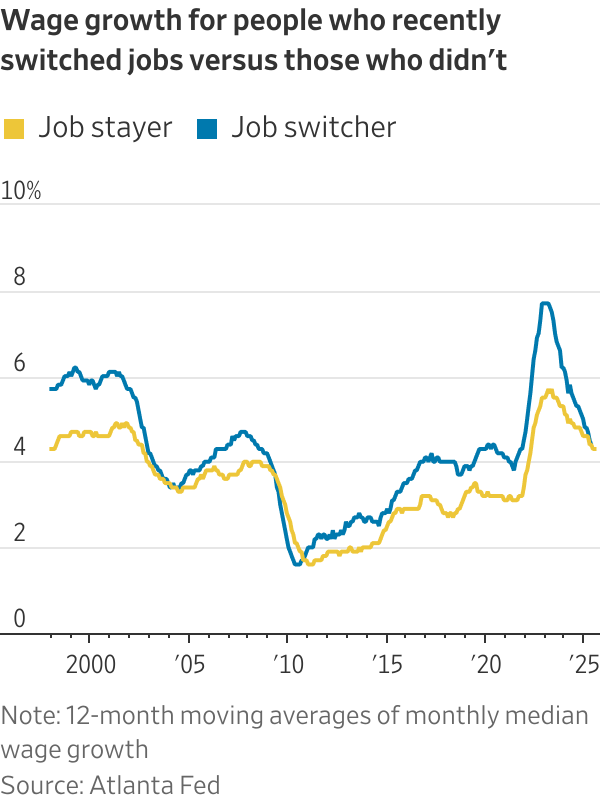
According to the Atlanta Fed, wage growth for people who have recently switched jobs came to 4.3% in July, the same as for people who stayed put. Before this year, the last time wage growth for job switchers wasn’t higher than for stayers was October 2010.
Poorer workers’ spending behavior appears to be changing, too. In June, the three-month moving average of BofA credit- and bank-card spending by households in the bottom third by income was 0.2% below the year-earlier level. That compared with a 0.7% gain for households in the middle, and a gain of 1.2% for households in the top third.
“That ties directly in with what we’re seeing with wage growth,” said Liz Everett Krisberg, head of the Bank of America Institute.
Uncertainty over President Trump’s trade policies might have contributed to some businesses’ reluctance to bring on new employees. So any clarity on trade might help wage growth for workers at the lower end. That said, the pace of hiring was already extremely slow before Trump came to office. Moreover, if the recent weakness in the job market persists, it could be low-income workers, who are typically at much higher risk of getting laid off, who are hardest hit.
If wage growth for lower-income households continues to be constrained, that could affect the overall spending outlook. That is because even though poorer people spend far less than their better-off counterparts, they have far more unmet needs, and as a result tend to spend more of each additional dollar they get. More fundamentally, widening wage inequality can make it harder for the poor to move up the income ladder.
Write to Justin Lahart at Justin.Lahart@wsj.com



Stay updated with US News covering politics, crime, weather, local events, and sports highlights. Get the latest on Donald Trump and American politics along with Horoscope 2026.


