
 E-Paper



US suspending military aid to Pakistan over terrorism may not inflict big pain
It is unlikely that even a complete withdrawal of US aid by Donald Trump would make a substantial dent on Pakistan’s economy.

 Prefer HTon Google


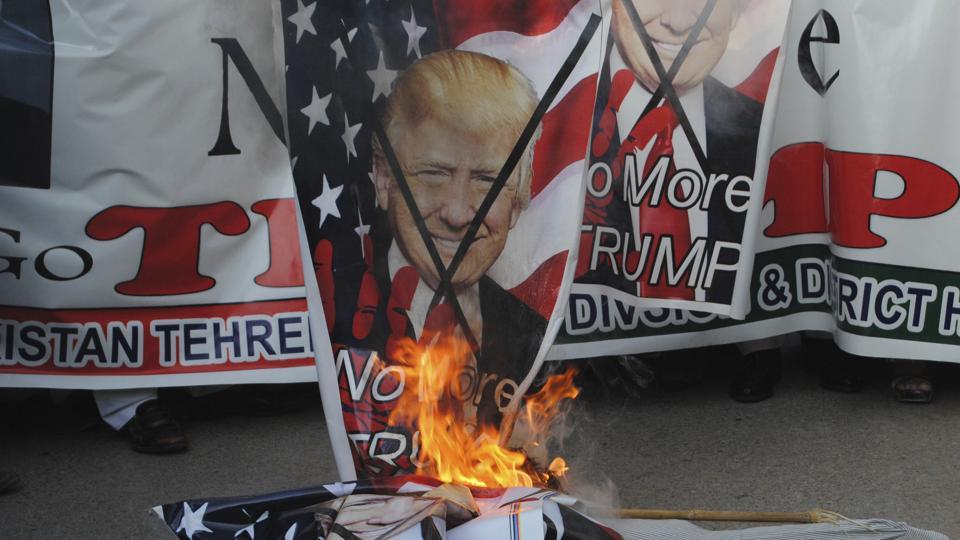
The Donald Trump administration has decided to suspend military aid to Pakistan citing its failure to act against terrorist groups operating from Pakistani soil. Exact details of how much aid would be cut are not yet clear. Whether this move would pressurise the Pakistani regime to withdraw patronage to the terror infrastructure remains to be seen.
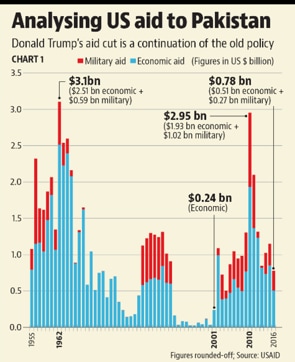
However a couple of things stand out if one analyses statistics on US aid to Pakistan since the 1950s. Trump is not the first President to cut aid to Pakistan. His actions are in keeping with the policies of the Obama administration which had started cutting aid to Pakistan in this decade.
Data from the United States Agency for International Development (USAID) shows that American aid to Pakistan has seen many ups and downs in the last six decades. In real terms, it peaked in the year 1962 with a value above $3.1 billion. There was a sharp fall after the end of the Cold War. But things changed in a big way after the September 2001 terrorist attack on America, when Pakistan became a front line ally of US in its war against terror. Both economic and military aid started increasing once again and it peaked in 2010, a year before al-Qaeda founder Osama Bin Laden was killed. The US started cutting back on aid to Pakistan after his death in 2011. By 2016, US economic and military aid to Pakistan stood at 26% of its aid in 2010 (See Chart 1).
These statistics suggest American aid policy to Pakistan is more a function of its domestic needs than principled positions on terrorism. Voices within the American policy establishment have argued for long that there has been no improvement in Pakistan’s conduct in controlling terror. Another question which needs to be asked is how would a severe cut in US aid affect Pakistan. An exact answer would require greater clarity on changes in US policy. But a look at the importance of military spending and US in the Pakistani economy can provide some answers.
World Bank statistics show that Pakistan’s military spending as a share of its GDP has been coming down since the 1990s.
This decline seems to have accelerated during the post 9/11 phase, which might be a result of greater military aid from the US. The fact that the share of military spending in GDP started increasing after 2010, when US aid started declining, supports this reasoning (See Chart 2).
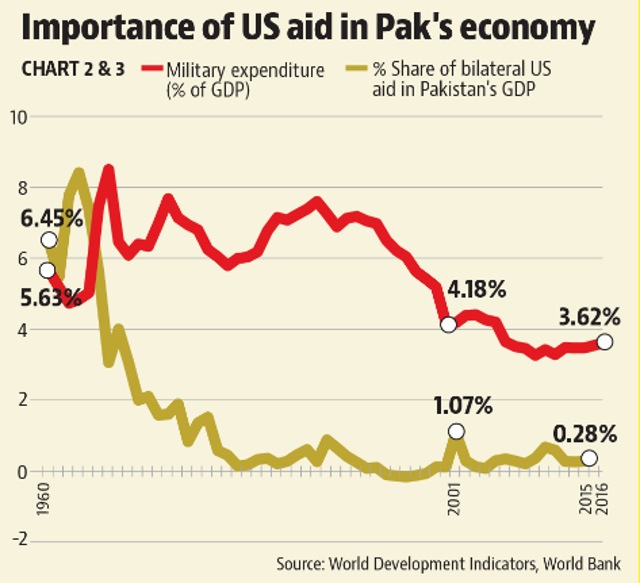
If there are further cuts in US military aid, Pakistan’s economy would have to carry the burden of a greater share of the military expenditure. As far as the share of total US bilateral aid in Pakistan’s GDP is concerned, it is less than 0.5% of its GDP. This used to be more than 5% in the early 1960s. Thus, it is unlikely that even a complete withdrawal of US aid would inflict a big enough pain on Pakistan economy (See Chart 2). Having said this, there is one factor which might not have been very important in determining US-Pakistan relations earlier.
China’s economic engagement with Pakistan is bound to reach unprecedented levels thanks to its initiatives such as One Belt One Road. Given Pakistan’s geopolitical importance in China’s plans to extend its economic influence in the region, China is not very likely to care about Pakistan’s conduct vis-à-vis controlling terror. This might reduce the need for Pakistan to depend on US aid. If this happens, the US is likely to experience diminishing returns from its aid-diplomacy in Pakistan.


