E-Paper



West has policy to engage India in ‘anti-China games’, says Russian foreign minister Lavrov
Speaking at the general meeting of the state-run think tank Russian International Affairs Council on Tuesday, Sergey Lavrov also accused Western powers of trying to undermine Russia’s ties with India

 Prefer HTon Google


Western powers have adopted an “aggressive and devious” policy to engage India “in anti-China games by promoting Indo-Pacific strategies”, Russian foreign minister Sergey Lavrov has said against the backdrop of the India-China border standoff.
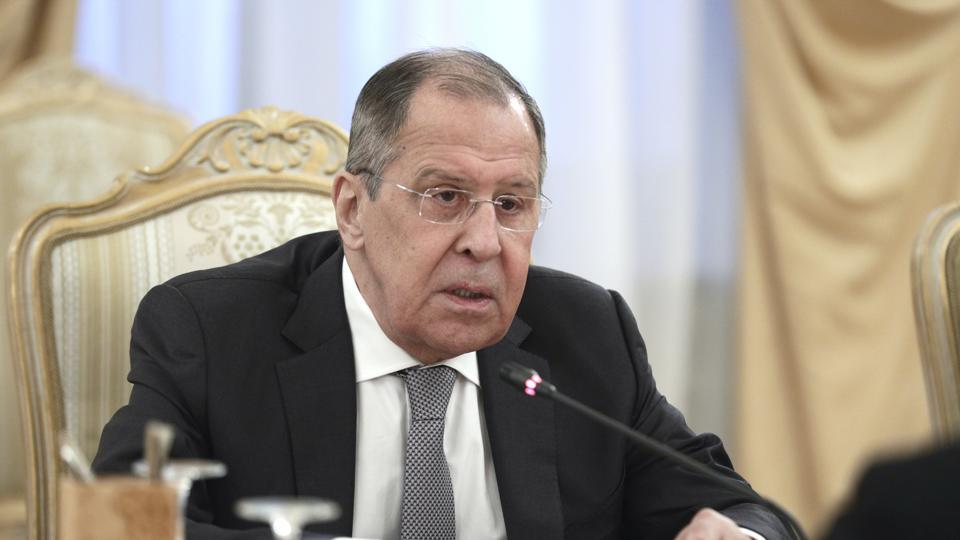
Lavrov also accused Western powers of trying to undermine Russia’s “close partnership and privileged relations with India”.
The comments, made during the general meeting of the state-run think tank Russian International Affairs Council on Tuesday, reflected Moscow’s traditional suspicion of the Indo-Pacific concept. The remarks are also significant as Russia has been nudging India and China to resolve the border standoff.
Criticising Western and European powers for their “notorious concept” of a rules-based order and use of sanctions for alleged chemical and cyber-hacking violations, Lavrov said such moves are made without the involvement of global bodies under the UN.
He accused Western powers of presenting their positions and initiatives to the world as the “only correct ones”, saying Russia is convinced it is better to work within global organisations despite existing differences. The West is also trying to restore the unipolar world order but poles such as “Russia and China are unlikely to be subordinate to it”.
Lavrov said, “However, India is currently an object of the Western countries’ persistent, aggressive and devious policy as they are trying to engage it in anti-China games by promoting Indo-Pacific strategies, the so-called ‘Quad’ while at the same time, the West is attempting to undermine our close partnership and privileged relations with India.”
The “very tough pressure” from the US on India in relation to military-technical cooperation with Russia is part of the efforts to undermine the partnership, he said, without giving details.
Lavrov was apparently pointing to the US threat of imposing sanctions on India under the Countering America’s Adversaries Through Sanctions Act (CAATSA) for the $5.4-billion deal with Russia for S-400 air defence systems.
There was no immediate response from Indian officials to Lavrov’s remarks. In the past, India has said that its relations with Russia are time-tested and unaffected by developments in ties with other partners such as the US.
Lavrov also said the US-led West had rejected trends towards the formation of a multi-polar world, sidelined Russia and China and is “trying to draw all others into a unipolar world by any means possible”.
Russia, he said, will promote a unifying agenda and the G20 is the “only mechanism outside the UN Security Council where it is still possible to come to terms based on a balance of interests”. This is because the G20 represents the G7 and Brazil-Russia-India-China-South Africa (Brics) and other states that share the philosophy of Brics such as Saudi Arabia, Mexico, Argentina, Indonesia and Egypt, he said.
Russia has attempted several times in recent months to push India and China towards a negotiated settlement of the border standoff. In September, Russia hosted in-person meetings of the foreign and defence ministers of the Shanghai Cooperation Organisation (SCO) that facilitated meetings of the Indian and Chinese ministers.
Though external affairs minister S Jaishankar and his Chinese counterpart Wang Yi agreed on a road map for disengagement at that meeting, the two sides haven’t been able to move forward with de-escalation efforts on the Line of Actual Control (LAC).