
 E-Paper



With 8 new ones, 35 features on Moon now have Chinese names
China is the second country after the US in more than 50 years to plant its flag on the Moon following the landing of Chang’e-5 spacecraft.


At least eight features on the Moon near the landing area of the Chinese spacecraft Chang’e-5 were named after Chinese scientists and places earlier this month.
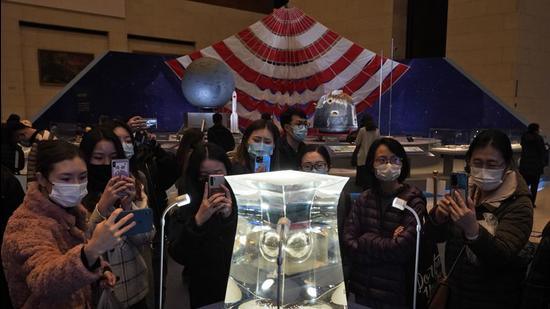
The Paris-based International Astronomical Union (IAU) said that it had approved eight Chinese names for features on the Moon in the vicinity of Chang’e-5’s landing site.
The total number of lunar features, which now have Chinese names is 35.
The new names are Mons Hua, Mons Heng, Pei Xiu, Shen Kuo, Liu Hui, Song Yingxing, Statio Tianchun and Xu Guanqui. The names are of Chinese mathematicians, astronomers, cartographers, mountains, and a constellation.
“Planetary nomenclature, like terrestrial nomenclature, is used to uniquely identify a feature on the surface of a planet or satellite so that the feature can be easily located, described, and discussed,” the IAU says.
According to Chinese state media, lunar entities are named in four categories: deceased outstanding scientists, existing place names on Earth, Latin words that describe weather or other abstract concepts, and then the landing sites, which can be named however the team behind the mission wants.
“China first got approval for the names of lunar locations in August, 2010. Three craters on the surface were named after Chinese scientists Cai Lun, who invented the technique of paper making; Bi Sheng, who invented movable-type printing; and Zhang Yuzhe, considered the father of modern Chinese astronomy,” CGTN, China’s state-run English channel, reported earlier.
The Chang’e-5 spacecraft successfully landed on the near side of the Moon in December, 2020.
China became the second country after the US in more than 50 years to plant its flag on the Moon following the landing of the spacecraft.
Later that month, on December 17, the return capsule of China’s Chang’e-5 probe touched down on Earth, bringing back the country’s first samples collected from the moon, as well as the world’s freshest lunar samples in over 40 years, Chinese state media reported.
Five Chinese names for lunar features were approved by the IAU in 2019 after the Chang’e-4 probe became the first spacecraft to land on the dark side of the Moon.
The IAU, which announced the names, describes itself an international astronomical organisation that brings together more than 13,500 professional astronomers from more than 100 countries.
“The IAU also serves as the internationally recognised authority for assigning designations to celestial bodies and the surface features on them,” it states on its website.
Names successfully reviewed by a task group are submitted by the task group chair to the Working Group for Planetary System Nomenclature (WGPSN).
After a successful review by the members of the WGPSN, names are considered approved as official IAU nomenclature, and can be used on maps and in publications.
Approved names are then entered into the Gazetteer of Planetary Nomenclature, which is maintained by the US-based USGS Astrogeology Science Centre, and posted on its website, the IAU stated.


