
 E-Paper



Yen, Swiss franc jump in volatile trade as global recession fears grow
Asian stock markets and Wall Street futures dove and investors wagered that the mounting risk of recession could see US interest rates cut as early as May.

 Prefer HTon Google


Investors poured into safe havens like the yen and Swiss franc on Monday and heavily sold the risk-sensitive Australian dollar as the market rout from U.S. President Donald Trump's sweeping tariffs deepened and fears of a global recession grew.
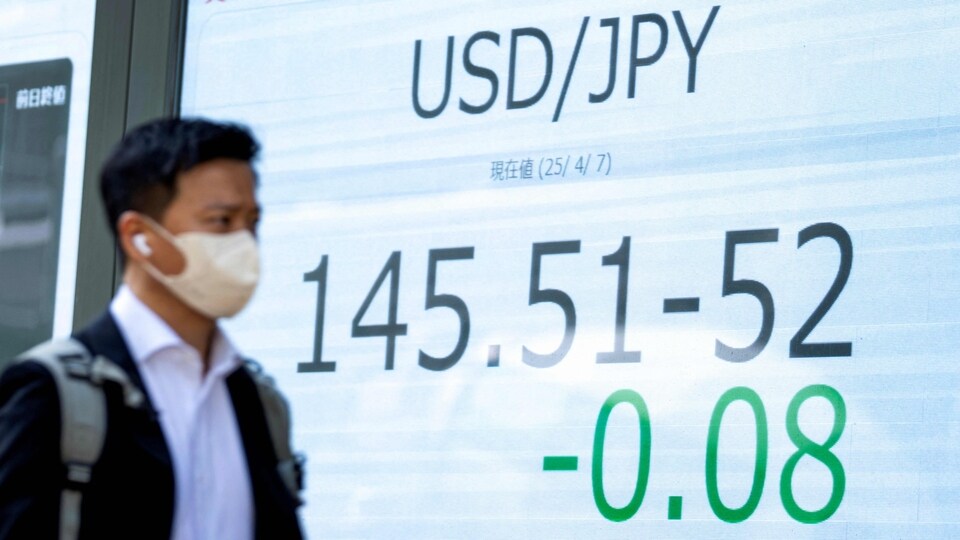
Asian stock markets and Wall Street futures dove and investors wagered that the mounting risk of recession could see U.S. interest rates cut as early as May.
The dollar was down 0.45% against the yen at 146.21 but had pared some losses after falling more than 1% against the Japanese currency earlier in the session.
"The big theme has been selling USD/JPY because it's a good U.S. recession proxy and it's a good U.S. yields proxy and U.S. yields tanked," said Brent Donnelly, president of market maker and analytics firm Spectra Markets.
Also Read | Black Monday repeat? Bill Ackman warns of ‘economic nuclear winter’ as markets wobble
The Swiss franc jumped more than 0.6% to 0.8548 per dollar, extending its 2.3% surge against the greenback last week.
Both currencies have emerged as significant winners in the aftermath of Trump's latest tariff salvo but others have not.
The Aussie tumbled to a five-year low early in the session, before paring some of those losses to last trade 0.66% lower at $0.6005.
The New Zealand dollar, also a proxy for risk, was down 0.38% at $0.5575, having also slid more than 1% earlier in the session.
"Things have gone from bad to worse this morning," said Tony Sycamore, a market analyst at IG.
Also Read | Five crazy Trump tariffs you wouldn’t believe
"If there isn't some sort of walking back of the announcements, then we’re heading for a liquidity event and liquidity will get sucked out of these markets big time across all asset classes."
Trump's tariff announcements wiped out nearly $6 trillion in value from U.S. stocks last week. When asked about the impact, Trump on Sunday said that sometimes medicine was needed to fix things, adding that he was not intentionally engineering a market selloff.
More than 50 nations have reached out to the White House to begin trade talks. China, which has struck back with a slew of countermeasures including extra levies of 34% on all U.S. goods, said on Saturday "the market has spoken".
Assets like government bonds and gold have also risen on safety bids.
While the dollar is also typically known to be a safe haven asset, that status seems to be eroding as uncertainty over tariffs and concern over their impact on U.S. growth intensify.
Against a basket of currencies, the dollar was little changed at 102.81, having tumbled 1% last week.
"Given the U.S. is at the epicentre of the trade war, the USD has been suffering from outflows" with investors "looking ... to diversify away from U.S. assets," said Rodrigo Catril, senior FX strategist at National Australia Bank.
The euro was up 0.03% at $1.0967 in Asia, while sterling eased 0.11% to $1.2892.
Traders have ramped up bets of more Federal Reserve rate cuts this year on the view policymakers would have to ease more aggressively to shore up growth in the world's largest economy.
Markets swung to imply an around 55% chance of a Fed cut in May, and futures now point to more than 100 basis points worth of rate cuts by December this year. Investors were previously expecting the Fed to keep rates on hold next month.
Fed Chair Jerome Powell cautioned on Friday it was still too soon to know what the right response from the central bank ought to be.
Onshore yuan fell to an over two-month low on Monday at 7.3145 per dollar, after China's central bank set the midpoint rate - around which the yuan is allowed to trade in a 2% band - at its weakest level since December 3.
Its offshore counterpart eased more than 0.3% to 7.3193 per dollar.


