E-Paper



Death toll in Nepal landslide reaches 156
With authorities formally declaring all 123 missing as dead, the death toll in the devastating landslide that struck Nepal last Saturday has climbed to 156.


With authorities formally declaring all 123 missing as dead, the death toll in the devastating landslide that struck Nepal last Saturday has climbed to 156.
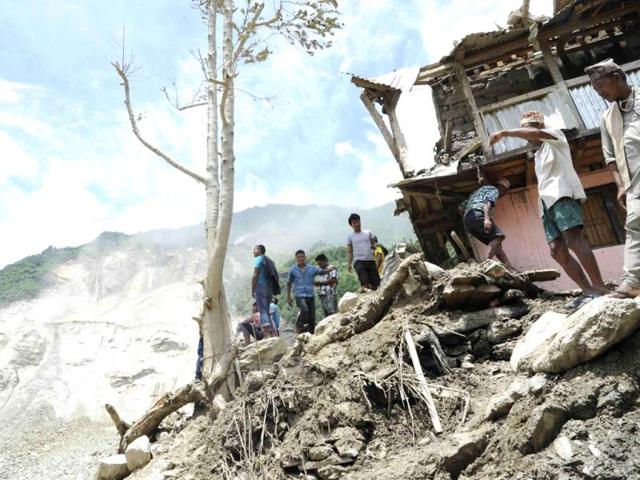
Till Wednesday 33 dead bodies have been recovered from the site of the landslide at Jure and Mankha villages in Sidhupalchowk district, 120 km northeast of Kathmandu.
The landslide has blocked the Sun Koshi River and created a large artificial lake nearly 100 metre deep and spread over 4 km.
Efforts are underway to remove the blockage in a controlled manner in order to prevent large scale flooding in five districts of Nepal lying downstream and also parts of north Bihar.
Chief Development Officer of the district Gopal Prasad Parajuli said the decision to declare all the missing as dead was taken as there was no possibility of finding anyone alive now.
Once the declaration is made families of the missing will be able to claim the Rs 40,000 compensation being provided by the government to conduct last rites of the deceased.
Following the announcement many family members of the deceased have performed last rites using ‘kush’, a type of grass used in Hindu religious rituals, as an embodiment of their missing kin.
The landslide and subsequent flooding due to the blockade in the river has uprooted 5000 people in nearby areas, submerged a small hyrdo power plant and stalled six others with total installed capacity of 65 MW.
District authorities informed that Nepali Army is planning to conduct more controlled explosions at the site to allow the blocked water to flow.
Since the landslide blocked more than a kilometer of the Arniko highway, efforts are also underway to construct an alternate route and allow vehicular movement disrupted since Saturday.