E-Paper



Former Nepal PM Bhattarai resigns from party, House
Nepal’s former Maoist premier Baburam Bhattarai resigned from his party and Parliament after announcing his support to bring changes to the new constitution.


Former Nepal prime minister and senior Maoist leader Baburam Bhattarai quit the party and also resigned as a lawmaker on Saturday — six days after the Himalayan nation adopted a secular constitution which has deeply divided political parties over minorities’ representation.
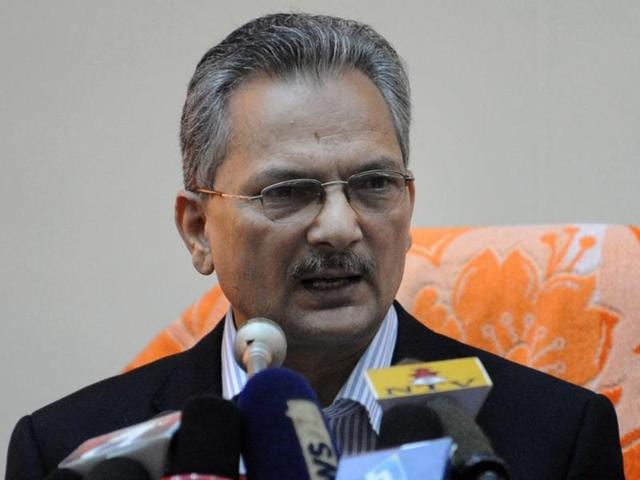
Bhattarai, the senior-most leader of Unified Communist Party of Nepal (Maoist) after party chief Pushpa Kamal Dahal, said a new party was needed to transform the Maoist movement, but refrained from revealing his next move.
Bhattarai, said to be close to India, had played a key part in drafting the new constitution and has been sympathetic to the agitation launched by Madhesi parties demanding more rights and representation to the people residing in the Terai region in the southern plains of Nepal.
India, too, has been critical of Nepal’s political leadership for rushing through the constitution despite dissent. In an interview to IANS, KP Sharma Oli, chief of CPN-UML — the second-largest party in the coalition government — expressed dismay at India’s reaction.
“We are very concerned with the cracks in relationship that are visible,” Oli said.
“I am surprised that our reliable, our permanent friend India only took note of it (adoption of new constitution). If the biggest friend only notices, it will cause surprise. We did not expect this. Some confusion can be created in this but our relations cannot be damaged,” he added.
Madhesis, Indian-origin inhabitants of the plains, and the ethnic Tharu community say the model of splitting Nepal into seven provinces leaves them under-represented in the country’s parliament. More than 40 people have died in the ensuing protests over the new constitution.
“It was a failure on our part that despite previous agreements, we failed to create a Tharu state in the west and two Madhesi states,” Bhattarai said at a press conference here on Saturday. “The old party is not enough for a new age. A new party, a new ideology, new work ethics, new leadership is needed to transform the Maoist movement in Nepal,” he added. The UCPN-M is the biggest Maoist party in Nepal and has 124 seats in the 601-member parliament. Bhattarai leads a strong faction within the party and many supporters were likely to toe his line.
Accusing India of an “undeclared embargo” which has affected the supply of goods into Nepal, Bhattarai urged the government to resolve the issue soon. “We need to talk to India to try and address the situation but before that we need to resolve the ongoing protests in Terai,” he said.
Bhattarai, who spent his student years at New Delhi’s Jawaharlal Nehru University, led Nepal’s second Maoist government between 2011 and 2013. He was one of the key figures in Nepal’s civil war that killed nearly 17,000 people. He was the vice chair of the UCP-M that fought a decade-long war to topple the monarchy.
(With inputs from agencies)