
 E-Paper



New limbs aid Syrians in long walk back from war
A clinic in Turkey has taken up the nobel cause of providing free treatment and prosthetics to Syrians. According to a report, the clinic has helped around 370 people since it opened a year ago.


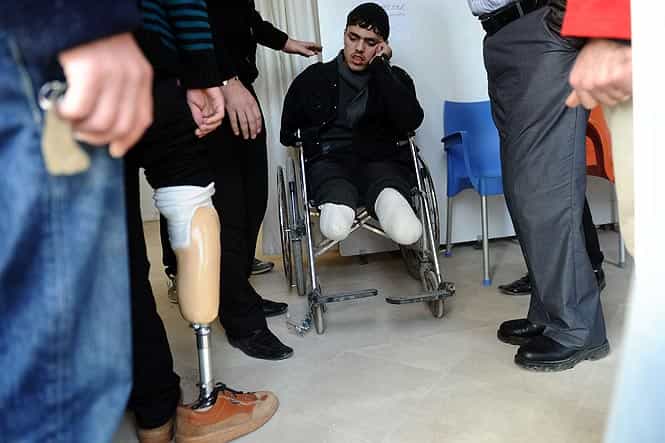
Omar Sheikhhamdu hoists himself up on prosthetic limbs and takes his first halting steps since a Syrian air strike tore off his legs nearly a year ago.

Clinching waist-high bars on either side of him, the 19-year-old former university student will pace back and forth for five minutes before stopping to rest.
That he is able to walk at all is down to the National Syrian Project for Prosthetic Limbs, which provides free treatment and prosthetics to any Syrians who make their way to the clinic in Reyhanli, just across the border in Turkey.
The clinic does not ask whether patients are fighters or civilians, but Raid al-Masri, the director of the centre, says around 40% of the 370 patients it has treated in the last year are women and children.
"We have a patient who is a year and a half old. He was wounded when he was eight months old," he said.
"He hadn't even learned to walk and he lost his leg. The first time he walks he'll walk on a prosthetic limb."
An estimated 130,000 people have been killed in Syria's war, and if there were a reliable tally for the number of wounded it would likely far exceed that number.
The Reyhanli clinic is registered in Britain and funded by Syria Relief, a non-governmental organisation based there, as well as the Syrian Expatriates Medical Association, a group of doctors from abroad who treat war victims.
On a recent day several young men arrived, some hobbling on crutches while others, like Sheikhhamdu, had to be carried in by relatives.
One man, just 22 years old, lost both legs and an arm in a rocket attack in Aleppo six months ago.
It takes at least four months after the last surgery before a patient can even be fitted with prosthetic limbs, followed by months of physical therapy.
"For those who have lost both legs, it's a little harder to rehabilitate them after they get the prosthetic limbs," Masri says.
"It's hard for them to get used to it."
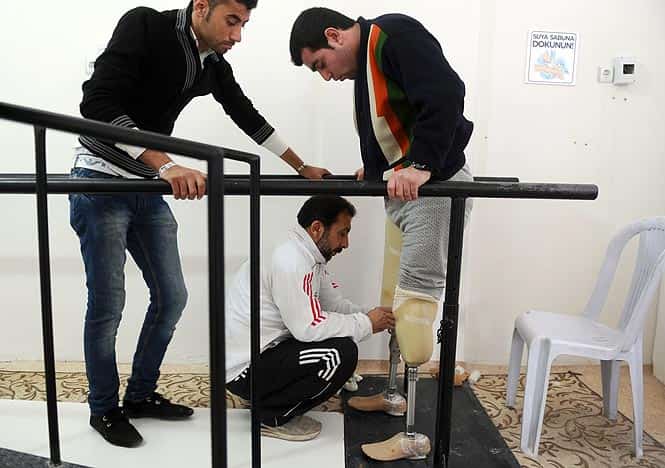
Sheikhhamdu, who lost one leg below the groin and the other above the knee, seems to take to the new limbs, at least as long as he holds onto the bars.
"He'll go back and forth for five minutes and then rest. Next week we will try for 10 minutes," says Samir al-Masri, a volunteer physical therapist.
Earlier, Sheikhhamdu had quietly recalled the day everything in his life changed.
The family was preparing to go to Friday prayers when a bomb dropped by a regime warplane struck their home, killing his sister and wounding him and two others.
"Sometimes I feel like I lost everything," he says. "I can't move."
The little things
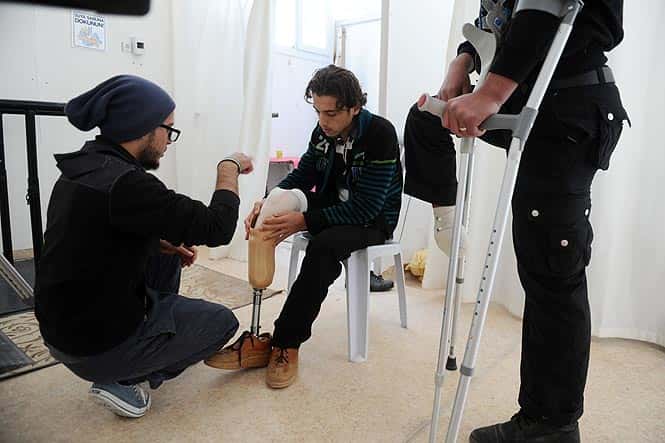
Therapists encourage the patients as they help them to stretch their legs and exercise the muscles before fitting them with prosthetics.
Abdelmawla, an 18-year-old volunteer, shares a special bond with those who come in.
He was riding in a car with his family on a highway north of Damascus when a government patrol fired a burst of heavy machine-gun fire at the car, shredding his left leg from above the knee.
"Everything seemed normal. And right that moment there was very heavy gunfire, very heavy," he says.
"It was really frightening."
Months later he found the clinic by chance during a trip to Turkey and was later fitted with a prosthetic leg.
Today he walks with only a slight limp, but he still struggles with the little things.
"There are things little kids can do that I can't, like play football," he says.
"Some people can go to the bathroom and it's perfectly normal. I can't go to the bathroom in a normal way."
He tells new patients they have a long road ahead, urging them to take it one daring step at a time.
"Some people have lost all hope in their lives, but then they see me, and I have a prosthetic limb," he says.
"They see me and they realise they can live the life they did before, maybe even better."


