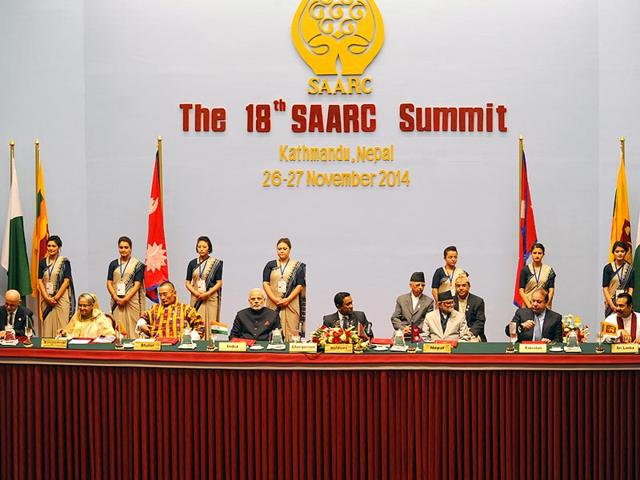
Saarc summit ends with agreement on energy cooperation
The 18th Saarc Summit concluded in Kathmandu on Thursday with the member states signing an agreement on energy cooperation — thus managing to salvage something substantial in the two-day meet.

A nod from Pakistan Prime Minister Nawaz Sharif and some last minute discussions among heads of states and governments during their retreat outside Kathmandu ensured the deal going through.
“Till yesterday (Wednesday) evening we didn’t know whether the agreement on energy cooperation would be concluded. But we are happy that it finally did,” said Nepal’s foreign ministry spokesperson Khaganath Adhikari.
The Saarc Framework Agreement on Energy Cooperation (Electricity) is aimed at easier distribution and transmission of electricity and allowing public and private entities of member states to buy and sell electricity.
On Wednesday during his policy statement Prime Minister Narendra Modi had sought signing of the energy cooperation agreement.
“The heads of government took a final call on the issue. We appreciate the flexibility that has been shown for it benefits common citizens of South Asia,” commented external affairs ministry spokesperson Syed Akbaruddin.
But two other important agreements on increased road and rail connectivity within the region didn’t get through as Pakistan opposed them.
ABOUT THE AUTHORUtpal ParasharA seasoned senior journalist, I have nearly three decades of experience across print, digital, and online platforms, covering political transitions, insurgencies, environmental issues, and development stories in India and Nepal. I am skilled in breaking news, leading editorial teams and launch of newspaper editions. I am adept at leveraging digital trends and social media to expand global reach, with a strong ethical foundation and a reputation for impactful journalism. An alumnus of Asian College of Journalism, I joined Hindustan Times in New Delhi as a trainee reporter in May 1997. Over the years, I have been posted in Dehradun, Kathmandu (Nepal) and Guwahati. Currently, as Senior Assistant Editor at Hindustan Times, I lead a team reporting on India’s northeastern states. My work involves in-depth analysis, and engaging multimedia storytelling across formats, including text, photo, video, and interactive content. I am skilled in producing timely, shareable content, leveraging digital platforms and social media to engage global audiences. Throughout my career with the Hindustan Times, I have led diverse editorial teams, designed capacity-building activities, and supported reporters in developing strong story ideas, ethical reporting practices, digital skills, and fact-checking techniques. As Senior Assistant Editor for Northeast India, I have been responsible for guiding correspondents through complex political, humanitarian, and community-level stories using multimedia formats. Earlier, as Foreign Correspondent in Nepal, I produced extensive reporting during Nepal’s democratic transition and the 2015 earthquake and its aftermath.Read More

E-Paper