
 E-Paper





Follow the latest breaking news, major developments and agenda-setting stories from India and around the world with the newsdesk at Hindustan Times. Operating round the clock, the desk brings together experienced editors, reporters and correspondents to deliver fast, accurate and contextual reporting across subjects that influence public policy, governance, business, society and international affairs. The HT News Desk covers politics, elections, government policies, the economy, business and markets, science and technology, the environment, law and order, infrastructure, education, climate issues and geopolitics, while closely tracking developments across states, institutions and global capitals. The team also leads coverage of major breaking news events, policy announcements, court proceedings, natural disasters, public emergencies and significant international developments. Reports published by the newsdesk are based on information gathered from reporters on the ground, official statements, government agencies, court records, regulatory filings, recognised institutions and other authoritative sources. Stories undergo editorial scrutiny and verification processes to ensure accuracy, fairness and relevance, and are updated as events evolve and additional information becomes available. Whether covering a key political decision in New Delhi, an economic policy shift affecting millions, a landmark court ruling or a major global event, the HT News Desk aims to provide readers with reliable, fact-based journalism that delivers not only the latest developments but also the context and analysis needed to understand their wider implications.
 Trending News
Militants take hostages at Philippine school, using them as human shields: army
The army spokesperson said did not know how many hostages had been taken, or if they included children.


Islamic militants occupied a primary school and took hostages in a southern Philippine village on Wednesday, a few hours drive from a city where other jihadists were fighting a month-long war, authorities said.
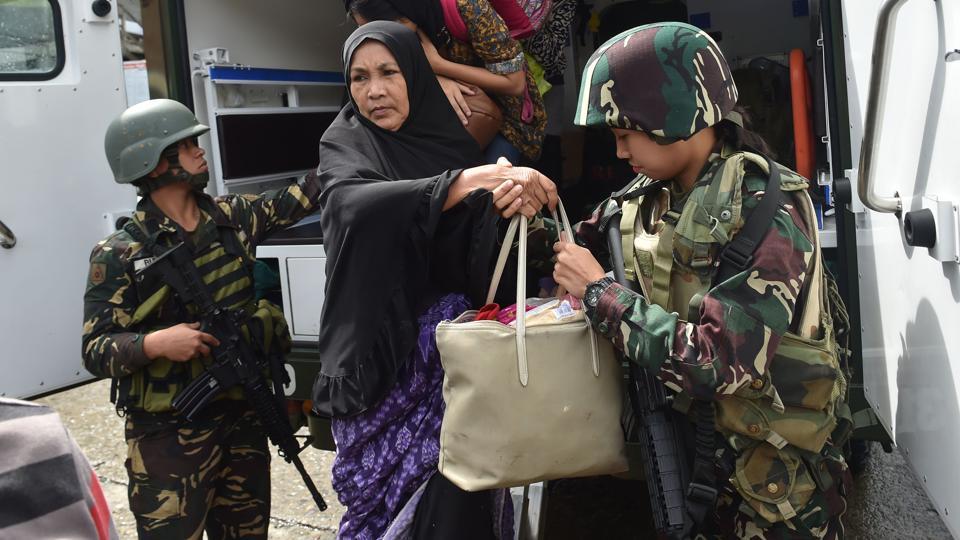
Hundreds of gunmen initially attacked a lightly guarded military outpost at dawn, with many withdrawing but about 30 then taking over the school and using civilians as human shields, the military said.
“As of now they are in the school holding the civilians. They are using them as human shields,” Captain Arvin Encinas, spokesman for the army division with responsibility for the area, said over phone.
He said the gunmen had planted improvised bombs around the school.
Encinas said he did not know how many hostages had been taken, or if they included children.
The unrest occurred in Pigkawayan, a farming town about 160 kilometres from Marawi city where fighters linked to the Islamic State (IS) group have been battling troops for a month in a conflict that has claimed hundreds of lives.
Armed forces spokesman Restituto Padilla earlier said the attackers on Wednesday belonged to the Bangsamoro Islamic Freedom Fighters (BIFF), one of four groups in the southern Philippine region of Mindanao that have pledged allegiance to IS.
Local police said the BIFF attack may have been intended to help the militants in Marawi by distracting the military.
Padilla said the gunmen attacked the outpost at daybreak, then exchanged fire with troops in the morning before retreating in a hit-and-run assault typical of BIFF fighters.
“It’s already resolved. The enemy has withdrawn... they failed,” Padilla said late on Wednesday morning.
However about six hours later Encinas reported the hostage crisis at the school. Padilla then appeared on television and confirmed militants were occupying the school.
Encinas and Padilla said there had also been skirmishes throughout the day outside of Pigkawayan, which is surrounded by marshlands, mountains and farmlands.
Pigkawayan mayor Eliseo Garsesa said about 200 gunmen were involved in the initial assault.
Hardline groups
Muslim rebels have been fighting for more than four decades for an independent or autonomous region in the south of the mainly Catholic nation, with the conflict claiming more than 120,000 lives.
The major rebel organisations have signed, or are pursuing, peace deals with the government, but small hardline groups such as the BIFF have vowed to continue fighting.
Philippine President Rodrigo Duterte declared martial law across Mindanao on May 23 immediately after fighters flying the IS flag rampaged through Marawi.
Their assault on Marawi ignited an unprecedented urban war that has claimed hundreds of lives and which Duterte has warned is part of an IS campaign to establish a base in Mindanao.
The fighting has left Marawi, the most important Muslim city in the Philippines, largely in ruins.
The militants involved in the Marawi fighting are mostly from the Maute and Abu Sayyaf organisations, which have united with the BIFF under the IS umbrella, according to the government.
The military has said foreign fighters, including those from Chechnya, Indonesia and Malaysia, have also joined the Marawi conflict.
IS has ambitions of setting up a caliphate in Southeast Asia -- home to largely Muslim nations like Indonesia and Malaysia -- as the group loses territory in Iraq and Syria.
The BIFF was blamed for attacking at least nine Mindanao towns in 2008, with the assaults claiming about 400 lives and forcing 600,000 people to flee their homes.


