E-Paper



Delhi Master Plans: The price of under-implementation since 1962
The capital’s long wait continues as unrealised provisions keep resurfacing in successive plans over six decades

 Prefer HTon Google


The more things change, the more they remain the same. The draft Master Plan-2041, which has been put up for public scrutiny, lays out the roadmap for Delhi’s development for the next 20 years. This will be the fourth Master Plan for Delhi (MPD) since 1962, and several provisions have resurfaced over the last six decades.
The real test of any plan, however, lies in its implementation. For the new Master Plan to deliver, lessons must be learnt from missed opportunities. Appreciating both the cost and the causes of under-implementation over six decades, experts say, may enable policymakers to finally realise the vision of a more liveable Delhi.
Déjà vu
“I am greatly worried about happenings with regards to promiscuous buildings and layouts… traffic jams and accidents, sprawling colonies without the vital conveniences of life,” wrote India’s first health minister Rajkumari Amrit Kaur in 1956 in the foreword to the Interim General Plan for Greater Delhi, the predecessor of the 1962 master plan.
Also Read | Underground car parks among govt proposals to improve Delhi master plan 2041
“Delhi suffers from the unplanned sprawl… a sprawl made possible by the radius of reach of the motor car which, in turn, has its revenge in cluttering up the roads. New Delhi was built without any heed to old Delhi... Green spaces and open recreation areas recede further and further,” Kaur wrote 65 years ago.
To address these concerns, and more, MPD-62 introduced regional planning by identifying “ring towns” around Delhi as self-contained in matters of work and residential places. Prepared with the help of the Ford Foundation, it felt that was the only means “to prevent the increasing urban sprawl, which is threatening to grow into one giant urban mass with its long and senseless commuting to work, substandard services, and lack of social cohesion”.
MPD-62 sought a Delhi Metropolitan area that included Ghaziabad, Faridabad-Ballabhgarh, Gurugram (then, Gurgaon), Bahadurgarh and Loni, and projected Narela—which was within the city limits and had adequate water, a wholesale food market, and manufacturing units—to become “an ideal place for suburban living” by 1981.
The National Capital Region Planning Board was set up in 1985. Ghaziabad and Faridabad, along with Noida and Gurugram (then, Gurgaon), became boom towns and helped in dispersing the city’s growing population. The Metro provided the much-needed local connectivity.
But Delhi’s very own Narela missed the bus.
Lost opportunities, missed targets
For years now, the Delhi Development Authority (DDA)’s Narela sub-city has found few takers because of the absence of connectivity. MPD-2001, which was notified in 1990, proposed four new interstate bus terminals, including one in Narela that never came up. This time, the draft MPD-41 proposes extending the Metro link from Rithala to Narela.
Belatedly, DDA has commissioned a concept plan for the development of land parcels in the Narela sub-city and committed in this year’s budget to pay ₹1,000 crore to the Delhi Metro Rail Corporation for the construction of the Rithala-Bawana-Narela corridor.
Sixty years and the Narela project is still a work-in-progress.
AK Jain, former planning commissioner at the DDA, said Narela had a branding problem. “It could never be sold as an attractive option to home buyers. People preferred south Delhi because of the proximity to the airport and railway stations. When it came to the Metro, Rohini was given preference over Narela.”
Sanjukkta Bhaduri, professor of Urban Planning at the School of Planning and Architecture said that a growing city such as Delhi cannot afford to be stuck in plans for so long. “Time is an important dimension in urban planning. People won’t wait for decades for an area to get developed. They will go somewhere else,” she said.
DDA, the primary landowner and developer of the city, has not been able to provide enough affordable housing. Many city dwellers have already been priced out of Delhi into the National Capital Region. A large number have settled for homes in unplanned unauthorised colonies built in violation of zoning regulations, mostly on land meant for agricultural use.
In 2008, the Delhi government issued provisional regularisation certificates to 1,218 unauthorised colonies. In 2019, the Centre enacted a law to give ownership rights to people living in 1,797 unauthorised colonies, which is estimated to be housing four million people in the city.
“Unauthorised colonies and haphazard growth in urban villages have increased the risk factor. They have poor quality construction, which makes them extremely hazardous. Also, there is a big social and economic cost of pushing people into neighbourhoods where their basic needs, such as healthcare and education, are not provided for,” said Bhaduri.
Early warnings ignored
MPD-62, in fact, warned that any village, which is overtaken by urban development, should not be left as such, otherwise, the city will be “pockmarked with the type of slums such as Kotla Mubarakpur”.
It recommended that such villages should be redeveloped while underlining the need for comprehensive master plans for rural pockets and effective enforcement of planning standards and prevention of squatting and encroachment.
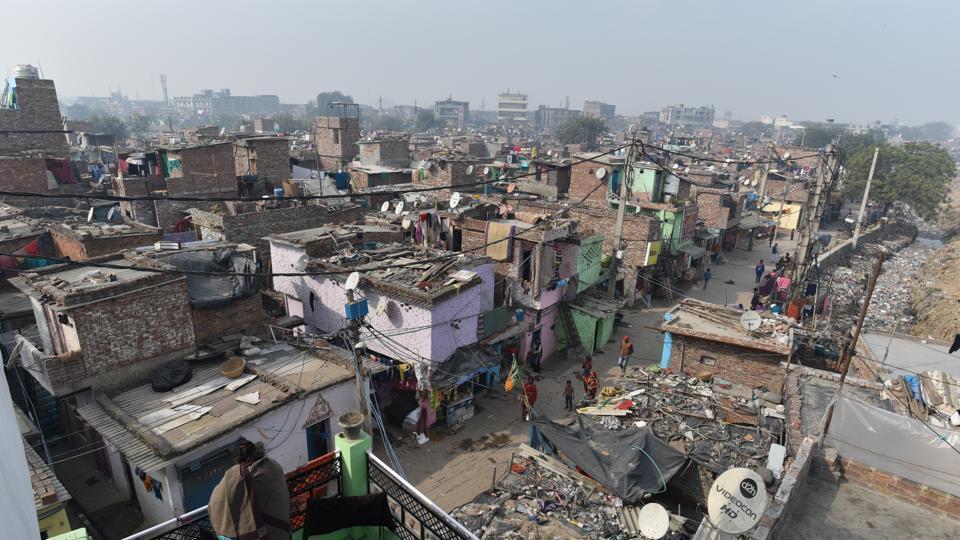
Six decades later, Delhi’s 366 villages—49 rural and 317 urban—continue to suffer. Exempt from municipal bylaws, the narrow alleys framed by frail multi-storey constructions have become a major civic threat.
The new draft master plan confirms that urban villages in Delhi have emerged as “islands of unplanned growth in the city” and are not different from unauthorised colonies even as it prescribes specific regulations for their development and regeneration to be formulated by the DDA within two years of notification of this plan.
Paras Tyagi, a resident of Budhela village who runs the Centre for Youth Culture and Law and Environment, a citizen group working in the rural belt of Delhi, said that all plans to improve the quality of life in villages have remained on paper.
“The previous master plans made provisions for preparing a village development plan to give civic and social amenities. Even Budhela got a plan, which provisioned a hospital, a panchayat ghar, a pond, and a fire station. But nothing came of it,” said Tyagi.
Between 1985 and 2005, Jain pointed out, DDA prepared development plans for as many as 40 villages but the municipalities that were supposed to enforce them never sanctioned any.
“Those plans would anyway backfire as they were made by the government agencies in a top-down approach. There was little public involvement because back when the plan was made, villagers had little understanding of the pace of urbanisation these areas would see,” said Tyagi.
Experts said that the regeneration of the villages has to be community-driven, especially in the context of land-pooling policy to be implemented in 95 urbanised villages in the city to develop housing.
“If it is a market-driven initiative, there will always be unevenness because even within a delineated urban village zone, private players will find pockets of development — say a Metro station — that might give higher returns,” said Arunava Dasgupta, associate professor at the School of Planning and Architecture.
Arrested renewal
Reimagining existing areas is integral to modern city planning. In Delhi, the concept is as old as the Master Plan itself. MPD-62 projected urban renewal as the “strategy of redevelopment, rehabilitation, and conservation to preserve and enlarge the total capacity of existing housing”.
“Concentrating on new housing without taking these steps to improve the existing ones and protecting new developments is like missing the wood for the trees,” it stated.
Pointing to congestion and unsanitary conditions, which were particularly bad in Old Delhi, planners said that even the new rehabilitation colonies built in the 1950s to house the Partition refugees were fast deteriorating. The plan also mandated shifting hazardous industries and redeveloping vacant plots or dilapidated structures as community facilities in the walled city and its extension areas such as Sadar Bazar, Paharganj, and Karol Bagh.
Jain said only two pockets of Old Delhi—Dujana House (near Jama Masjid) and Turkman Gate—were redeveloped during the Emergency of 1975-77.
“There were large-scale protests and violence. This is because the enforcement agencies took a very top-down approach without taking into consideration the community ties and livelihood of people who were to be moved. The medicine was worse than the disease,” he said.
MPD-2001 acknowledged the “large scale infill by commercial use replacing residential use” in Shahjahanabad and mandated an upgrade in physical and social infrastructure. The central city area—the walled city and its extension and Karol Bagh—was designated as a “special area” barred from redevelopment based on the normal planning policies or controls.
Bringing “heritage” in the planning parlance, the plan recognised the need for protection and restoration of historical buildings in the Mughal-era city and making “conservation surgery” the basis of urban renewal.
While MPD-2021 designated Shahjahanabad as a special conservation zone, it also authorised the redevelopment of the city’s newer neighbourhoods that are in “poor urban form”. It backed a higher floor area ratio to allow taller buildings, possibly in cluster courts or group housing, to be developed by private parties. The plan estimated that 40% of Delhi’s land requirement could be met through the redevelopment of the existing areas.
But except for East Kidwai Nagar and the seven government colonies—including Sarojini Nagar, Netaji Nagar, Nauroji Nagar—the plans have remained on paper. “Land-ownership was the key here. In the case of these projects, it helped that the government owned the plots, made the plans, and implemented the projects,” said Bhaduri.
But when it came to private land, Jain explained, it was difficult to implement such schemes. “How do you get multiple owners on a common platform? In many of the old buildings, the titles/ownership is not clear. Also, if the owner agrees, the tenant, who fears displacement or a hike in rent after redevelopment, might not,” he said.
The draft MPD-41 promotes private sector-led development through pooling, amalgamation, joint planning, and execution and also provides incentives such as higher FAR or relaxed norms and charges provided that the requirements of structural safety, sustainable services, and improved walkability are met.
Dasgupta said that regeneration is the way forward for Delhi because greenfield land is scarce and inner-city areas have lived its cycle. But the mechanism of how it will happen has not been detailed out enough conceptually. “If private players are involved in this process, they will be interested in only certain parts of the city. Also, they will enter zones with the least amount of complexity because they will not like to get burdened on their investments,” he cautioned.
“As a result, the city might develop in pockets of convenience, areas of excellence, and eventually exclusive zones. So in a way are we sponsoring a fragmented urban fabric,” he said.
Jain pointed out that such projects required proof of concept. “Agencies such as the DDA, municipal corporations could have taken up a project each, got architects to act as a catalyst, and demonstrated to people that regeneration is feasible,” he added.
But for that to happen, somebody has to bell the cat. “When there are multiple stakeholders involved, especially private individuals, conflicts are bound to arise. Which agency will take the lead, negotiate and resolve these conflicts? That’s a moot question our authorities have to address,” said Bhaduri.
More of the same
In the old city, meanwhile, hundreds of dilapidated buildings, many of them heritage structures, continue to remain death traps. The havelis (mansions) have turned into garages and warehouses, while many residents live in dingy one- or two-room accommodations built by private builders.
The much-delayed first phase of the Chandni Chowk redevelopment project is almost complete with the pedestrianisation of 1.5km between Fatehpuri Masjid and Red Fort. The maze of electric and other cables has been tucked underground and street infrastructure has been upgraded and beautified. But despite this partial makeover, the old Delhi remains the most decrepit part of the capital.
To decongest the old city, successive master plans have proposed relocation of wholesale businesses that operate here. The draft MPD-41 also proposes shifting wholesale activities, noxious trades, godowns out of the walled city to designated areas within 10 years.
It also calls for the promotion of retail and cultural activities such as artist studios, performance spaces, museums, libraries, cafes, co-working spaces, hotels, B&Bs — all in sync with the concept of a 24X7 city floated in the draft MPD-2041.
For this, it envisions a multi-agency coordinated initiative, marking out of cultural precincts within two years, giving support to owners of heritage buildings to undertake conservation and adaptive reuse. The draft plan also proposes that all area level plans for katras, bazaars, etc be prepared in consultation with residents and stakeholders.
But Old Delhi has heard those ideas before.
“Successive master plans talked about removing wholesale markets. But the opposite has happened. Scores of residents have left and new shops and warehouses have opened,” said Anil Pershad, owner of 157-year-old Chunnamal Ki Haveli.
For action and accountability, Pershad said that the walled city needs a single authority. “All agencies work in silos. We need a municipal corporation that understands the needs and the sentiments of the residents and the heritage value of the area.”
The Shahjahanabad Redevelopment Corporation board has already passed a proposal to turn the corporation into an autonomous authority that has the powers of a municipal agency and mandate to implement projects.
Nitin Panigrahi, deputy general manager at Shahjahanabad Redevelopment Corporation — a special purpose vehicle for restoration and conservation of the walled city – said although old Delhi is just 7.5 sq km in area, it must have its own plan, not just for civic infrastructure upgrades, but also traffic and transportation.
(This is the first part of a two-part series on Delhi’s master plans)