
 E-Paper



Ecostani | Amid power struggle, Delhi is a city in a governance mess
With Delhi assembly polls scheduled for February 2025, the public continues to bear the brunt, facing persistent infrastructure problems

 Prefer HTon Google


For many, Delhi is a city of flyovers, underpasses and tunnels where traffic crawls. Exasperating traffic jams, potholed and waterlogged roads, bad air and the stink that rises from open nullahs have become too common for Delhi residents who now seem resigned to deteriorating civic conditions. They are so busy trying to run their everyday lives amid Delhi’s perennial chaos that they don’t ponder how the city once on the move has come to a grinding halt.
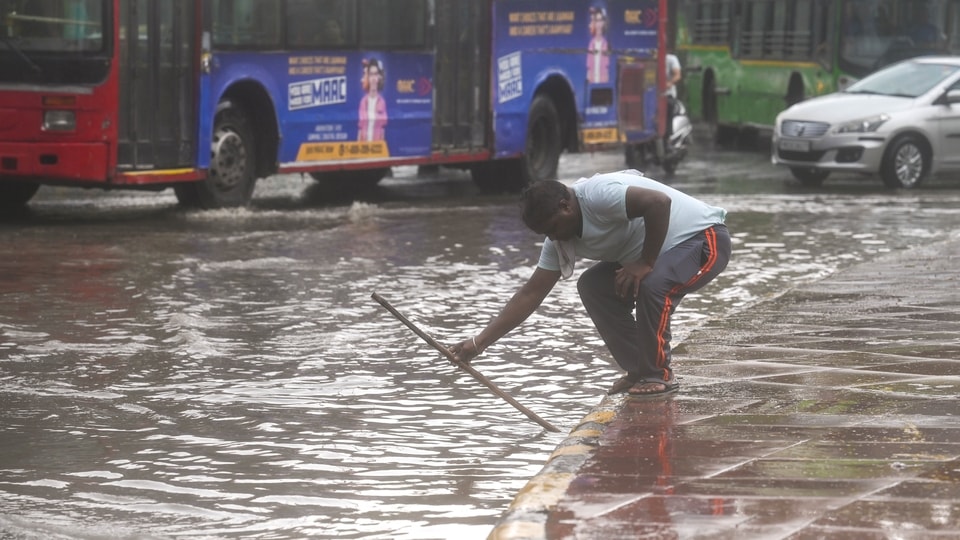
If one calculates the imputed cost in man-hours of time lost in stalled traffic, it would be mind-boggling. People have to wait for hours on water-clogged roads in the national capital with no government department taking responsibility to resolve the daily chaos faced by residents. The Aam Aadmi Party (AAP) and the Bharatiya Janata Party (BJP), the two parties that run the city, appear to be interested only in blaming each other for the mess.
The city’s inability to address its flood management was shockingly revealed after the recent tragedy in Old Rajendra Nagar where three students lost their lives. Students poured onto the streets in protest, and the incident reverberated in Parliament. Yet, the city remained indifferent, perpetuating a cycle of disaster and inaction that left Delhi on the brink of a catastrophe. In all, at least eight people have died due to rains and flooding in Delhi this season.
Delhi has seen unprecedented flooding in the past few years. This year, the area in Lutyens’ Delhi was impacted including the homes of senior legislators; posh localities like Golf Links and Defence Colony were flooded too.
Ingress of this magnitude has never occurred in the worst of monsoons since these localities were inhabited over five to seven decades ago. Additionally, low-density upscale localities like Friends Colony West, a stone’s throw from the river, now experience damaging floods.
Experts believe that large-scale destruction of the underground natural water channels, especially because of the construction of Pragati Maidan tunnels, the Bharat Mandapam underground parking spread over 40 acres, the Central Vista project and the redevelopment of government accommodation in many parts of Lutyens Delhi, is causing flooding in Delhi’s heart.
The Central Vista project, which attempts to gather nearly 60,000 government employees into the heart of this beleaguered capital, has caused 1,838 magnificent water-sequestering trees to be removed in just the first phase. These trees, on the erstwhile IGNCA campus, that now houses three of 10 proposed office buildings, were part of an inviolable deemed forest. One-third of Rajpath’s water-percolating lawns have been replaced with concrete pavements. All these works plus the underground Delhi metro network have damaged the natural groundwater flow systems and disturbed natural water tables.
Delhi’s natural water drainage system allowed water to flow into the Yamuna river. The Delhi Ridge arcs around the central and southern parts of the city – from the Northern Ridge near Delhi University to Rashtrapati Bhavan and the diplomatic area in the West, through Vasant Kunj in the Southwest, and all the way to Asola Bhatti and Tughlakabad in the East — and ensuring the flow of rainwater into Yamuna.
As with surface water, there is possibly a massive subterranean water flow throughout this region towards the Yamuna. Rajendra Nagar, where three young IAS aspirants died due to flooding of the basement in July, falls on the other side of a Ridge and gets heavy water flow, which was managed by the subterranean system taking water to Najafgarh drain. However, heavy construction including the building of basements has impacted the groundwater flow system, experts like Dunu Roy of Hazard Centre believe.
The neglect of the drains such as Barapullah Nallah and Kushak Nahar and very little desilting of drains before the monsoon by authorities have added to the flooding.
The Yamuna floodplains, in particular, have suffered due to arbitrary changes in land use patterns. Once serving as natural buffers to absorb excess water and mitigate flooding, with urban sprawl and the expansionist view of development, large portions of the floodplains have been converted into residential and commercial areas, drastically reducing their natural capacity to manage water.
“They evicted the slum residents on the grounds of unauthorised occupation and reclaimed the land as legal development,” said Roy. “In the first master plan, the floodplain was marked to remain free of any encroachments. With the second master plan, it became available to be used for development. The DDA is responsible for damaging the floodplain, having built the Commonwealth Games Village, structures for the Asian Games, and a CRPF camp. They avoid responsibility and instead blame the poor,” Roy said.
If the damage to natural water flows was not enough, the governance in Delhi appears to have taken a backseat because of an incessant jurisdictional fight between the Delhi government and Lieutenant Governor V K Saxena, a representative of the Union government in the national capital, who manages land and law and order.
The Delhi Jal Board, which manages the sewage system, and the Municipal Corporation of Delhi, whose job is to ensure the cleaning of colony sewer lines and drains, are two primary bodies responsible for managing the sewer systems. The Delhi Development Authority and Public Works Department (PWD) also have a role to play.
Urban experts believe that coordination problems arising due to the multiplicity of authorities have been further compounded by the “intense” tussle between the Delhi government and Saxena over jurisdiction and authority, pushing governance into limbo. “We are caught in the devil and deep sea. Nobody wants to decide on anything as it invites umbrage of ministers or the LG,” said a senior Delhi government official, summarising the state of mind of the capital’s bureaucracy.
Amid this power struggle, with Delhi assembly polls less than six months away in February 2025, the public is bearing the brunt, facing persistent infrastructure problems without any constructive resolution of their problems.
Chetan Chauhan, national affairs editor, analyses the most important environment and political story in the country this week


