E-Paper



What studies say is behind Mizoram’s high Covid-19 infections
Its close-knit society and lack of Covid-19 appropriate behaviour, coupled with strict contact tracing and mass testing, have led to a spike in cases

 Prefer HTon Google


Guwahati: Mizoram recorded 1,741 new cases of Covid-19 infections on Thursday — two days after the northeastern state witnessed 1,846 cases, the highest-ever figure recorded to date.
These are not aberrations. The small state with just over 1.1 million people (according to the 2011 census) has been recording over 1,000 new cases every day for nearly three weeks, leading to concerns in Aizawl and New Delhi.
Almost untouched by the first wave last year, it has now recorded a total of 93,660 infections and 307 deaths. There are close to 17,000 active cases at present, and test positivity rates have been hovering around and above 20% for days, putting strain on health care facilities and medical workers.
“The high number of cases is a concern. Studies done by the state government over the past weeks have found some probable reasons for the increasing trend,” said Dr ZR Thiamsanga, chairman of the medical operation team on Covid-19. Based on studies, it has been surmised that a lack of Covid-19 appropriate behaviour (CAB) in a close-knit society where visits to each other’s houses are common, coupled with strict contact-tracing and mass testing, are some of the causes that have led to a high number of cases.
“Our society is very close-knit, people visit each other for occasions, and there are small gatherings. Plus, CAB is not followed by many. Studies showed these were contributing factors for the high community spread of Covid-19,” Thiamsanga, who is also a ruling Mizo National Front (MNF) Member of Legislative Assembly (MLA) from Champhai North, added.
Dr Pachuau Lalmalsawma, state nodal officer and spokesperson, agreed with Thiamsanga. He added that strict contact tracing and mass testing have also added to the increase in the number of daily cases.
“We have been following aggressive contact tracing with help of the police and civil society groups. Once a positive case is detected, all those who came in contact with that person are traced, quarantined and tested. The quality of sample collection in Mizoram is also very good,” said Lalmalsawma.
“Genome sequencing reports have indicated that besides Alpha and Eta variants of Covid-19, there is also a prevalence of the highly contagious Delta and Delta Plus variants in the state leading to a surge in infections,” he added.
Both Lalmalsawma and Thiamsanga said that although all these factors have contributed to high numbers, it is difficult to point out the single biggest reason for the surge. Two central teams also visited the state to study the scenario and are yet to release their reports, said Lalmalsawma.
Experts say that Mizoram’s lack of exposure to Covid-19 during the first wave that swept the rest of the country could be another reason why the state is witnessing high numbers during and after the country’s second wave. Mizoram recorded its first Covid-19 case in late March last year, and the first death was seven months later. From the first case on March 24, 2020, until March 31, 2021, Mizoram had recorded just 4,473 total cases and 11 deaths. But in the six months from April 2021 to the end of September, the total number of cases skyrocketed to nearly 94,000, with the number of deaths reaching 307.
“The first wave was not really a wave in Mizoram. Most of our population was not exposed to the virus. Maybe that’s why we lack protective antibodies. This needs to be studied. A sero study conducted locally found hardly any prevalence among residents,” said Lalmalsawma. Both government servants denied reports that high dependence of Rapid Antigen Tests (RAT) tests instead of RT-PCR in Mizoram could be responsible for false-negative reports, leading to infected, but undetected, patients spreading the disease.
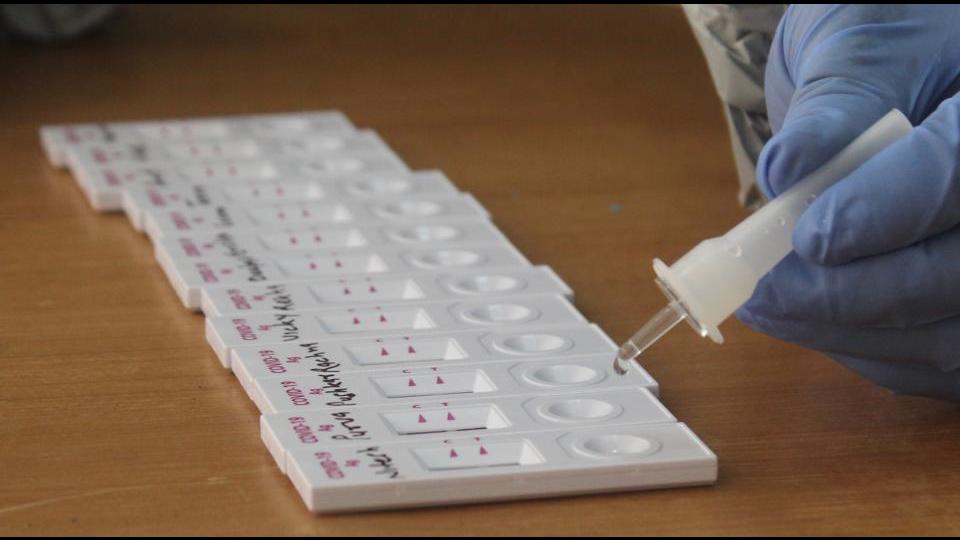
On Thursday, of the 1,741 total cases, 1,263 were detected through RAT and 420 through RT-PCR. The state has just one RT-PCR machine at Zoram Medical Centre in Aizawl, and 20 TruNat machines in all of the 11 districts.
“The government’s claims of managing the situation are baseless. While the ICMR [Indian Council of Medical Research] recommends that at least 70% of all tests should be RT-PCR, in Mizoram, nearly 70% of tests are RAT. It is known that negative results in RAT are not always conclusive,” said Lalduhoma, a legislator from the Opposition Zoram People’s Movement (ZPM).
“Even now the state has only one RT-PCR machine. We had offered to buy RT-PCR machines, but it seems that the government is not interested. There was no mass testing earlier in the state. They have started doing it now, but it’s too late as the infection has spread to all parts,” he added. The high number of cases has put a strain on the state’s health infrastructure. The state has one dedicated Covid-19 hospital in Aizawl, 18 Covid-19 health care centres, and around 500 Covid-19 care centres run by the state government, security forces, and villages. Mizoram has, so far, administered 1,135,539 vaccine doses. Of them, 696,634 are first doses and 438,905 are second doses. “To bring down cases, we should strictly follow CAB. We also need to isolate people with co-morbidities. We are hopeful that by mid-October, we will see a downward trend,” said Thiamsanga.