
 E-Paper



View: Why 'Aatmanirbhar Bharat' is required in strategic thinking apart from manufacturing
The heavy reliance on Western war models and phraseology of US-UK-based think tanks has stunted Indian strategic growth.

 Prefer HTon Google


New Delhi: Two decades ago, the Indian Navy prepared a war doctrine for 2025, which talked about Indians sending expeditionary forces to different parts of the globe. The doctrine prepared by an Indian Navy Vice Admiral, as it turned out, was, unfortunately, a rehash of the US expeditionary forces doctrine and was subsequently trashed as India in the late 1990s was hardly capable of launching carrier strike forces against the then global superpowers. Albeit promoted by the then Navy Chief, the doctrine was thrown out of the Naval Headquarters.
Despite Prime Minister Narendra Modi underscoring the need to decolonize the Indian mindset as part of “Paanch Prans” announced on 2022 75th Independence Day, the Indian strategic mindset is hugely influenced by Western terminology. This has not only permeated into the training institutions of the Indian Armed Forces and is reflected in the term papers even at the level of higher command courses. The downside of this is that future Indian warriors have a Western approach towards a problem with the regional/civilizational context not appreciated well enough and dismissed as baggage of Indian history or archaic past.
Even in top-level national security institutions or war colleges, words like “Maximalism”, “Gradualism” , “Global Commons”, “Kinetic and non-kinetic weapons” and “Multilateralism” are very much part of the lingua franca as they are in US think tanks. In higher defence institutions, the most often quoted war strategists are Chinese Sun Tzu or Prussian general Carl Von Clausewitz with or without context not Indian strategist Chanakya aka Vishnugupt of the Mauryan era.
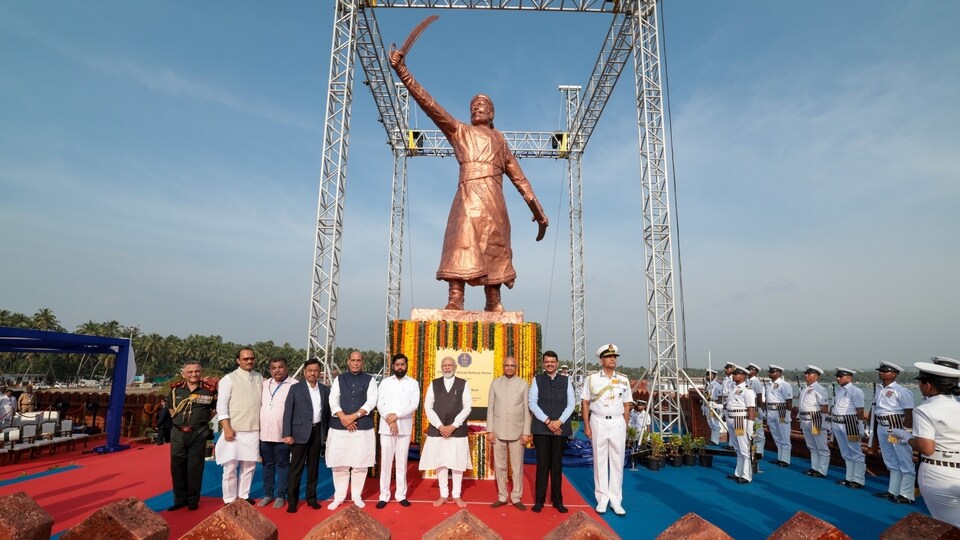
The heavy reliance on Western war models and phraseology of US-UK-based think tanks has actually stunted Indian strategic growth as we are more than happy to ape Western solutions to inherent Indian problems. It is in this context that Prime Minister Narendra Modi urged the Indian Navy to host the Navy Day at Sindhudurg of Chhatrapati Shivaji to highlight the Indian maritime legacy. It is for this very reason that the seal of the Maratha Emperor was included in the Indian Navy flag and in Shivaji-inspired epaulettes for Indian Navy personnel. All this is part of shedding the vestiges of the colonial era for a maritime force that used to flaunt the colonial St George’s Cross till the commissioning of INS Vikrant aircraft carrier in 2022. It was this Cross that was replaced by the seal of the Maratha Emperor, who had a maritime vision like Chola Emperor Rajendra Chola in the past centuries.
Since India has ambitions to sit on the global high table, it has to develop original strategic thinking and solutions in the context of India and not merely ape Western concepts. “Atmanirbhar Bharat” should not be limited to making India a military-industrial power, it should also trigger original strategic thinking.


