
 E-Paper



Byzantine church to mystery martyr unearthed near Jerusalem


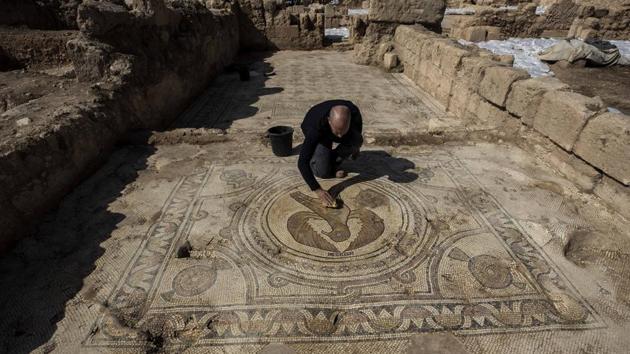
The findings will be exhibited at Jerusalem’s Bible Lands Museum. An inscription on a mosaic says the site was built in honour of a “glorious martyr.”
Israeli archaeologists have revealed an elaborately decorated Byzantine church dedicated to an anonymous martyr that was recently uncovered near Jerusalem.
The Israel Antiquities Authority showcased some of the finds from the nearly 1,500-year-old structure on Wednesday after three years of excavations. The findings will be exhibited at Jerusalem’s Bible Lands Museum.
An inscription on a mosaic says the site was built in honour of a “glorious martyr.” The martyr is not identified, but other inscriptions commemorate the empire’s expansion under the sixth-century ruler Justinian and one of his successors, Tiberius II Constantine.
Because of the church’s size and rich trappings, researchers from the Israel Antiquities Authority believe it was a popular pilgrimage site until it was abandoned during the Muslim Abbasid caliphate in the 9th century AD.
The elaborate design of the church, including a lattice marble chancel, calcite flowstone baptismal and floor mosaic depicting an eagle, a symbol of the Byzantine Empire, shows the site’s notable funding and significance.
The excavation’s director, Benjamin Storchan, said the excavation showcases a phenomenon known as “imperial church building.”
He said the empire maintained important sites and supported a tourist industry. “They took part in ensuring the development of pilgrimage routes,” he said.
The site was discovered during construction of a new residential neighborhood.
It covers 1,500 square meters (16,000 square feet) and includes a large courtyard, a corridor and the basilica-style church.
Following the collapse of the Byzantine Empire, the church entrances were sealed shut with large stones which excavators have opened and found glass lamps, mosaics and a piece of the vault where the unknown martyr was buried.
(This story has been published from a wire agency feed without modifications to the text. Only the headline has been changed. )


