
 E-Paper



Acrimonious campaign for Delhi assembly elections ends; over to poll booths
On the last day of the campaign, Aam Aadmi Party (AAP) leader and chief minister Arvind Kejriwal held a press conference, seeking the support of voters for what he called “a new kind of politics based on performance”.


With a final push by major parties in the fray, an acrimonious and bitter political campaign for Delhi’s assembly elections ended on Thursday evening. Voters will now choose representatives for 70 assembly segments on February 8.
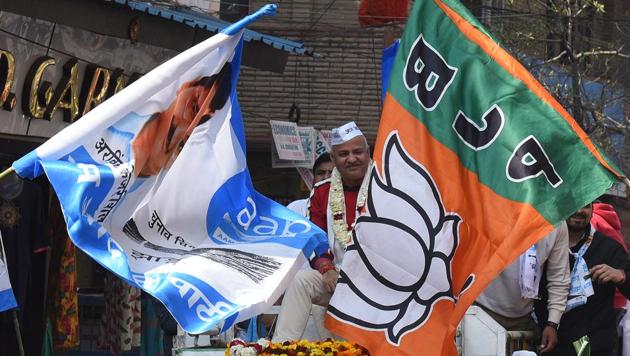
On the last day of the campaign, Aam Aadmi Party (AAP) leader and chief minister Arvind Kejriwal held a press conference, seeking the support of voters for what he called “a new kind of politics based on performance”. Union home minister and Bharatiya Janata Party (BJP) leader, Amit Shah, who has piloted the party’s campaign, did three roadshows in different parts of the city, and attacked the AAP for “false promises, appeasement and anarchy”. In what is widely seen as a fundamentally bipolar electoral battle between AAP and BJP, Congress leaders also addressed press conferences and rallies.
The election campaign broadly revolved around distinct themes for the different parties.
In the course of its outreach to voters, the AAP focused on its local governance record — and claimed to have improved government schools, public health facilities, electricity and water supply at subsidised rates, among other issues. The BJP’s campaign revolved around its decision to provide ownership papers to residents of unauthorised colonies, and a sharp attack on the AAP for what it alleged was support for the Shaheen Bagh protests against the Citizenship (Amendment) Act. This was seen as an effort to turn the election discourse around national and ideological issues, and polarise the electorate. While AAP sought votes in the name of Kejriwal as the CM face, the BJP did not put up a CM candidate and sought support in the name of Prime Minister Narendra Modi.
AAP began its campaign early. Back in September 2019, the party started the first phase of its election outreach, holding several janta samvaad (public interaction) programmes at the booth, assembly and even organisational levels. The party then launched its report card – “AAP ka report card” – in December, highlighting the major achievements of the AAP government in the last five years and distributing it to the city’s residents.
Kejriwal did a series of town halls, addressed 16 public rallies, and did close to three dozen roadshows, while the party’s candidates did close to 700 mohalla meetings.
On Thursday, Kejriwal said, “The campaign ends today and I am very happy that we based our entire campaign on development and welfare issues. The BJP, on the other hand, based their entire campaign on Hindu-Muslim issues.On February 8, people of Delhi will decide.”
The election discourse took a turn in January when Shah began campaigning energetically, primarily around the issue of the Shaheen Bagh protests. Based on AAP leader and deputy CM Manish Sisodia’s statement that they were with Shaheen Bagh, Shah and other BJP leaders alleged that the AAP was encouraging violence, anarchy and anti-national elements.
Minister of state for finance, Anurag Thakur, encouraged the chanting of provocative “shoot the traitors” slogans and Delhi MP Parvesh Verma said that protesters will “enter your houses, they will pick up your sisters and daughters, rape them and kill them”, and Modi and Shah would not be able to save them later. Both Thakur and Verma were penalised by the Election Commission. Uttar Pradesh CM Yogi Adityanath was a key campaigner for the BJP, focusing largely on how a win for the AAP would benefit Pakistan.
According to the BJP, senior party leaders held 5,239 rallies, public meetings, ‘nukkad sabhas’, party workers’ meetings and road shows as part of its campaign. While the PM addressed two rallies, Shah covered nearly 60 out of 70 assembly constituencies with either public meetings or roadshows every day since January 23. BJP chief JP Nadda held meetings in all 70 assembly constituencies. He also held public meetings as well as meetings with party workers to check the election preparedness at the grassroots level.
While nationalism has remained a key issue for the party, Delhi BJP chief Manoj Tiwari said the party has been able to damage the ruling AAP with its “reality check campaigns”. “We raised the issue of dirty and poisonous drinking water supplied by the AAP government. We raised the issue of inflated electricity bills, pathetic condition of schools and mohalla clinics. This has hampered the AAP’s campaign. We have been successful in exposing the AAP,” Tiwari said.
The Congress, widely seen as the weakest of the three forces, did not put up a CM candidate and is primarily relying on the local influence of a set of high profile candidates. Former Congress president Rahul Gandhi addressed four public meetings across the city — Jangpura, Sangam Vihar, Kondli and Matia Mahal — and in two of these, party general secretary Priyanka Gandhi also joined him. Former Prime Minister Manmohan Singh addressed one public meeting in west Delhi’s Tilak Nagar.
The shifting contours of the campaign have made the electoral outcome uncertain.
Praveen Rai, political analyst with Centre for Study of Developing Studies, said: “For a long time, the election competition in Delhi seemed loaded in favour of the AAP. With the BJP taking up the Shaheen Bagh protest in their poll campaign, the electoral turf has changed to a large extent. Attempts to polarise the voters are visible.”
He added that while the AAP highlight its development agenda, the party’s conflicting stands on Shaheen Bagh did not help. “It is difficult to assess at this point how much impact it can have on the February 8 polls. The saffron party is back in contention and the results could be yet another psephological surprise.”


